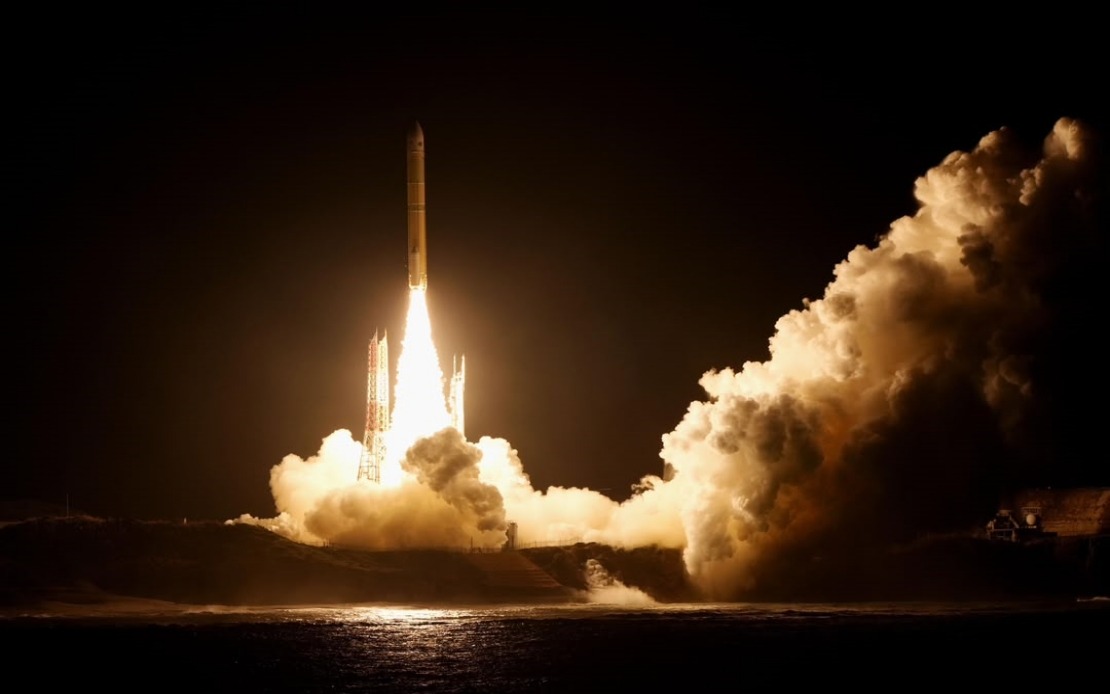
Japan's space programme achieved a significant milestone on Tuesday with the successful launch of an H3 rocket carrying the Michibiki No. 7 positioning satellite from the Tanegashima Space Centre located on a small island in southwestern Japan. The Japan Aerospace Exploration Agency executed the mission early in the morning, marking a crucial recovery moment for the nation's flagship launch vehicle following setbacks that had plagued the programme just months earlier. The satellite deployment signals Japan's determination to establish greater independence in space-based positioning technology, a capability increasingly vital to regional economies and national defence infrastructure across Asia.
Weather complications delayed the launch by two days before conditions finally permitted the mission to proceed. The operation had originally been scheduled for Friday but was postponed to Monday when a typhoon threatened the launch facility. Additional meteorological concerns around the Tanegashima site forced another postponement until Tuesday, demonstrating how environmental factors remain a consistent challenge for space operations despite technological advances. Such delays, while frustrating for programme managers, underscore the unforgiving nature of rocket launches and the safety protocols that space agencies maintain to protect personnel and equipment.
The successful deployment of the Michibiki No. 7 satellite represents a redemption narrative for Japan's space ambitions following the December setback. The H3 rocket numbered eight failed to achieve its objective in that earlier attempt, leaving the Michibiki No. 7 mission suspended for several months. The original timeline had anticipated launching this satellite by February, but the previous failure necessitated a comprehensive review and troubleshooting process that extended the wait considerably. Tuesday's achievement demonstrates that Japanese engineers identified and resolved the technical problems that caused the December malfunction, restoring confidence in the H3 platform.
The Michibiki constellation forms part of Japan's Quasi-Zenith Satellite System, a positioning network designed to provide highly accurate location information for civilian applications ranging from smartphone navigation to vehicle guidance systems. Currently, five Michibiki satellites are operational and delivering positioning services across the region. However, the Japanese government recognises that a full constellation of seven satellites would enable comprehensive coverage and eliminate dependence on foreign systems, particularly the American GPS network that currently anchors regional positioning infrastructure. This objective drives Japan's sustained investment in both satellite deployment and reliable launch vehicles.
The strategic importance of an independent positioning system extends well beyond commercial convenience. For a technologically advanced nation like Japan, reducing reliance on external systems enhances national security and technological sovereignty. In an era of great power competition and potential supply chain disruptions, maintaining indigenous space capabilities provides a critical buffer against geopolitical vulnerabilities. Southeast Asian nations observing Japan's progress recognise similar strategic imperatives, particularly as regional tensions underscore the value of self-sufficient technological infrastructure.
Tuesday's mission also represents a validation of the H3 rocket platform itself, which replaced the highly successful H2A launch vehicle that had served Japan as its primary orbital workhorse for over two decades. The H2A established an impressive reliability record, conducting numerous missions with minimal failures across 23 years of operations. The H3 was designed to succeed this proven platform with enhanced capabilities, reduced operational costs, and greater flexibility. However, the transition from one generation to the next inevitably involves a learning curve, and the December failure illustrated this transitional vulnerability.
The H3's development trajectory reflects the complex engineering challenges inherent in designing next-generation launch systems. Following the December setback with the H3 No. 8 rocket, the Japan Aerospace Exploration Agency executed a rapid diagnostic and remediation effort. By June, barely six months later, engineers had successfully launched the H3 No. 9 precursor mission, deploying multiple miniature satellites into orbit. That June accomplishment provided encouraging evidence that the technical issues had been identified and resolved, though full confidence required another successful operational mission carrying a full-scale satellite.
Tuesday's launch of H3 No. 9 carrying Michibiki No. 7 now provides that validation. Two consecutive successes establish an improved trajectory for the programme and position the H3 as a capable successor to the H2A legacy. However, space industry observers note that establishing consistent reliability typically requires a larger sample size of successful missions, suggesting that Japanese engineers will remain vigilant in monitoring H3 performance across subsequent launches. The programme's mixed record to date means that continued operational success remains essential to fully restoring stakeholder confidence.
For Southeast Asian nations developing their own space programmes or relying on launch services, Japan's H3 development carries meaningful implications. A successful and cost-competitive Japanese launch vehicle offers regional customers an alternative to dominant international providers and potentially stimulates competitive pricing in the commercial launch market. Malaysia, Indonesia, and other nations with earth observation or communications satellite programmes may increasingly view the H3 as a viable launch partner. Japan's space programme has historically marketed its services through pragmatic commercial approaches, and a fully reliable H3 platform would strengthen this market position considerably.
The broader context of Japan's space ambitions extends beyond positioning satellites to encompass lunar exploration, advanced robotics, and international collaboration through space station programmes. The successful H3 operations directly support these wider objectives by demonstrating that Japan possesses the fundamental capability to reliably reach orbit with payloads of varying weights and configurations. Each successful mission adds confidence for more ambitious future ventures, from lunar landers to deep space probes that require absolute launch reliability.
Technologically and diplomatically, Japan's space achievements carry significance throughout Asia. As China advances its own space programme and India demonstrates increasingly sophisticated capabilities, Japan's progress in reliable launch systems and satellite constellations maintains Japanese prominence in Asia-Pacific space activities. The Quasi-Zenith Satellite System, once fully established, will represent a distinctly Japanese contribution to regional infrastructure that complements rather than directly competes with other positioning systems, creating a collaborative rather than adversarial dynamic in space technology development.
Moving forward, the Japan Aerospace Exploration Agency will monitor H3 performance metrics closely while planning subsequent launches and satellite deployments. The path to deploying the complete seven-satellite Quasi-Zenith constellation now appears achievable within reasonable timelines, pending continued H3 reliability and securing necessary budgetary allocations. Each successful launch incrementally advances this goal while simultaneously strengthening Japan's position as a trusted space partner for commercial and governmental entities throughout the Indo-Pacific region seeking reliable access to space.

