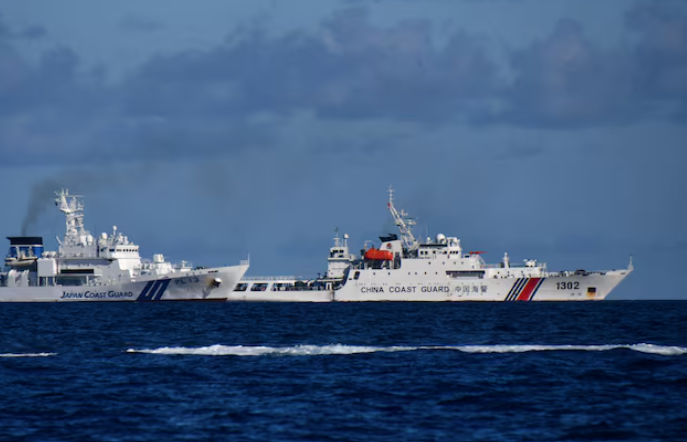
Japan's coast guard successfully expelled two Chinese coast guard vessels from waters it claims as its own near the contested Senkaku Islands on Tuesday, July 7, according to an official statement from Tokyo. The expulsion came after the Chinese ships were observed approaching a Japanese fishing vessel operating in the contested area, prompting coordinated action by Japanese maritime authorities to secure the safety of the commercial boat and maintain control over the disputed waters.
The incident underscores the fragile state of maritime relations between Asia's two largest economies. While Chinese coast guard ships have previously ventured into waters that Japan considers its territory, the deliberate approach toward a Japanese fishing vessel represents an unusual escalation in tactics. Japanese authorities responded by issuing direct orders for the Chinese vessels to depart and maintaining a protective cordon around the Japanese fishing boat until the Chinese ships withdrew at approximately 9:20 a.m. local time. In their formal statement, Japanese coast guard officials characterised the presence and actions of the Chinese vessels as a violation of international law, signalling Tokyo's intention to resist what it views as unlawful intrusions into its sovereign maritime space.
The Senkaku Islands, which China identifies as the Diaoyu Islands, sit strategically positioned between Taiwan and Okinawa and have been a persistent flashpoint in Japan-China relations for decades. These small but geopolitically significant outcrops have assumed heightened importance as tensions surrounding Taiwan's international status have intensified. The islands themselves hold limited intrinsic value, but their location places them at the heart of competing claims over maritime boundaries, exclusive economic zones, and potential energy resources in the East China Sea. Japan administers the islands, which remain uninhabited, but Beijing has never renounced its historical claims and views Japanese control as illegitimate.
The timing of this latest confrontation is no accident. Bilateral relations between Tokyo and Beijing deteriorated noticeably following Prime Minister Sanae Takaichi's November remarks regarding Japan's willingness to provide military support should Taiwan face attack. These statements infuriated Beijing, which regards Taiwan as a breakaway province and views any external military involvement as interference in internal affairs. China responded with characteristic assertiveness, implementing informal economic pressure on Japanese companies and discouraging its citizens from travelling to Japan, measures designed to signal displeasure while stopping short of formal sanctions.
Chinese coast guard operations near the disputed islands have become increasingly routine, with Beijing maintaining a persistent presence designed to demonstrate administrative control and challenge Japanese authority in the region. Prior to this week's incident, Chinese vessels last entered the contested waters on June 10, though that intrusion did not involve direct contact with Japanese civilian vessels. The pattern of Chinese activities—deploying multiple ships around the area before select vessels penetrate further into disputed waters—suggests a deliberate operational doctrine aimed at testing Japanese response capabilities and gradually normalising Chinese presence in waters Tokyo considers sovereign.
Beyond the immediate territorial dispute, the incident reflects broader competition for resources and strategic advantage in the East China Sea. Geological surveys have identified significant deposits of natural gas, oil, and rare earth minerals beneath the seabed in this region, resources that could prove economically significant for energy-dependent nations. China's willingness to deploy coast guard vessels despite Japanese protests indicates Beijing's intent to maintain pressure on resource exploration and underscore its territorial ambitions. Japan, meanwhile, has sought to prevent unilateral Chinese activities while avoiding military escalation that could spiral into armed conflict.
The Japan coast guard's response demonstrates Tokyo's determination to enforce what it considers its maritime rights through non-military means while maintaining readiness to escalate if circumstances demand. Officials emphasised their commitment to responding with both firmness and restraint, adhering to international maritime law while protecting Japanese interests. This calibrated approach reflects the delicate balance Japan must maintain—asserting sovereignty without providing Beijing with justification for military retaliation or further economic coercion. The decision to position coast guard vessels around the Japanese fishing boat represented a practical assertion of protective authority that Japan hopes will deter further Chinese incursions targeting civilian vessels.
For Southeast Asian nations observing these developments, the implications extend beyond bilateral Japan-China relations. Maritime disputes in the East China Sea and the broader Western Pacific remain contested by multiple claimants, and the precedent established through how Tokyo and Beijing manage their territorial disagreements could influence behaviour across the region. Countries including Vietnam, the Philippines, and others with overlapping maritime claims watch closely to gauge whether assertiveness backed by economic and military capacity can successfully challenge the established international legal order, or whether rules-based frameworks will ultimately prevail.
The frequency and intensity of these maritime confrontations suggest that tensions over the Senkaku Islands will likely persist as long as fundamental disagreements over Taiwan persist. China's recent decision to encourage citizens against Japan travel and restrict certain Japanese trade reflects how thoroughly Taiwan disputes have become entangled with broader bilateral relations. Unless diplomatic efforts succeed in establishing clearer protocols for maritime behaviour and reducing hostility over Taiwan's status, Japanese and Chinese vessels will probably continue these tense encounters in contested waters, each side demonstrating resolve while calculating carefully to avoid incidents that could trigger broader military confrontation.

