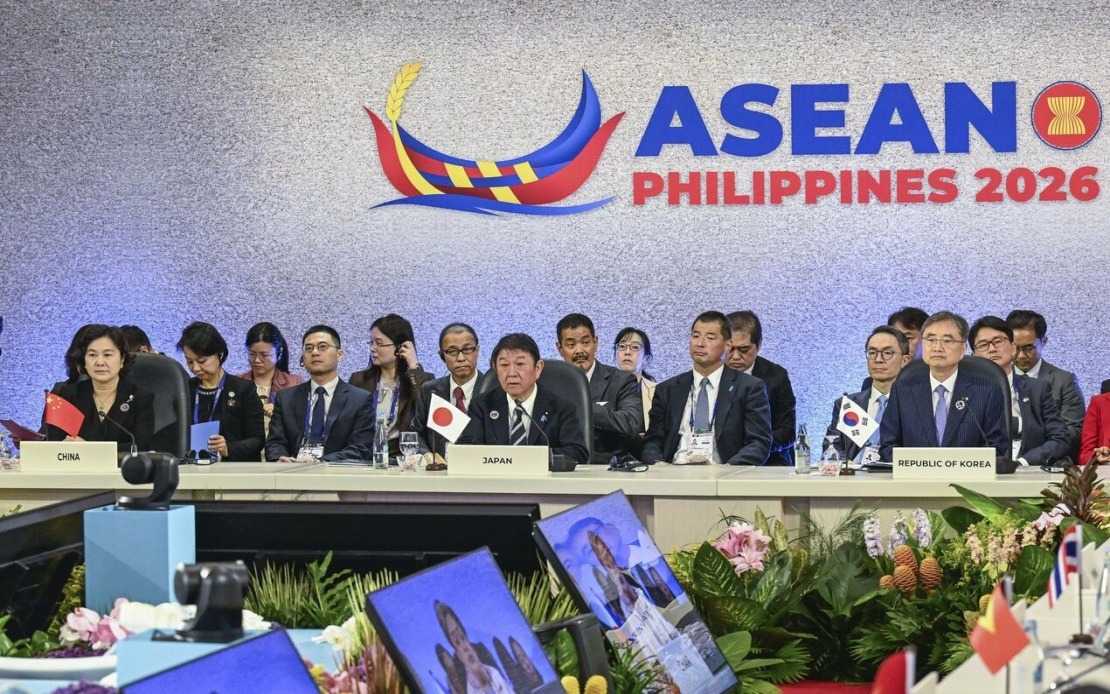
Japan has pledged to deepen its collaborative efforts with ASEAN, China, and South Korea across energy security and the fight against digital fraud, signalling Tokyo's commitment to regional stability amid shifting geopolitical dynamics. The commitment was made during a ministerial gathering in Manila, where Japanese Foreign Minister Toshimitsu Motegi outlined Japan's strategic priorities alongside his counterparts from across East and Southeast Asia. The announcement reflects Japan's broader strategy to strengthen ties within the wider Asian sphere while maintaining its emphasis on regional rule-based cooperation.
Toshimitsu Motegi articulated Japan's vision during opening remarks at the ASEAN-plus-three foreign ministers' meeting, emphasising the formidable economic weight wielded by the grouping. He underscored that the combined gross domestic product of the member nations now represents more than one-quarter of global economic output, positioning the alliance as an increasingly critical player in shaping both regional and international stability. This economic heft translates into considerable geopolitical influence, making decisions taken within this framework particularly consequential for the broader Indo-Pacific region and beyond.
China's participation came through Vice Foreign Minister Hua Chunying, who stood in for Foreign Minister Wang Yi at the Manila gathering. This representational choice, while potentially significant in protocol terms, did not diminish the substantive nature of discussions or China's commitment to the framework. The ASEAN-plus-three mechanism itself has deep roots in Asian regionalism, having emerged in response to the turbulent 1997 Asian financial crisis as a vehicle for promoting practical cooperation among its diverse membership.
Motegi emphasised Tokyo's unwavering support for ASEAN's central role in regional affairs, as well as the bloc's commitment to maintaining internal cohesion and shared purpose. He specifically highlighted Japan's alignment with the ASEAN Outlook on the Indo-Pacific (AOIP), a comprehensive initiative designed to safeguard regional peace, freedom, and economic prosperity. By positioning Japan's own free and open Indo-Pacific vision alongside AOIP, Motegi suggested that Tokyo sees substantial compatibility between its strategic approach and ASEAN's regional framework, paving the way for coordinated action through the ASEAN-plus-three mechanism.
Energy security emerged as a central concern during the ministerial discussions, with participants calling for strengthened regional supply networks in response to ongoing tensions in West Asia. The emphasis on energy cooperation carries particular resonance for Southeast Asian nations, many of which depend heavily on stable energy imports and face vulnerability to supply disruptions. For Malaysia and other ASEAN members, Japanese technological expertise and investment in renewable and liquefied natural gas infrastructure represent valuable assets in diversifying energy portfolios and insulating the region from external shocks.
The fight against online scams constituted the second major pillar of Japan's proposed cooperation agenda. This reflects a growing recognition across the region that cybercrime—particularly elaborate fraud schemes orchestrated across borders—poses an increasingly serious threat to citizens, businesses, and national security. The cross-border nature of digital scams makes them particularly difficult for individual nations to address in isolation, creating a compelling case for coordinated regional responses. Japan's willingness to lead on this front suggests Tokyo may offer technological solutions, intelligence-sharing protocols, and capacity-building assistance to partner nations.
The ASEAN-plus-three framework itself carries considerable institutional weight within Asian regionalism. Established in the aftermath of the 1997 financial crisis, it evolved to serve as a practical mechanism for cooperation on diverse issues ranging from economic recovery to disaster management and public health. The framework's longevity and consistent engagement across ministerial and summit levels underscore its perceived value among member states as a forum for addressing shared challenges without the more rigid structures of formal alliance arrangements.
Leaders within the grouping convened most recently at a summit held in Malaysia during October of the previous year, where they addressed strategic priorities and provided political direction for ongoing cooperation. These periodic summits ensure that work conducted at technical and ministerial levels remains anchored to broader strategic objectives and national leadership priorities. The regularity of such engagement helps maintain institutional momentum and ensures that regional cooperation initiatives enjoy consistent high-level attention.
Beyond the ASEAN-plus-three framework, Motegi also met with newly appointed British Foreign Secretary Ed Miliband, underscoring Japan's simultaneous engagement with Indo-Pacific nations and extra-regional powers. During this bilateral conversation, Motegi expressed Japan's commitment to continued collaboration with the United Kingdom in addressing global challenges, noting the importance of partnership under Prime Minister Andy Burnham's administration. This broader diplomatic engagement illustrates how Japan calibrates its foreign policy to maintain strong relationships across multiple regional and international forums while advancing its core strategic interests in energy security, cybersecurity, and regional stability.
For Malaysian policymakers and regional observers, Japan's initiatives carry several implications. The emphasis on energy cooperation creates opportunities for Malaysian firms and investors to engage with Japanese technology providers and to participate in regional supply chain integration. The cybercrime cooperation agenda aligns with Malaysia's own national priorities, particularly given the growing sophistication of digital fraud networks targeting the country. Furthermore, Japan's explicit support for ASEAN centrality and the AOIP framework reinforces the bloc's position as the legitimate locus of regional architecture, a principle that Malaysia and other ASEAN members have consistently championed. The convergence of Japanese and ASEAN interests on these issues suggests a period of productive cooperation ahead, provided member states can navigate their competing strategic priorities and ensure that great power competition does not undermine the consensus-based principles that have traditionally governed ASEAN-plus-three engagement.

