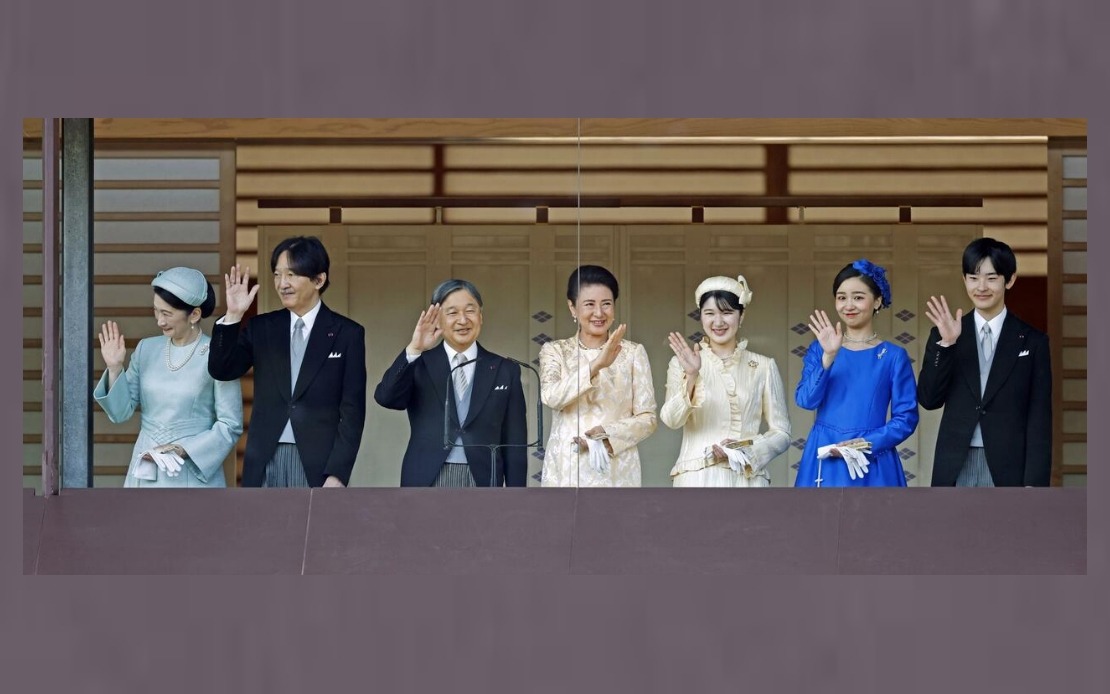
Japan's parliament has taken a significant step toward stabilising the imperial succession by approving a reformed Imperial House Law on Friday, marking the first substantive revision in over 75 years. The changes, which Prime Minister Sanae Takaichi championed as essential for preserving the world's oldest monarchy, introduce limited flexibility to address the acute shortage of male heirs currently threatening the institution's continuity. Yet the legislation stops short of the more fundamental transformation that public opinion increasingly favours, revealing a persistent tension between conservative institutional traditions and democratic preferences among ordinary Japanese.
The revised law introduces two key modifications that represent meaningful departures from the rigid framework established in 1947. First, the government may now adopt unmarried male descendants from the 11 former imperial branch families that were stripped of their royal status in the aftermath of World War II, when occupation authorities restructured Japan's monarchy. This change effectively reopens a door that had been sealed for decades, allowing the current 16-member imperial family to expand through the recruitment of suitable males aged 15 and older who trace their lineage exclusively through male ancestors to historical emperors. Second, female imperial family members who marry commoners may now retain their status rather than losing it automatically, a symbolic recognition of gender equality that nonetheless leaves them excluded from succession.
The legislative background reveals the complexity of imperial reform in modern Japan. Cross-party consultations spanning months produced what parliament termed a consensus, drawing on positions articulated by 13 different political parties and groups. Yet this broad coordination deliberately sidestepped the succession question itself, leaving unresolved whether women could ever occupy the throne. The ruling coalition's decision to preserve the male-line restriction, despite these months of deliberation, triggered substantial criticism from opposition legislators who argued that the process lacked sufficient parliamentary scrutiny and that the outcomes reflected a predetermined conservative outcome rather than genuine democratic deliberation.
The numerical context underscores why imperial succession has become urgent. Emperor Naruhito currently has only three potential male heirs, a perilously thin line of succession for an institution whose legitimacy rests partly on an unbroken male inheritance chain stretching back nearly 1,500 years. Without legislative changes, demographers warned that within a generation or two, no suitable male candidate would exist to assume the Chrysanthemum Throne, forcing either an unprecedented break in tradition or a constitutional crisis. The new adoption mechanism theoretically resolves this by allowing the imperial household to draw on the descendants of former princes and their families who have lived as commoners since the 1940s, potentially offering dozens of candidates to replenish the line.
Yet the gap between elite decision-making and public sentiment remains striking. A Kyodo News poll conducted in May revealed that 83.0 per cent of Japanese respondents expressed willingness to accept female emperors, with only 13.1 per cent opposed. This overwhelming majority opinion stands in sharp contrast to the legislative outcome, which makes no provision for female or maternal-line succession. The disparity highlights a broader generational shift in Japan's social attitudes, where younger voters and women increasingly view imperial traditions through the lens of contemporary values rather than historical precedent. That such strong democratic support yielded no legislative accommodation suggests that the institutional weight of the imperial system, and the conservative ideological commitment to preserving patrilineal succession, outweighs even robust expressions of popular preference.
Prime Minister Sanae Takaichi, in championing this legislation, achieved a historic distinction as Japan's first female prime minister shepherding through a major reform of the imperial institution. Yet her government's refusal to address female succession, despite her own position, underscores how deeply the male-line principle permeates Japanese political and cultural thinking even among those who have themselves broken gender barriers elsewhere. The government has explicitly maintained that the new law permits male descendants of adopted candidates to ascend the throne, essentially projecting imperial authority forward through these newly-integrated families into future generations, provided sufficient males can be identified and recruited.
The 1947 Imperial House Law, which the revision amends, itself embodied significant rupture with pre-war practice, having been drafted under American occupation and fundamentally restructuring the imperial family after the military defeat. At that time, 51 members spread across 11 branch families were removed from official imperial status, a process now partially reversible through the adoption mechanism. The original law codified the principle that succession must flow through the male line exclusively, language that the new revision retains unchanged. This historical continuity suggests that the architects of today's reform view themselves as defending long-established constitutional principles rather than innovating, even though the adoption provision itself represents a significant reinterpretation of what succession and family membership entail.
For Southeast Asian observers, Japan's imperial succession debates offer instructive lessons about how traditional institutions navigate modernisation pressures. Like Japan, several Southeast Asian monarchies face succession challenges and evolving public attitudes toward gender and legitimacy, yet the region's varied constitutional arrangements mean each kingdom will chart its own course. Japan's approach—modest flexibility on peripheral matters while defending core patrilineal principles—reflects a particular cultural and political commitment to continuity that may or may not serve as a template elsewhere. The fact that Japan's ruling establishment could resist overwhelming public support for female succession demonstrates the deep structural power that institutional tradition can exercise even in a functioning democracy.
Looking forward, the practical success of the adoption mechanism will determine whether the revised law proves sufficient to sustain the imperial system, or whether mounting demographic pressures eventually force a reconsideration of succession rules. If the pool of eligible male descendants from the former branch families proves insufficient, or if subsequent generations show declining interest in assuming imperial status, the government may face renewed pressure to revisit the female succession question. Conversely, if adoptions proceed smoothly and provide ample candidates, the current arrangement may prove durable for several more generations, potentially pushing the succession crisis beyond the immediate political horizon.
The legislative process itself, marked by criticism over inadequate deliberation and rushed implementation, reflects broader anxieties about how Japan manages constitutional change in an era of institutional stress. The conservative ruling coalition's apparent determination to minimise parliamentary debate on fundamental questions, combined with its evident preference for preserving tradition over accommodating democratic sentiment, raises questions about how responsive Japanese governance can be to evolving social values. Yet the very fact that this debate occurs openly, that opinion polls measure public preferences, and that opposition voices articulate alternatives, demonstrates that the imperial succession question, though touching on Japan's deepest historical sensibilities, remains embedded within a functioning democratic framework.

