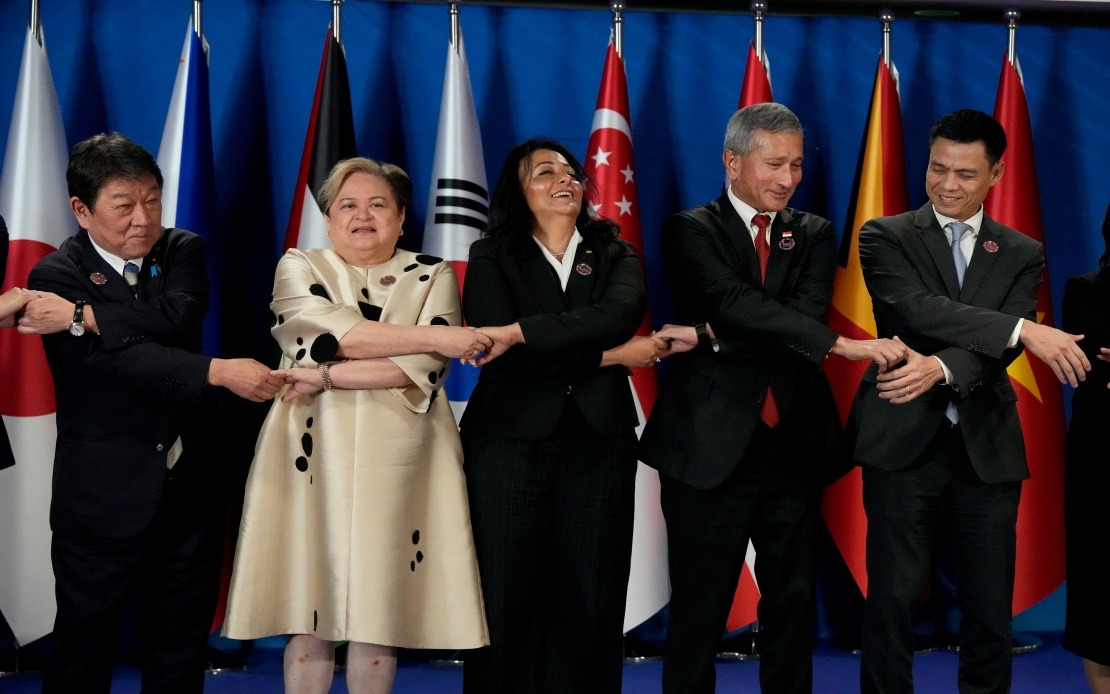
Four major Asia-Pacific democracies have underscored the critical importance of ASEAN's central role in regional stability and prosperity, calling for enhanced partnerships on emerging technologies and economic challenges at Post-Ministerial Conferences held in Manila this week. The discussions, which brought together foreign ministers from Japan, South Korea, Australia and New Zealand with their ASEAN counterparts, reflected growing recognition that the region faces an interconnected set of pressures requiring coordinated responses across multiple domains.
Japanese Foreign Minister Toshimitsu Motegi framed Tokyo's engagement with ASEAN around three strategic pillars that speak to both immediate and long-term regional concerns. Beyond expressing Japan's commitment to respecting ASEAN's unity and centrality—a diplomatic principle that has underpinned the regional order for decades—Motegi emphasized areas where mutual interests align and collaborative potential remains untapped. His focus on digital transformation, artificial intelligence and green energy transitions reflects Japan's broader strategic positioning as a technology leader seeking to guide regional development along paths aligned with its values and economic interests.
South Korea's Foreign Minister Cho Hyun articulated a diagnosis of regional transformation that extends beyond single issues to encompass systemic shifts reshaping the strategic environment. The minister identified three concurrent pressures: the fragmentation of global supply chains that had previously anchored regional prosperity, persistent instability in West Asia that threatens energy supplies and regional confidence, and the accelerating pace of technological change that creates both opportunities for leapfrogging development and risks of disruption for established industries. This assessment resonates particularly with Southeast Asian economies that depend heavily on integrated manufacturing networks and energy imports.
Seoul's approach emphasizes solidarity as a practical tool for managing uncertainty, not merely as rhetorical flourish. By strengthening collective confidence and expanding strategic options available to the region, Cho suggested that ASEAN and its partners can reduce the likelihood of miscalculation while creating space for economic innovation. South Korea's concrete initiatives—an AI companionship programme and a cultural and creative industries framework—demonstrate how partnership commitments translate into tangible collaborative projects that distribute benefits across member economies.
New Zealand's Foreign Minister Winston Peters brought the perspective of a more distant but strategically engaged power, identifying four overlapping challenges that define the contemporary environment. His enumeration of renewed great-power competition, threats to the rules-based multilateral system, artificial intelligence advancement and climate change reflects concerns that transcend regional boundaries yet have particular salience in the Asia-Pacific. Peters' emphasis on partnership as a foundational strength underscores a conviction that the region's prosperity depends not on strategic isolation or hedging between major powers, but on robust institutional frameworks and cooperative networks that enable shared problem-solving.
Australian Foreign Minister Penny Wong offered perhaps the most candid assessment of recent regional turbulence, characterizing the year as exceptionally challenging due to the intensification of great-power competition and elevated risks of military escalation or miscalculation. She highlighted how multiple shocks—conflicts in West Asia, tensions within the Asia-Pacific, and global economic instability—have created cascading effects on fundamental inputs to regional prosperity including food security, energy availability and the functioning of global supply chains for fertilisers and other critical commodities. For a country like Australia deeply integrated into Asian markets and dependent on regional stability, these vulnerabilities carry particular weight.
Wong's framing of ASEAN's importance to Australia deserves careful attention from Malaysian policymakers. She explicitly connected ASEAN's regional centrality to Australia's own prosperity, arguing that ASEAN's ability to build relationships, establish governing norms and foster collective resilience directly benefits her country and the broader region. This positioning suggests that major powers increasingly view ASEAN-led frameworks not as constraints on their freedom of action but as infrastructure enabling their strategic interests. Australia's support for ASEAN initiatives—specifically the ASEAN Power Grid and Digital Economy Framework Agreement—demonstrates how great powers operationalize their rhetorical commitments through concrete support for ASEAN-led integration projects.
The emphasis across all four nations on economic resilience initiatives reflects a shared recognition that the region's prosperity depends on diversifying supply chains, reducing energy vulnerabilities and building digital infrastructure. For Malaysia, which occupies a central position within regional supply networks and energy flows, these initiatives carry direct implications. Malaysian firms increasingly participate in regional digital economy projects and infrastructure development, making ASEAN-led frameworks critical to capturing emerging opportunities in these sectors.
The ministers' collective focus on artificial intelligence and digital transformation also signals an implicit concern that Southeast Asian economies risk being left behind in the technological race if they do not quickly develop indigenous capabilities and integrate into advanced digital networks. The region's success in manufacturing has historically depended on attracting foreign investment and participating in global value chains; the shift toward AI and digital services requires different policy responses and institutional capacities. Collaborative initiatives with developed partners offer Southeast Asian countries pathways to acquire technological knowledge while maintaining agency over how these technologies are deployed within their societies.
The invocation of the rules-based multilateral system by New Zealand and others reflects anxiety that the existing international order—which underpinned post-Cold War prosperity and enabled smaller nations to constrain larger ones through institutional frameworks—faces erosion. ASEAN's traditional strategy of working through institutional processes, maintaining relationships with multiple great powers, and building consensus-based regional mechanisms directly addresses this concern. The reinforced backing from Japan, South Korea, Australia and New Zealand for ASEAN centrality suggests that these nations view ASEAN as an essential stabilizing force whose leadership must be preserved even as regional competition intensifies.
The discussion of West Asia instability and its regional effects merits particular attention. The repeated references to disruptions emanating from Middle Eastern conflicts underscore how Southeast Asia's prosperity remains vulnerable to distant geopolitical shocks beyond the region's direct control. Energy prices, shipping disruptions and supply chain reorientation flowing from West Asia turmoil directly affect Malaysia and neighbouring economies. This reality reinforces the case for greater Southeast Asian economic diversification and resilience-building, themes that aligned with the partners' discussion of green transformation and digital economy development.
For Malaysian observers, these ministerial exchanges suggest that regional cooperation frameworks remain vibrant despite geopolitical competition. Japan, South Korea, Australia and New Zealand have not responded to great-power tensions by abandoning multilateral engagement or attempting to exclude rivals from regional forums. Instead, they continue investing in ASEAN-led institutions while selectively pursuing bilateral partnerships. This approach offers Southeast Asian countries, including Malaysia, significant leverage in managing relationships with multiple partners without being forced into exclusive alignments.
The partners' emphasis on ASEAN unity and centrality also implies a recognition that the association's cohesion cannot be taken for granted. The very repetition of these themes across multiple ministerial statements suggests ongoing concern that internal ASEAN divisions or external pressure could fragment the bloc. Malaysia's role as a respected ASEAN voice makes its contributions to maintaining regional unity increasingly valuable, both for the bloc's own interests and for major powers seeking stable partnerships in Asia-Pacific.

