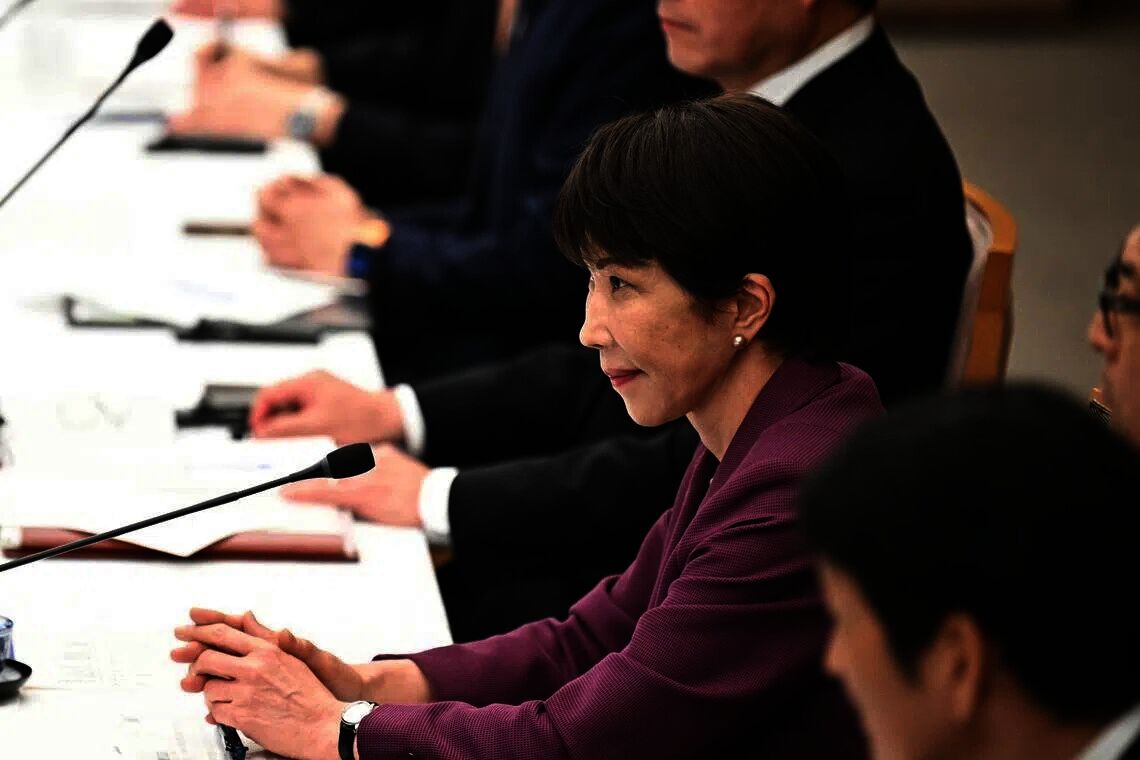
Japanese Prime Minister Sanae Takaichi faces mounting domestic pressure following the circulation of a video clip from a 2002 political debate programme in which she defended Japan's wartime conduct in starkly revisionist terms. The footage, which recently surfaced on social media platforms across Japan, shows Takaichi—then a parliamentary legislator—characterising Japan's invasion of China as an act of "self-defence" and describing imperial expansion across the Asian mainland during the 1930s as conforming to international standards of the era. The resurgence of these remarks has triggered a wave of criticism from Japanese intellectuals, politicians, and ordinary citizens questioning how someone holding such views could ascend to the nation's highest executive office.
The original debate aired on TV Asahi, where Takaichi squared off against Soichiro Tahara, a prominent Japanese political journalist and television personality. Tahara's contemporaneous response proved withering. He dismissed her characterisation of Japanese military conduct as "completely incorrect" and "ignorant," and expressed bewilderment that parliament would seat anyone espousing such revisionist interpretations. The exchange, dormant for over two decades, has regained visibility at a politically sensitive moment, with social media users amplifying clips across YouTube and other platforms. The response has been overwhelmingly negative, with highly engaged comments castigating Takaichi for what observers describe as a fundamentally flawed comprehension of historical fact and warning of the dangers posed by her elevation to the premiership.
Yusuke Yamashita, an associate professor of Corporate Social Responsibility at Sakushin Gakuin University, contributed a particularly sharp critique via social media, arguing that Takaichi's most alarming vulnerability lies not in deliberate dishonesty but in intellectual incoherence. According to Yamashita, Takaichi demonstrates an inability to articulate any rational foundation for her "self-defence war" thesis, suggesting that her convictions rest on emotion rather than logical reasoning or empirical grounding. This observation points to a troubling paradox: that dangerous historical narratives need not be sophisticated or well-reasoned to exert political influence, particularly when amplified through high office.
Ichiro Ozawa, a veteran politician with parliamentary experience spanning from 1969 to 2026, has likewise demanded Takaichi's resignation, framing her historical revisionism as a threat to national stability. Ozawa's intervention carries weight given his long engagement with Japanese politics across multiple administrations and factions. His language—warning of "unforeseen catastrophe" and "immense sacrifices"—suggests concern that Takaichi's worldview may translate into consequential policy decisions regarding regional security, military expansion, and diplomatic relations. His call for her removal reflects a fear that historical revisionism at the leadership level can metastasise into strategic miscalculation.
Takaichi's controversial positions are not anomalies in her career but rather consistent expressions of a nationalist ideology she has maintained since entering parliament in 1993. Throughout her three decades in elected office, she has aligned herself with the Liberal Democratic Party's conservative-nationalist faction and has persistently advocated for constitutional amendments that would expand Japan's military scope and capabilities. She has championed renaming the Self-Defense Forces, a proposal that symbolises a broader ambition to shed post-war constitutional constraints on Japanese militarism. These positions have evolved gradually but persistently, creating an ideological through-line that culminated in her selection as Prime Minister.
Takaichi's rhetoric mirrors that of other right-wing politicians across Japan who continue promoting narratives that minimise, reframe, or entirely deny wartime atrocities committed by Imperial Japan against China and other occupied Asian territories. This historical revisionism serves a political function beyond mere academic debate: it legitimises contemporary policies regarding regional military posture, territorial claims, and the framing of neighbours as potential adversaries. By recasting Japan's pre-war expansion as defensive and aligned with international norms, such narratives attempt to rehabilitate militarism and create intellectual space for military expansion under the guise of legitimate security response.
The controversy arrives at an inauspicious moment for Takaichi's administration. Public opinion surveys conducted in July revealed that support for her government has declined substantially, with disapproval exceeding approval in several polls for the first time since her assumption of office. Critics contend that Takaichi's focus on politically divisive matters—constitutional revision, military enhancement, and nationalist historical reinterpretation—has diverted attention from substantive economic and social policy concerns that directly affect Japanese households. Rising costs of living, stagnant wages, and infrastructure needs remain pressing, yet the administration's energies appear consumed by cultural and security matters that dominate elite political discourse but resonate less urgently with ordinary voters concerned about immediate material wellbeing.
The convergence of historical revisionism and policy drift has catalysed a broader questioning of Takaichi's suitability for office. Japanese civil society and political figures across the spectrum worry that a prime minister whose grasp of historical reality appears demonstrably flawed may prove unreliable in navigating complex contemporary challenges. The concern extends beyond domestic politics to regional and international dimensions. Japan's relationship with China and South Korea—both countries that experienced Japanese military aggression—remains delicate, contingent partly on Japan's willingness to acknowledge historical wrongs. Takaichi's revisionist positions potentially complicate these relationships, risking diplomatic friction precisely when regional stability depends on careful management of historical memory and present-day tensions.
For Malaysia and broader Southeast Asia, the controversy carries particular relevance. The region experienced Japanese occupation during World War II, and multiple ASEAN nations maintain territorial disputes and strategic concerns regarding Japanese military capacity. Takaichi's ideological commitment to expanding Japan's military posture, coupled with her evident historical revisionism regarding wartime conduct, raises questions about how a Japan under her leadership might approach regional security cooperation, maritime disputes, and historical accountability. Her ascension to prime minister during a period of Chinese strategic assertiveness and technological advancement in Asia creates an uncertain dynamic for regional powers attempting to maintain balanced relationships and peaceful resolution mechanisms.
The persistence of Takaichi's revisionist positions across a three-decade political career suggests that this controversy will likely prove temporary rather than transformative. Japanese political culture has demonstrated considerable tolerance for nationalist and revisionist figures within mainstream conservative parties, and internal Liberal Democratic Party mechanisms have consistently protected such figures from discipline or expulsion. However, declining public support creates vulnerability. If disapproval continues rising and economic conditions fail to improve, ordinary Japanese voters may ultimately prove less forgiving than political elites regarding a leader whose preoccupations appear disconnected from material concerns. The resurfaced video clip thus functions as a referendum not merely on Takaichi's historical interpretations, but on the broader sustainability of an administration that combines nationalist ideology with inadequate attention to public welfare.

