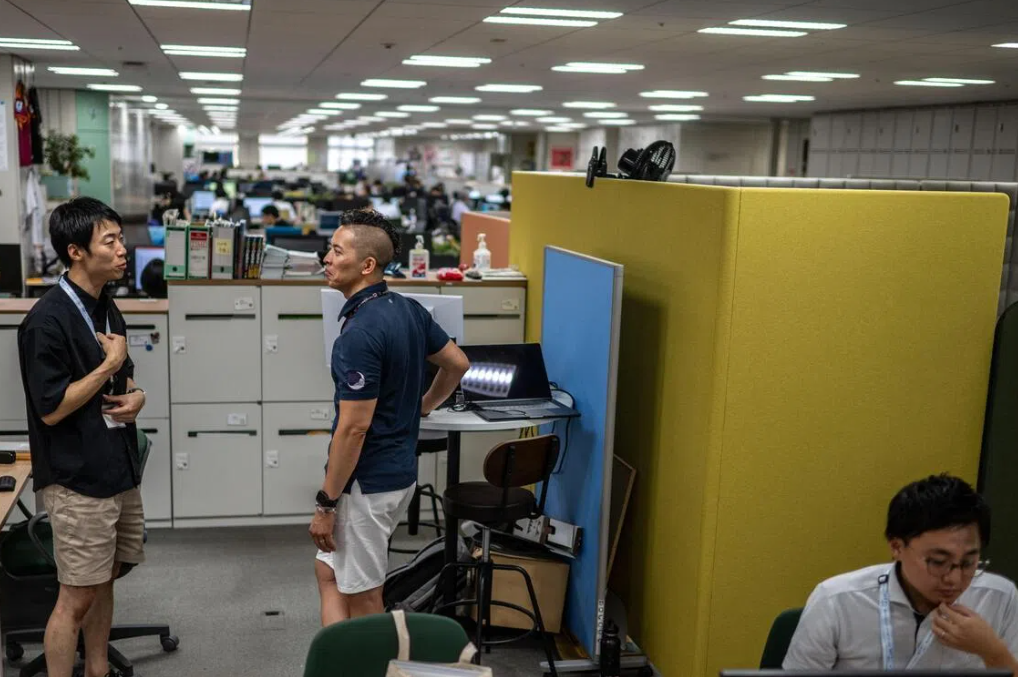
Japan's capital has launched an ambitious effort to ease the discomfort of scorching summer temperatures by expanding its longstanding "Cool Biz" workplace dress code, yet the initiative has stumbled into an unexpectedly contentious cultural conversation centred on something as simple as exposed shin hair. The Tokyo metropolitan government introduced the relaxed guidelines in April, explicitly encouraging office workers to abandon traditional formalwear in favour of casual alternatives such as T-shirts, trainers, and crucially, shorts—a radical departure from Japan's rigid corporate dress standards. However, the seemingly straightforward push to offer workers respite from the brutal summer heat has inadvertently unleashed a gendered debate about workplace acceptability and body presentation, revealing deeper anxieties about professional boundaries in modern Japanese workplaces.
The controversy crystallises around an emerging social complaint branded "sunehara" or "leg hair harassment", a term coined online to express discomfort at the sight of male colleagues' exposed leg hair during the working day. This neologism captures a distinctly Japanese workplace sensitivity, where visible body hair has long been considered aesthetically undesirable and somewhat impolite in professional settings. Women have been particularly vocal in their opposition to seeing male coworkers with unshaved legs at their desks, framing the issue as one of workplace propriety rather than merely personal preference. Tokyo environmental official Noboru Watanabe attempted to address such concerns by framing the policy as one of personal choice, telling the BBC that "we want to give people more options in the severe heat, not tell them what to wear," and asserting that "there should be no issue as long as the work attire is not offensive to anyone." Yet this formulation itself reveals the core difficulty: defining what constitutes "offensive" in professional dress has proven far more slippery than policymakers anticipated.
Data from a June survey conducted by Gorilla Clinic, a leading men's cosmetic treatment retailer, illustrates the depth of public division on the matter. The poll found that 53.5 per cent of respondents opposed wearing shorts to work, while 46.5 per cent supported the practice—a near-even split that suggests society remains fundamentally ambivalent about this shift. The research identified concerns about body shape and visible hair as primary objections, with women substantially outnumbering men among those opposed to the proposal. This gender imbalance in opposition suggests that female workers are considerably less enthusiastic about normalising the sight of male colleagues' exposed legs in office environments, even during extreme heat conditions. The survey results underscore how deeply ingrained aesthetic standards around body presentation remain in Japanese professional culture, and how fraught attempts to relax these norms can become.
The policy's unintended consequences extend beyond mere complaint; it has triggered measurable behavioural changes among male workers anxious about social judgment. Akifumi Funatsu, a director at Gorilla Clinic, has observed a noticeable increase in male clients seeking laser hair removal treatments, driven not primarily by vanity but by what many perceive as essential "social etiquette when wearing shorts". This development reveals how workplace norms can cascade into personal grooming decisions, with men internalising the discomfort their colleagues have expressed and attempting to preempt criticism through cosmetic intervention. Such responses demonstrate that "Cool Biz" has inadvertently created new social pressures around body presentation, particularly for men who now face implicit expectations to remove leg hair if they wish to avoid making others uncomfortable—an ironic consequence of a policy designed to reduce stress and increase comfort.
The "Cool Biz" initiative itself represents nearly two decades of incremental cultural shifts in Japan's approach to workplace formality. The campaign originated in 2005 when Yuriko Koike, then serving as environment minister (she later became Tokyo Governor), introduced the original "Cool Biz" concept with the explicit goal of reducing air-conditioning consumption during summer months. The initiative gained considerable public traction when then Prime Minister Junichiro Koizumi appeared at official functions without a tie or jacket, lending the campaign prestigious political endorsement. By appearing in relaxed dress himself, Koizumi signalled that casual attire was compatible with high office and professional authority—a significant statement in a country where business suits had long symbolised competence and respectability. Following the devastating 2011 earthquake and tsunami, which strained Japan's power supply and made energy conservation a national priority, the government launched an even more permissive variant called "Super Cool Biz", further loosening restrictions on workplace clothing.
Since those reforms, casual dress has become increasingly normalised, particularly in Japan's burgeoning technology and startup sectors where younger workers have rejected traditional formality in favour of comfort-focused professional cultures. Tokyo's recent expansion to explicitly permit shorts represents a dramatic further liberalisation, pushing boundaries that would have seemed unthinkable in Japanese corporate environments just a decade ago. Yet this policy shift arrives at a moment when Japan faces increasingly severe climate challenges that make such adaptations genuinely necessary rather than merely fashionable. The summer of 2024 has brought extreme temperatures and humidity levels that fundamentally compromise workers' wellbeing; according to the Fire and Disaster Management Agency, seven people died from heatstroke and 4,580 were hospitalised between July 6 and July 12 alone. These grim statistics underscore that "Cool Biz" is not merely about comfort but about public health and safety—making the resistance to shorts seem, in practical terms, potentially dangerous.
Government officials have responded to the severe heat crisis by urging residents to maintain hydration, utilise air-conditioning, and gradually acclimate themselves to elevated temperatures through careful exposure management. However, such passive recommendations prove insufficient during heatwaves of the current magnitude, motivating the push for more structural solutions including revised dress codes. Consumer behaviour reflects this urgency; the market for cooling technologies has exploded, with workers purchasing clothing embedded with cooling fans, heat-blocking umbrellas, portable cooling devices, and specialised cooling wipes—all expensive and somewhat cumbersome solutions that shorts could replicate simply and affordably. This consumer response reveals a market demand for solutions to summer heat stress, yet paradoxically, the most straightforward option—wearing shorts—has become entangled in social and aesthetic objections that transcend practical considerations.
The "leg hair harassment" controversy illuminates broader tensions within Japanese society regarding gender, professionalism, and bodily norms. By focusing criticism on male leg hair rather than on female workers' comfort with casual dress more broadly, the debate implicitly reinforces assumptions about gendered appearance standards. Men are expected to groom their bodies to conform to female colleagues' comfort standards, rather than women and men mutually adjusting to more relaxed professional norms. This gendered dimension suggests that beneath the practical conversation about heat management lies a deeper cultural ambivalence about loosening the strict aesthetic controls that Japanese professional environments have historically imposed. For Southeast Asian readers observing Japanese workplace culture, the "leg hair harassment" debate offers instructive insights into how even seemingly technical policy initiatives—designed to address objective health and environmental concerns—become entangled in deeply rooted cultural values about propriety, gender, and bodily presentation.
The resolution of this dispute remains genuinely uncertain, with no clear consensus emerging on how much casual exposure constitutes appropriate workplace attire. Some organisations may implement compromise solutions, such as permitting shorts only in common areas while maintaining trouser requirements at client-facing desks, or establishing voluntary guidelines rather than formal policies. Others may follow the lead of tech companies that have abandoned formal dress codes altogether, betting that younger workers' attitudes will eventually normalise casual presentation. The Tokyo government's cautious framing—emphasising personal choice rather than mandate—suggests policymakers recognise the sensitivity of the issue and may be prepared to allow organic adaptation rather than imposing top-down solutions. Nevertheless, the fundamental question remains unresolved: in a nation facing genuine public health threats from extreme heat, will practical necessity ultimately override aesthetic objections to visible leg hair, or will Japanese professional culture find ways to accommodate both cooling concerns and traditional appearance standards? The answer will reveal much about how quickly longstanding workplace norms can evolve when confronted by climate imperatives.

