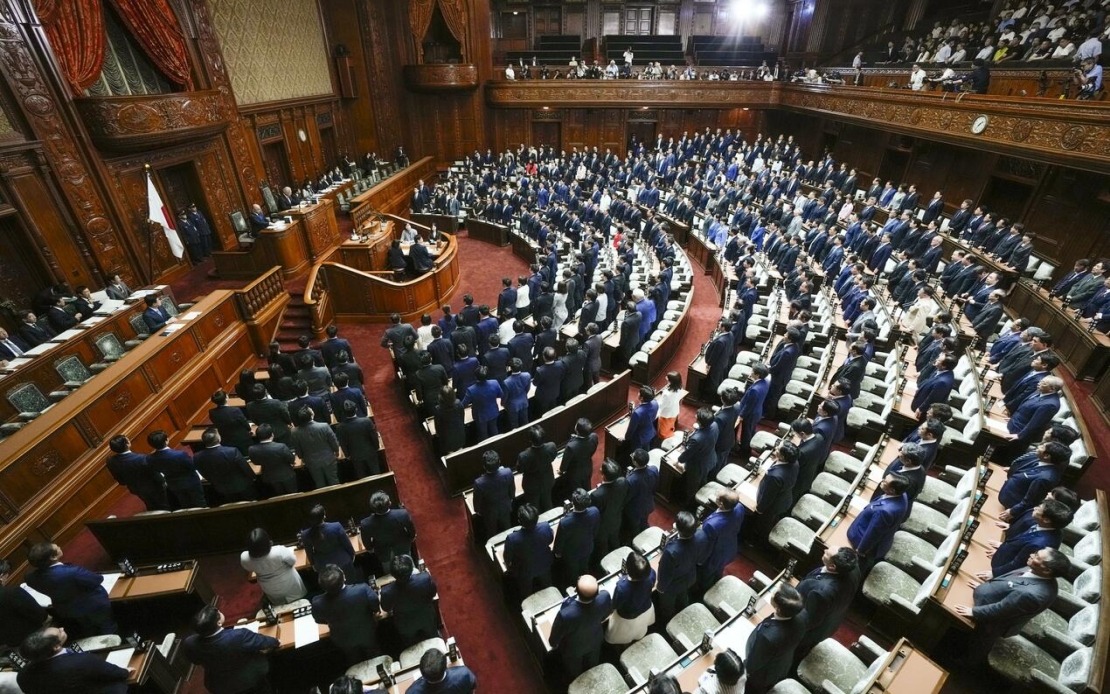
Japan moved swiftly on Friday to reform one of its most venerable institutions when the House of Representatives passed sweeping amendments to the Imperial House Law, breaking a legislative deadlock that had paralyzed parliament for weeks. The bill represents the first substantive overhaul of the succession framework in over seven decades, tackling a demographic crisis that threatens the continuity of the imperial lineage. Prime Minister Sanae Takaichi's government now expects the upper chamber to endorse the measures before the parliamentary session concludes on July 17, paving the way for formal enactment of rules that will reshape how Japan manages its imperial succession.
The rush to legislate reflects careful political choreography between the ruling Liberal Democratic Party and its coalition partner, the Japan Innovation Party, who together command the supermajority needed to pass bills even without upper house support. Deliberations began and concluded on the same day, with lawmakers voting within hours of discussions commencing, a speed that underscores both the government's determination and the fragile consensus underpinning the measure. This compressed timeline came only after weeks of parliamentary friction over unrelated governance matters finally eased, allowing the coalition to advance its agreed priorities.
At the heart of the legislation lie two pivotal changes that fundamentally alter imperial succession principles. The first provision permits the imperial family to recruit male members aged 15 and older from 11 dormant branch families, provided these individuals descend exclusively through the male line from former emperors. This mechanism essentially reconstitutes portions of the imperial family that were deliberately excluded from succession nearly eight decades ago. Simultaneously, the law grants female imperial family members the unprecedented right to maintain their status should they marry outside the imperial house, reversing a long-standing rule that treated such unions as automatic disqualification.
Crucially, the framework incorporates a further innovation that generated controversy among opposition lawmakers: the male children of adopted branch-family members would themselves become eligible to ascend the throne, creating a pathway to succession that extends beyond the adoptees themselves. This provision effectively converts adopted individuals into conduits for dynasty continuation rather than sovereigns in their own right. The legislation deliberately excludes the more contentious proposals for female emperors or empresses regnant descended through the maternal line, despite public opinion surveys suggesting broad support for such possibilities. This restraint suggests that parliament opted for an incremental approach rather than fundamentally reconceiving gender roles within the imperial institution.
The demographic urgency propelling these changes cannot be overstated. Under existing law, only males with paternal imperial descent can assume the throne, while female members lose imperial status upon marrying commoners, both factors contributing to a steep decline in the eligible heir pool. With fewer legitimate successors and fewer overall imperial family members, the monarchy faces what experts describe as a structural sustainability problem. The proposed adoptions would immediately inject new blood into the system, though experts debate whether this measure suffices for long-term stability or merely postpones more fundamental reforms.
The bill itself emerged from consultation that the government claims was comprehensive. Parliamentary speakers from both chambers compiled a proposal after soliciting input from all 13 parliamentary parties and groups, establishing a baseline framework intended to balance competing concerns about imperial continuity, institutional stability, and democratic legitimacy. Yet the final legislation departed from that consensus document in material respects, particularly regarding the eligibility of adoptees' descendants, prompting accusations from opposition figures that the ruling camp had overreached its mandate and hijacked a process designed to produce cross-party consensus.
These imperial amendments form part of a broader coalition agreement struck on October 20 between the LDP and the Japan Innovation Party, which enabled Takaichi to become Japan's first female premier the following day. Updating imperial succession law figured prominently in those coalition negotiations, signalling its importance to both parties' leadership and their respective constituencies. The sequence of events—coalition formation, then legislative priority-setting, then delayed implementation due to procedural friction—illustrates the complex interplay between constitutional conventions and parliamentary realpolitik that characterizes contemporary Japanese governance.
Parliamentary dysfunction had nearly derailed the entire legislative agenda. From late June onwards, opposition parties orchestrated a systematic boycott of deliberations on multiple bills, including measures to reduce lower house seat counts and establish a secondary administrative capital to backstop Tokyo. Their resistance stemmed partly from broader displeasure with what they characterized as the ruling coalition's heavy-handed management of Diet procedures, but also from specific allegations regarding online smear campaigns that Takaichi's associates allegedly conducted against political opponents since April. The opposition demanded personal accountability from the prime minister, insisting that normal legislative business could not resume until senior-level discussion sessions between her and opposition leaders took place.
The standoff only broke after the ruling camp made calculated concessions on Tuesday, abandoning efforts to pass the contentious seat-reduction bill during the current session and pledging to hold the demanded accountability discussions. A joint parliamentary committee meeting on Friday formally scheduled those one-on-one debate sessions for Wednesday afternoon, rekindling hope for productive engagement following the previous such encounter in May. This negotiated reset demonstrates that even supermajority governments in Japan cannot entirely override opposition obstruction without eroding their political standing and inviting prolonged institutional gridlock.
For Malaysian and Southeast Asian observers, Japan's imperial succession reforms merit attention as a case study in how stable democracies navigate questions of institutional continuity and national identity. While Malaysia's own constitutional monarchy operates within a distinctly different framework—with its rotation among sultans and its embedding within a federal structure—the underlying tension between preserving traditional forms and adapting to contemporary realities resonates across the region. Japan's deliberate, incremental approach to reform rather than revolutionary change may offer instructive parallels for other Asian nations grappling with questions about how hereditary institutions should evolve.
The legislation's passage through the lower house signals that the imperial succession crisis, at least in its immediate manifestation, will be addressed through adoption mechanisms rather than through the more radical institutional reordering that female succession would represent. Implementation will reveal whether these measures genuinely stabilize the imperial family's numerical and structural position or whether they merely defer more fundamental questions about the monarchy's future role in Japanese society. The bill now faces upper house consideration, where significant modification remains theoretically possible, though the government's supermajority makes substantial revision unlikely.

