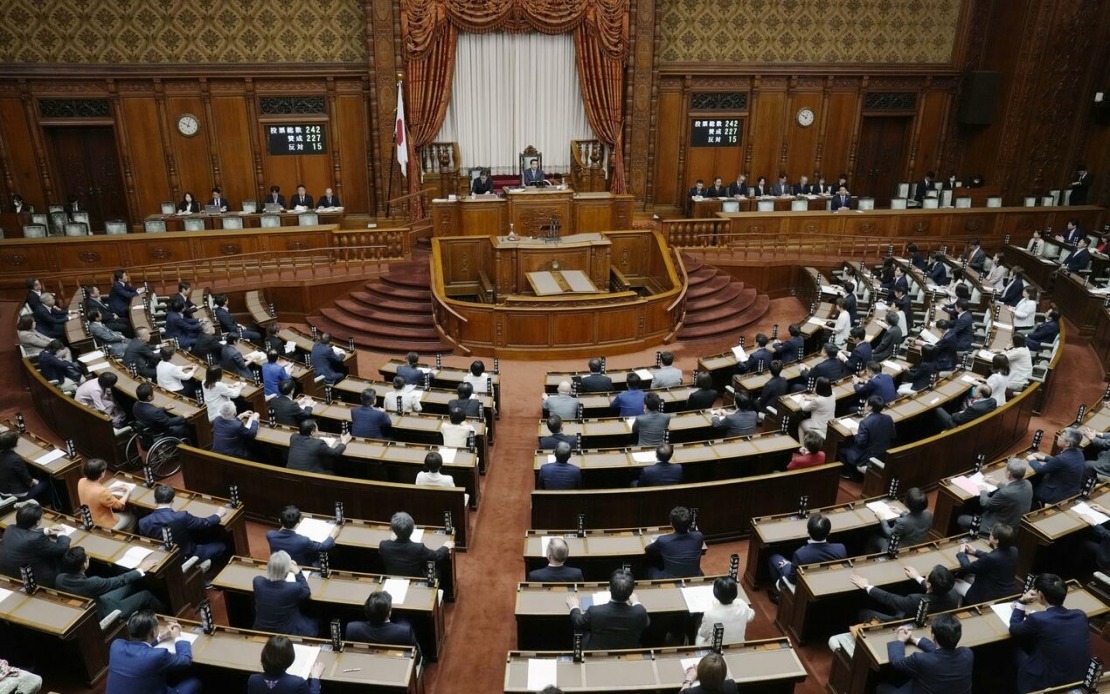
Japan's parliament has taken a significant step in modernising its military structure by approving sweeping reforms to the Air Self-Defence Force, incorporating space operations as a central pillar of national defence. The legislation, passed by the House of Councillors on Friday, marks a watershed moment in how Tokyo approaches security in an era where satellite systems and space-based capabilities have become inseparable from conventional warfare and civilian infrastructure alike. This restructuring underscores Japan's determination to adapt its defence posture to emerging threats in the Indo-Pacific region, where geopolitical tensions continue to intensify.
The newly reorganised military branch, officially incorporating "space" into its nomenclature, will commence operations during the fiscal year ending in March 2027. Central to this transformation is the establishment of a dedicated space operations group, to be commanded by a lieutenant general and tasked with enhancing Japan's awareness of activities occurring in the space domain while bolstering the nation's satellite surveillance infrastructure. This represents a fundamental shift in how Tokyo structures its armed forces, acknowledging that terrestrial, naval, and aerial operations are increasingly dependent on space-based systems for communication, navigation, targeting, and intelligence gathering. The space operations group will function as a critical nerve centre for monitoring potential threats emanating from competitors who view space as a theatre for military competition.
Beyond the immediate restructuring of the Air Self-Defence Force, the legislation addresses broader institutional challenges facing Japan's military establishment. Lawmakers have authorised the appointment of a second senior vice defence minister, a position that will distribute administrative responsibilities more evenly during emergencies and large-scale natural disasters. This addition reflects Japan's experience managing multiple concurrent crises and the necessity for robust civilian-military coordination when disasters strike. The expanded ministerial capacity will also facilitate deeper engagement with security partners, particularly the United States, through enhanced diplomatic exchanges and collaborative defence planning that have become essential in maintaining stability across the region.
Defence Minister Shinjiro Koizumi articulated the rationale for this comprehensive modernisation during a press briefing, emphasising that space dependency extends far beyond military applications. He highlighted how contemporary society relies fundamentally on space-based infrastructure for everyday functions, citing satellite navigation systems that enable accurate positioning, the mapping applications embedded in smartphones that millions depend upon for navigation, and meteorological forecasting systems that protect public safety. This framing demonstrates Japan's sophisticated understanding that space operations transcend purely military concerns—a perspective that is increasingly relevant as nations grapple with the dual-use nature of space technology and the intersection between civilian and defence requirements.
The Japanese government has signalled its commitment to constructing comprehensive institutional frameworks that will enable the Self-Defence Forces to execute their expanding mandate effectively. This institutional development encompasses not merely operational capabilities but also the legal, administrative, and budgetary structures necessary to sustain a modern military establishment operating across multiple domains. As regional tensions persist, Japan recognises that maintaining military readiness requires continuous investment in infrastructure, training, and technological advancement. The deliberate, phased approach outlined in the legislation—with full implementation scheduled for fiscal 2027—allows Japan to develop capabilities methodically while managing fiscal constraints.
Recognising that military effectiveness depends fundamentally on personnel retention and recruitment, the legislation also implements improvements to post-retirement benefits for Self-Defence Force members. The SDF has confronted increasing difficulties in attracting and retaining qualified personnel, a challenge exacerbated by the fact that mandatory retirement ages for military personnel typically occur earlier than in civilian government service. By enhancing retirement entitlements, Japan aims to improve the attractiveness of military service and encourage experienced personnel to remain engaged. This personnel-focused approach reflects international best practices among developed militaries competing for skilled workers in competitive labour markets.
Particularly significant is the legislation's elevation of the 15th Brigade, currently based in Naha, Okinawa Prefecture, to full divisional status. This move directly addresses Japan's strategic concerns regarding its southwestern territories, where a cluster of remote islands occupy critical positions in maritime trade routes and represent potential flashpoints given China's increasingly assertive posture in the East China Sea. By upgrading the 15th Brigade to divisional strength, Japan substantially increases its defensive capabilities in this region and signals resolve in maintaining control over territories it considers integral to national sovereignty. The enhancement of forces in Okinawa comes amid broader Japanese efforts to strengthen defensive infrastructure throughout the southwestern island chain, creating layered defences against potential maritime encroachment.
Regional observers note that Japan's military restructuring cannot be viewed in isolation but rather as part of a coordinated response to shifting geopolitical realities across East Asia. China's rapid military modernisation, its assertive maritime activities, and its expanding space programme have prompted Japan to accelerate its own defence evolution. Similarly, North Korea's advancing weapons capabilities and Russia's broader strategic posture contribute to Japan's calculus regarding necessary defence investments. For Southeast Asian nations, Japan's strengthened military posture and enhanced space capabilities carry implications for regional stability, potentially supporting freedom of navigation efforts and contributing to regional security architecture that many nations in the area depend upon.
The appointment of an additional senior vice defence minister, expected to occur by summer, will provide the institutional capacity necessary for Japan to engage more actively in regional security dialogues while managing domestic defence administration. This expanded ministerial structure facilitates closer coordination between Japan's Defence Ministry and other government agencies addressing security challenges, from maritime domain awareness to cybersecurity. The enhanced capacity for high-level exchanges with the United States and allied nations strengthens the diplomatic infrastructure supporting security cooperation, enabling more frequent and substantive discussions of shared concerns and collaborative responses to emerging threats.
For Malaysia and other ASEAN members, Japan's military modernisation holds particular relevance given their shared interests in maintaining open sea lanes and preventing any single power from dominating regional waters. Japan's enhanced space operations capability could potentially contribute to regional maritime domain awareness initiatives, supporting efforts by Southeast Asian nations to monitor activities in their respective zones. Additionally, Japan's experience in managing defence relationships with the United States while maintaining economic ties with China offers lessons for Southeast Asian policymakers navigating similar balancing acts. The Japanese model of investing in defensive capabilities while avoiding aggressive posturing provides a template that emphasises deterrence through strength rather than destabilising military expansion.
The structural changes outlined in Japan's legislation reflect a maturation of defence thinking, moving beyond Cold War-era organisational models toward frameworks suited for contemporary security challenges. The explicit incorporation of space operations acknowledges that modern security threats emanate from multiple domains simultaneously, requiring integrated responses that transcend traditional service boundaries. As implementation proceeds toward fiscal 2027, observers will monitor how effectively Japan consolidates its new institutional structures and whether the enhanced space operations group develops the capabilities necessary to provide comprehensive situational awareness across the critical space domain. This modernisation effort, though framed as primarily responsive to regional threats, will likely influence broader military thinking throughout Asia as other nations contemplate their own organisational evolution.

