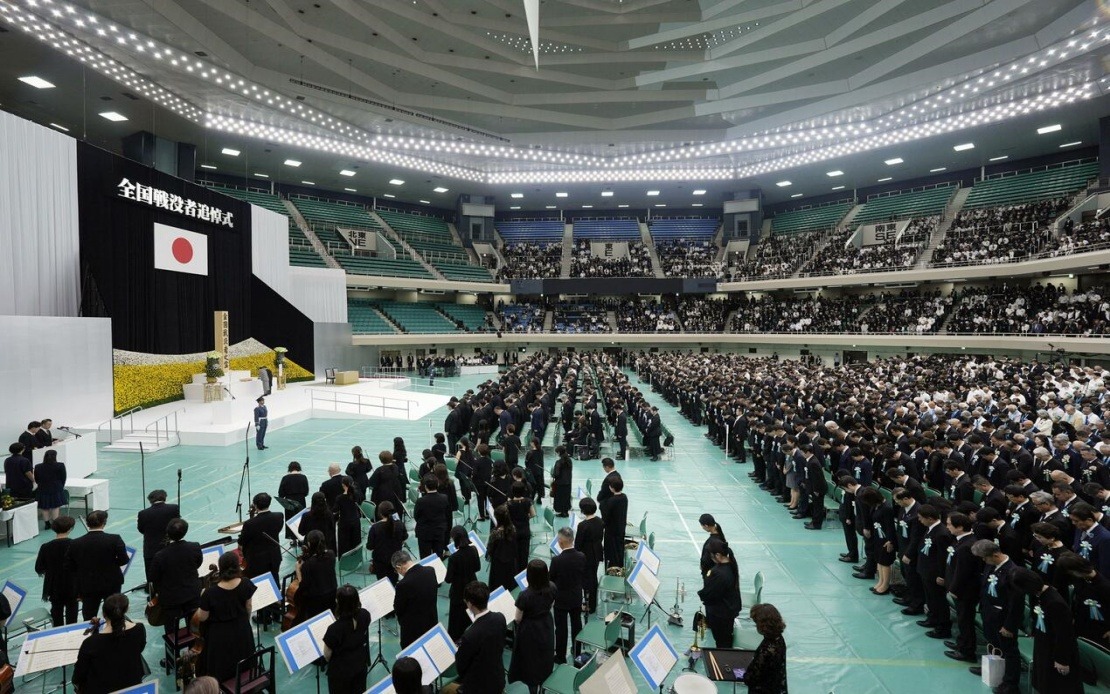
Japan commemorated the 81st anniversary of its World War II surrender on Saturday with a state ceremony in Tokyo, yet the occasion underscored evolving tensions within the nation's approach to its wartime past. Prime Minister Sanae Takaichi presided over the government-sponsored event to honour approximately 2.3 million military personnel and 800,000 civilians who perished during the conflict that ended in 1945, alongside Emperor Naruhito and Empress Masako. However, her carefully chosen remarks conspicuously omitted reference to Japan's "remorse" over the war—language that carries significant diplomatic and domestic political weight in how Tokyo frames its historical responsibility.
Takaichi's first attendance at the August 15 memorial ceremony since assuming office in October 2024 revealed the philosophical distance between her administration and that of her immediate predecessor, Shigeru Ishiba. Where Ishiba had explicitly invoked Japan's "remorse" and pledged the nation's resolve to renounce war—a formulation absent from Japanese prime ministerial statements for thirteen years prior—Takaichi instead chose to emphasise that Japan "has consistently walked the path of a nation that values peace and made all possible efforts for world peace and prosperity." The shift in wording, though subtle to casual observers, carries profound implications for how Tokyo presents itself to regional neighbours and the international community.
The distinction matters considerably within Japan's political landscape and across East Asia. Takaichi, recognised for her hawkish stance on national security matters, represents a departure from the more conciliatory posture Ishiba had begun to reestablish. Her decision to omit explicit reference to wartime remorse aligns with patterns established before Ishiba's tenure, when Japanese leaders routinely avoided such acknowledgment. The last prime minister to regularly employ the remorse framework before Ishiba was Yukio Edano in 2011, making Ishiba's reintroduction of the term a notably deliberate choice that Takaichi has now reversed. This rhetorical retreat carries consequences far beyond ceremonial language, potentially influencing Japan's diplomatic relations with China and Korea, nations acutely sensitive to how Tokyo characterises its imperial aggression.
The retreat from explicit remorse language represents only part of Takaichi's broader approach to Japan's historical narrative. Like recent predecessors including her political mentor Shinzo Abe, she declined to directly reference Japan's wartime aggression in Asia, on the Chinese mainland, or across the Korean Peninsula. Before Abe's return to power in December 2012, such references had been standard practice at the August 15 ceremony, with leaders routinely acknowledging the nation's responsibility for military expansion that devastated the region. The absence of such acknowledgment under current leadership suggests a deliberate recalibration of how Japan wishes to be remembered on the international stage.
Emperor Naruhito's participation provided continuity with Japan's established monarchical approach to historical memory. Remaining faithful to his annual custom, the Emperor expressed "deep remorse" during his own remarks, offering a measured counterbalance to Takaichi's avoidance of the term. His statement that the nation should continue "passing down the memories of the suffering endured during and after the war" represents the imperial institution's commitment to remembrance, even as the political executive charts a different rhetorical course. This divergence between the throne and the prime minister's office reveals internal Japanese debates about how the nation should grapple with its past.
The timing of this ceremony carries particular significance given Japan's current geopolitical positioning. The commemoration occurred amid escalating tensions in West Asia and coinciding with Tokyo's most substantial shift in defence policy in decades. Japan has substantially increased national security spending and liberalised restrictions on defence equipment exports, moves reflecting growing anxiety about regional stability and Tokyo's expanding security commitments. These policy developments suggest that Takaichi's rhetorical choices are part of a broader repositioning of Japan as a more assertive military and security player, one less constrained by historical burden and more focused on contemporary strategic challenges.
The historical context illuminates the current shift. When Abe first ascended to power in 2006, he immediately departed from the established pattern of prime ministerial remorse statements, instead offering more ambiguous formulations about "pain and suffering." During his first tenure, he faced considerable international criticism, particularly from China and South Korea, for this rhetorical recalibration. Upon his return in 2012, Abe continued this approach, and other leaders who followed his example, including Yoshihide Suga and Fumio Kishida, similarly avoided explicit remorse language. Ishiba's reintroduction of the term thus appeared to signal a potential recalibration toward greater historical accountability—a signal Takaichi has now effectively cancelled.
For Malaysia and other Southeast Asian nations, Japan's shifting historical rhetoric merits close attention. While Japan occupied Southeast Asia only briefly during World War II compared to its longer presence in China and Korea, the region experienced substantial suffering under Japanese military rule. Malaysia's own understanding of this period and its approach to Japan's historical accounting shape bilateral relations and regional security dynamics. Japan's growing military assertiveness and its apparent retreat from explicit historical remorse may influence how neighbouring countries view Tokyo's strategic ambitions and whether historical grievances resurface in contemporary diplomatic contexts.
The noon moment of silence honoured the moment when then-Emperor Hirohito announced Japan's surrender via radio broadcast in 1945, a ritual that continues to anchor the nation's collective memory to that transformative instant. Yet the meaning attached to that moment appears increasingly contested between those, like the Emperor, who view it through the lens of remorse and learning, and those, like Takaichi, who prefer to emphasise continuity, peace, and forward-looking commitment. This internal Japanese debate will likely intensify as Tokyo navigates balancing its pacifist constitution and war-weary historical identity against emerging security challenges and its ambitions as a major power. The 81st anniversary thus marks not merely passage of time but a critical juncture in how Japan chooses to remember—and therefore to define itself.

