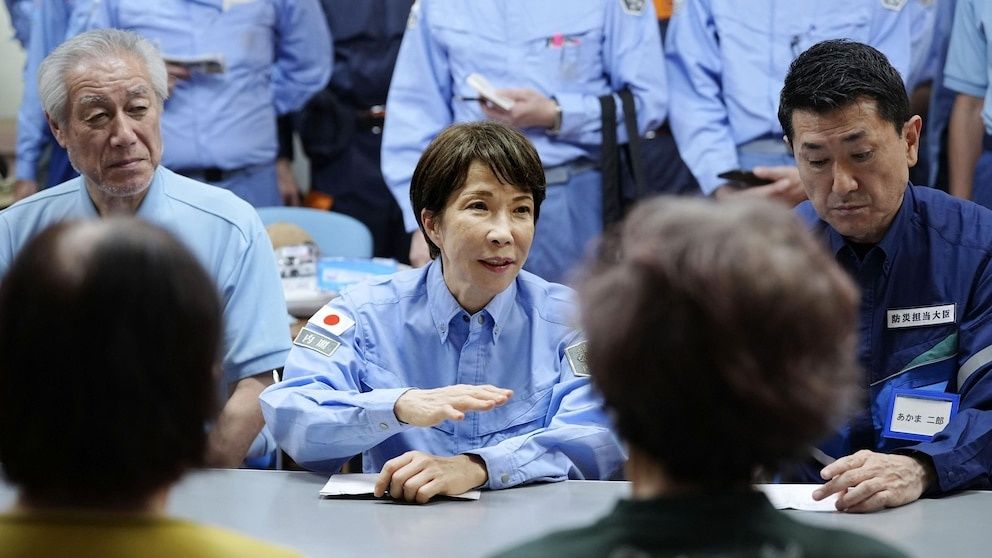
Prime Minister Sanae Takaichi toured Kumamoto Prefecture on Monday for the first time since a magnitude 7.1 earthquake devastated the southwestern region on Japan's main island of Kyushu on Tuesday, August 4. The visit came as residents across the affected communities began the lengthy process of debris removal while contending with dangerously hot weather that has compounded the disaster's humanitarian challenges.
The earthquake has exacted a severe human toll, with 38 confirmed deaths across the prefecture, according to officials. The circumstances surrounding these deaths underscore the particular vulnerabilities facing disaster survivors in summer conditions—one person died from apparent heat stroke while sheltering in a vehicle, while another death remains under investigation. The tragedy highlights how natural disasters in Japan's summer months create compounding health risks that extend well beyond the initial seismic event itself.
The scale of physical destruction across Kumamoto remains substantial. Approximately 700 homes have been completely destroyed, while more than 11,300 buildings sustained varying degrees of damage. Beyond the immediate structural devastation, the earthquake injured 114 people and left residents grappling with cascading infrastructure failures that have proven as disruptive as the quake itself.
Water supply systems remain severely compromised across the region, with more than 46,000 households still without access to clean water days after the disaster. This infrastructure failure, occurring during an extreme heat event when water needs spike dramatically, has created an acute public health crisis. Simultaneously, fuel shortages have hampered both emergency response operations and residents' ability to power essential equipment. The Japan Meteorological Agency forecasted temperatures approaching 40 degrees Celsius on Monday, intensifying the region's vulnerability to heat-related illness and complicating survival conditions for those without adequate shelter.
Over 8,500 people remained in crowded emergency shelters converted from community centers, school gymnasiums, and classrooms, many of which lack air-conditioning systems essential for surviving the intense summer heat. Additional evacuees have resorted to sleeping in vehicles parked in town hall lots and public parks or attempting to rest outdoors near their damaged homes. This dispersion of the displaced population reflects both the scale of the disaster and the inadequacy of formal shelter infrastructure—a chronic problem that disaster management experts have repeatedly highlighted as a significant vulnerability in Japan's emergency response capacity.
Governor Takashi Kimura met with Takaichi during her visit and emphasized what he termed the "abnormal heat" compounding residents' suffering. The governor appealed directly to the federal government for enhanced support to upgrade evacuation center conditions, particularly regarding access to clean water and medical care—resources that should be considered baseline necessities rather than luxuries in any emergency shelter system.
Takaichi's visit itself became controversial on social media, with observers noting that her tour included one of the prefecture's best-equipped shelters, featuring cardboard partition beds, designated sleeping areas, and functioning air-conditioning. Critics argued that the carefully curated site visit presented a misleading picture of conditions across the prefecture, where the vast majority of evacuees endure far more austere circumstances. The episode reflects broader tensions between government messaging and on-the-ground realities in disaster response management.
In response to the governor's requests, Takaichi stated that her administration would "quickly examine what the government can do for the disaster-hit region and affected people and move proactively." Such measured language, while diplomatically appropriate, has not assuaged concerns among observers that federal resources will prove insufficient for the scale of reconstruction required.
The disaster has also revealed troubling corporate accountability issues within the affected region. Habita, a local general store operator with a shop inside the Aeon Mall in Kashima, acknowledged instructing two employees to return to the collapsing building to secure daily sales proceeds in a company safe. Both employees were subsequently killed in an explosion that investigators believe resulted from a gas leak occurring after approximately 3,000 shoppers had already evacuated to a parking lot. Two company executives attended the funeral of 22-year-old Kurumi Otake, one of the deceased workers, and apologized to her parents. Otake's mother's tearful plea—"I wish someone had stopped her. My daughter is not coming back"—starkly illustrates the human cost of corporate decisions made under pressure.
Rescue operations at the collapsed mall recovered five survivors but also extracted seven bodies from the rubble, bringing total fatalities from that single structural failure to that count. The incident has raised questions about corporate duty-of-care obligations during natural disasters and the pressures placed on low-wage workers to prioritize company assets over personal safety.
Meanwhile, reconstruction efforts have begun with preliminary construction of temporary housing in the towns of Uki and Hikawa, acknowledging that longer-term displacement will characterize the recovery period for many residents. Local hotels and inns have begun offering rooms to evacuees, providing some relief from overcrowded emergency shelters and vehicle sleeping arrangements.
The Kumamoto earthquake represents both an immediate humanitarian crisis and a stress test of Japan's disaster management infrastructure during challenging seasonal conditions. The convergence of inadequate water systems, extreme heat, insufficient shelter capacity, and corporate accountability failures suggests that even in a nation with extensive disaster preparation experience, systemic vulnerabilities remain when multiple stressors collide. For Southeast Asian nations facing similar seismic risks and tropical heat challenges, Kumamoto's experience underscores the necessity of comprehensive, adequately resourced emergency shelter systems and robust corporate accountability mechanisms that prioritize human life over asset protection during disasters.

