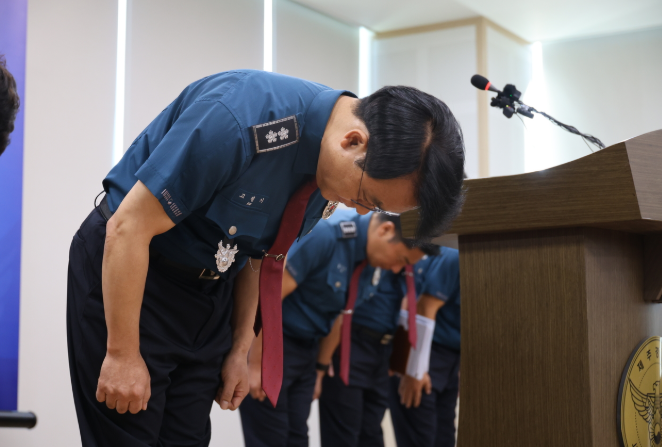
South Korea's Jeju Police Commissioner Ko Pyeong-gi delivered a formal public apology on Thursday, Aug 27, following the revelation that a police officer under his command had improperly closed at least two missing person investigations by fabricating evidence of contact with the missing individuals. The admissions have reignited concerns about accountability within South Korean law enforcement and the procedural safeguards meant to protect vulnerable populations during critical early stages of missing person investigations.
The circumstances surrounding the cases paint a troubling picture of institutional negligence. A 37-year-old woman named Jang Mi-ran vanished in May, but the case was closed on false grounds when officer Bu claimed to have directly spoken with her, despite no such interaction occurring. Tragically, Jang Mi-ran's body was discovered on Monday, Aug 24, prompting authorities to reexamine how her case had been handled. The same officer had employed an identical deception to close a separate missing person file involving a man in his 60s, whose remains were recovered on Saturday.
In his statement delivered at the Jeju Provincial Police Agency, Commissioner Ko acknowledged the profound breach of public trust, extending condolences to both deceased individuals and their families. He explicitly recognised the crushing emotional toll inflicted on bereaved relatives, describing their suffering as "beyond description." His language reflected an understanding that the officer's actions extended far beyond administrative mistakes—they represented a fundamental abandonment of the ethical obligations binding law enforcement personnel to the communities they serve.
The commissioner emphasised that police officers carry the explicit responsibility to safeguard public safety and preserve human life, responsibilities that officer Bu had deliberately disregarded through dishonest reporting. Ko acknowledged that by lying on official documentation, the officer had inflicted "permanent scars" not only on the affected families but also on the broader Jeju community's confidence in local policing institutions. This framing suggests recognition that such conduct damages the social contract underpinning effective law enforcement.
For readers across Southeast Asia, this case carries particular relevance given the ongoing scrutiny of missing person protocols across the region. In Malaysia, neighbouring Thailand, and other ASEAN nations, questions about how police departments classify and prioritise missing person cases remain contentious. The Jeju incident underscores how procedural vulnerabilities—especially the potential for individual officers to unilaterally close investigations without rigorous verification—can produce catastrophic outcomes. Southeast Asian jurisdictions managing similar caseloads would benefit from examining whether their oversight mechanisms sufficiently prevent such misconduct.
Ko pledged that authorities would conduct a comprehensive and transparent investigation into both the officer's conduct and the systemic failures that enabled such misconduct to occur undetected. This commitment to transparency represents an attempt to restore institutional credibility, though whether measures will prove substantive remains to be seen. The commissioner also announced that Jeju police would undertake a comprehensive audit of all missing person cases handled across the island to identify whether additional errors or misconduct had occurred within the same unit or elsewhere in the department.
The broader implications of this review initiative are significant. A systematic reexamination of closed missing person cases could reveal whether the falsification pattern was isolated to officer Bu or whether a wider cultural problem exists within the Jeju police apparatus. Such audits, when properly executed, serve a dual purpose: they provide accountability mechanisms that deter future malfeasance while simultaneously offering belated justice or answers to families whose cases may have been similarly compromised.
The case also highlights tensions inherent in managing missing person investigations during their critical early phases. Police departments worldwide struggle with resource allocation when distinguishing between voluntary absences and genuine disappearances. However, this operational challenge cannot justify falsifying documentation or claiming investigative contacts that never occurred. The fact that officer Bu employed deception rather than simply logging the case as inactive or requesting extensions suggests either institutional pressure to rapidly resolve cases or an individual's deliberate choice to circumvent proper procedures.
In the South Korean context, this incident arrives amid broader concerns about police accountability mechanisms. Over the past decade, several high-profile cases have raised questions about whether internal review processes possess sufficient independence and authority to meaningfully sanction misconduct. The public nature of Commissioner Ko's apology and the announced comprehensive review may represent an effort to signal that Jeju police recognise the seriousness of these failures and are committed to structural reform.
For Malaysian and Southeast Asian observers, the institutional response merits careful attention. Effective missing person protocols require not merely formal procedures but genuine commitment to their implementation, combined with robust oversight mechanisms capable of catching deviations before outcomes become tragic. The Jeju case demonstrates that well-intentioned administrative systems can fail when individual actors operate without sufficient scrutiny, particularly in units handling time-sensitive investigations where early intervention often proves decisive.
The families of Jang Mi-ran and the other deceased individual now face the grim knowledge that timely investigation might have altered outcomes. This knowledge, combined with the revelation that their loved ones' cases were deliberately mishandled, adds psychological trauma to their grief. As Jeju police proceed with their investigation and departmental review, their actions will signal to other law enforcement agencies throughout Asia whether taking responsibility for such failures translates into meaningful systemic change or remains performative.

