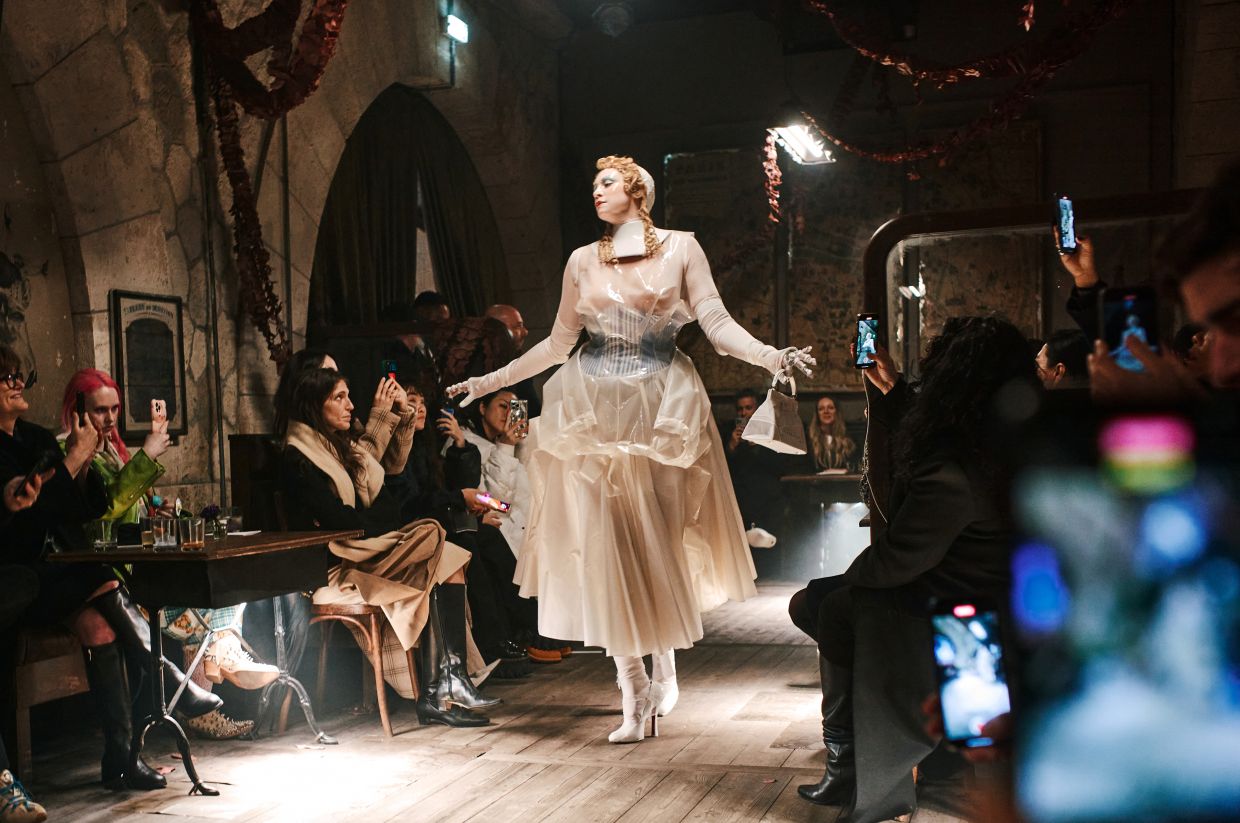
The Metropolitan Museum of Art convened an unusual gathering in May comprising some of fashion's most influential figures, including Vogue's Anna Wintour, to deliberate on a potentially controversial decision: mounting a retrospective celebrating the work of John Galliano, one of contemporary fashion's most transformative designers. The carefully orchestrated closed-door meeting represented just one in a series of consultations with Jewish community leaders over the past year, reflecting the institution's awareness that honouring Galliano carries significant reputational and ethical implications for all involved.
Galliano's career trajectory presents a study in extremes. Between 1996 and 2011, as Dior's creative director, he fundamentally reimagined the storied French house, elevating it from a respected heritage brand into a globally dominant fashion empire. His mastery of the bias-cut silhouette and his capacity to construct immersive, fantastical collections established him as an architectural genius within fashion design. Yet this legacy was violently interrupted in 2011 when he was filmed making severely antisemitic remarks, including expressions of admiration for Adolf Hitler, in a Paris bar. The incident destroyed his professional standing overnight, resulting in his termination from Dior, a conviction for hate crimes in a French court, and mandatory rehabilitation.
The proposed exhibition would position Galliano as only the third living designer to receive a solo retrospective at the Met, joining the legendary Yves Saint Laurent and Rei Kawakubo. Such an honour represents the pinnacle of institutional validation in the fashion world, amplifying both the prestige and the controversy. The show's opening would coincide with the Met Gala, arguably the world's most scrutinised fashion event, guaranteeing unprecedented visibility. This convergence of factors explains why museum leadership deemed it essential to consult extensively with New York's Jewish communities before proceeding.
The timing of this retrospective acquisition proved particularly sensitive. Antisemitic incidents have risen dramatically across the United States, and New York City has experienced particularly disturbing violence. Recent months witnessed a stabbing attack in broad daylight involving a man leaving a Jewish community centre in Manhattan, an assault prosecuted as a hate crime. This contemporary context of rising antisemitism meant that rehabilitating Galliano's reputation required more than his personal transformation; it demanded careful navigation of the broader social climate and genuine engagement with affected communities.
Museum director Andrew Bolton adopted a transparent approach to these consultations. He candidly acknowledged that whilst he had conceptualised a Galliano exhibition since 2010, he did not pursue it seriously until 2024. Bolton stated that both he and the museum's board recognised the necessity for extended deliberation, though he disputed suggestions that apprehension about Galliano's past motivated this hesitation. Rather, Bolton framed the current historical moment as rendering the exhibition particularly timely, positioning it as an opportunity for substantive cultural dialogue rather than mere aesthetic celebration.
Rabbi Rick Jacobs, president of the Union for Reform Judaism in North America, emerged from the May meeting with cautiously optimistic impressions. He highlighted Galliano's apparent sincerity during their encounter, characterising his demeanour as genuine rather than scripted. The rabbi spoke of the Jewish principle of teshuvah—repentance and spiritual restoration—and its traditional emphasis on redemption and second chances. Jonathan Greenblatt, CEO of the Anti-Defamation League, similarly endorsed Galliano's rehabilitation efforts, stating that his attempts to comprehend and amend the harm caused by his earlier remarks merit recognition.
Yet consensus remained incomplete. Rabbi Joshua Davidson of Temple Emanu-El, located mere blocks from the Met, articulated a more conditional perspective. He emphasised that the exhibition could prove genuinely transformative only if curators leveraged it as a teaching instrument about antisemitism's contemporary dangers and the necessity of active resistance. For Davidson and others in the community, the retrospective represented an opportunity transcending aesthetic assessment—it could either model how cultural institutions address historical wrongdoing or risk appearing to absolve serious antisemitic conduct.
Bolton's proposed curatorial strategy acknowledges these concerns by foregrounding what he describes as "the rupture" in Galliano's career. The museum plans to introduce the exhibition with an "orientation gallery" that contextualises both the designer's undeniable contributions to fashion history and the gravity of his transgression. Bolton indicated his intention to utilise Galliano's own words wherever possible, reflecting feedback from Jewish community leaders emphasising the importance of directness and the avoidance of euphemistic language. However, Bolton explicitly rejected the notion that the exhibition would simply reflect Galliano's personal narrative; instead, he committed to presenting the most historically accurate account available.
Beyond the physical exhibition, Bolton is exploring additional mechanisms for broader engagement, including an online forum to facilitate deeper community discussion about antisemitism, redemption, and institutional accountability. This expansion beyond traditional museum boundaries suggests recognition that the exhibition's implications extend far beyond fashion specialists and into questions affecting broader society.
Galliano's personal journey since 2011 has proceeded deliberately. Following his conviction, he underwent rehabilitation and engaged in systematic education about Judaism, the Holocaust, and antisemitism, working with both London-based rabbinical mentors and Anti-Defamation League representatives. His 2014 appointment as creative director at Maison Margiela represented a cautious re-entry into the industry. Over the succeeding decade, he has gradually rehabilitated his professional reputation; contemporary celebrities including Zendaya, Tyla, and Amal Clooney have worn his designs on major red carpets, whilst his vintage pieces command premium prices at auction houses, indicating sustained market demand.
The fashion industry itself has largely moved beyond discomfort regarding Galliano's presence, suggesting the institutional world has effectively closed the chapter on his transgression. This presents a fundamental tension at the heart of the Met's exhibition: the gap between fashion's apparent acceptance and broader societal concerns about whether sufficient accountability has occurred. The retrospective thus functions as a referendum not merely on Galliano's personal redemption but on the fashion industry's willingness to engage meaningfully with antisemitism and its ongoing social consequences.
The Met's deliberative approach, whilst time-consuming and unconventional, reflects an understanding that the exhibition cannot be insulated from its broader social implications. By soliciting community input and committing to contextualising Galliano's career within the framework of his antisemitic remarks, the museum has positioned itself as taking seriously the concerns of affected communities. Whether this engagement ultimately succeeds in transforming the retrospective into a genuine moment of institutional reckoning or merely provides aesthetic legitimacy to a designer whose past transgression has been absorbed into fashion's institutional memory remains uncertain.

