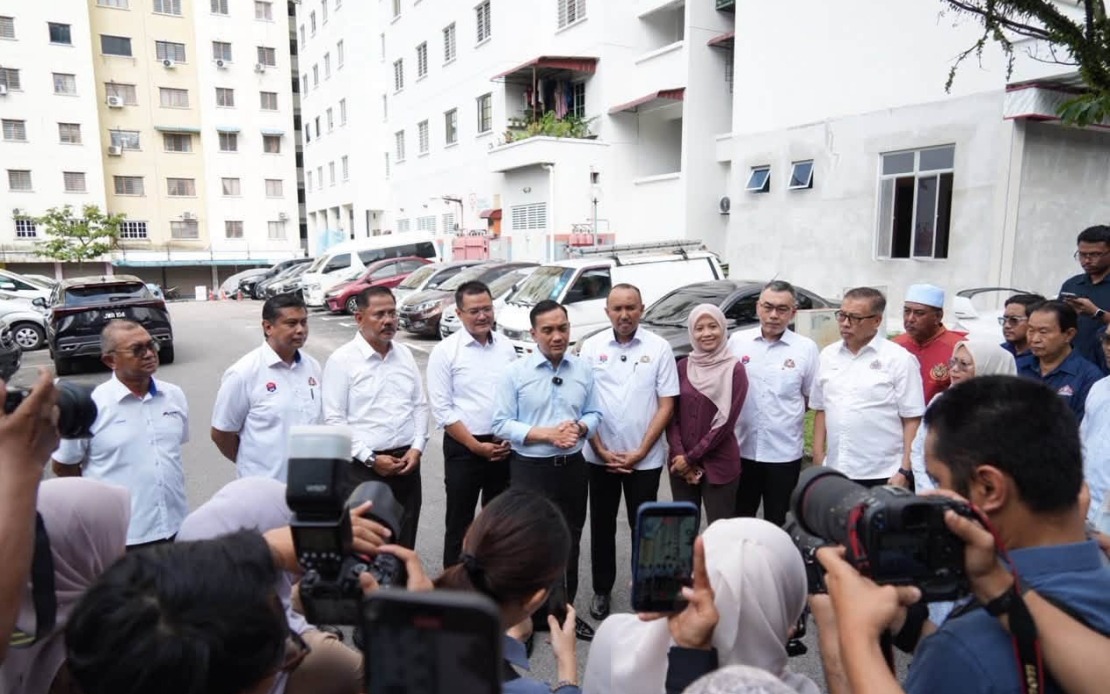
The Johor government has announced a RM50 million investment programme to repaint low-cost residential units, privately owned low-medium-cost apartments and public housing developments throughout the state. The initiative represents a significant commitment to enhancing living standards for lower-income households across one of Malaysia's most economically vibrant regions. State Housing and Local Government Committee chairman Datuk Mohd Jafni Md Shukor unveiled the scope of the undertaking during an inspection at Desa Muafakat Apartments alongside Johor Menteri Besar Datuk Onn Hafiz Ghazi, signalling high-level political backing for the programme.
The scale of the intervention is substantial, encompassing 170 housing blocks with a combined 11,693 residential units distributed across 26 strategic locations throughout Johor. The beneficiary population is anticipated to reach nearly 46,772 residents, making this one of the more extensive housing maintenance projects executed in the state in recent times. The geographical spread reflects the state government's intention to address maintenance backlogs across both urban centres and peripheral areas, ensuring equitable treatment of lower-income communities regardless of their location within Johor's administrative boundaries.
Datuk Mohd Jafni articulated a perspective that transcends the superficial understanding of cosmetic improvement, framing the repainting initiative within a broader social policy context. He emphasised that environmental restoration of residential spaces carries implications extending well beyond aesthetic enhancement, functioning instead as a tangible manifestation of governmental concern for resident welfare. A refreshed physical environment, he argued, generates psychological benefits including heightened comfort levels, reinforced community cohesion and restored confidence in public administration's responsiveness to constituents' needs. This framing positions housing maintenance not merely as infrastructure management but as a component of social policy addressing resident dignity and quality of life.
Implementation architecture for the programme involves coordinated action across multiple state and local government entities. The Johor State Housing Development Corporation (PKPJ) and the Local Government Division of the Johor State Secretary's Office will serve as primary coordinators, while four municipal authorities—the Johor Bahru City Council (MBJB), Iskandar Puteri City Council (MBIP), Pasir Gudang City Council (MBPG) and the Kulai Municipal Council (MPKu)—will provide operational support. This multi-agency approach reflects acknowledgement that successful execution requires institutional coordination and resource pooling across different governance levels, a structural consideration particularly relevant for Southeast Asian housing initiatives where fragmented jurisdictions frequently impede project continuity.
During the inspection visit, the Menteri Besar and committee chairman addressed multiple residential challenges beyond the primary repainting objective. Briefings encompassed slope subsidence issues adjacent to apartment parking facilities and deterioration of internal road networks within the housing complex, suggesting that the state government recognises interconnected infrastructure problems requiring simultaneous remediation. The identification of these ancillary concerns during site visits demonstrates a diagnostic approach that treats housing complexes as integrated systems rather than isolated structures, potentially unlocking comprehensive renewal rather than limited cosmetic intervention.
Quality assurance and project discipline emerged as explicit priorities within the programme framework. Datuk Mohd Jafni stressed that implementing agencies and appointed contractors face mandatory reminders regarding workmanship standards, occupational safety protocols and cleanliness maintenance throughout execution. He articulated explicit concern that projects demonstrating satisfactory completion aesthetics might subsequently deteriorate or generate unforeseen complications for residents, reflecting institutional learning from previous initiatives. By mandating adherence to stipulated schedules, technical specifications and quality benchmarks, the programme attempts to preempt the cyclical pattern where initial improvements degrade rapidly, thereby maximising return on public investment and sustaining resident satisfaction across extended timeframes.
The timing and scale of this initiative carries implications for Malaysian regional housing policy discourse. As urbanisation accelerates throughout Southeast Asia and housing affordability constraints intensify, maintenance of existing low-income housing stock increasingly competes with new construction for governmental budgeting. The Johor programme exemplifies a strategic shift toward preserving and upgrading existing units rather than emphasising supply expansion, a pragmatic approach for jurisdictions where inherited housing stock has accumulated significant maintenance deficits. For neighbouring states and regional policymakers, this initiative provides a potential template for addressing deferred maintenance in ageing low-cost housing developments.
The concurrent development of Tabika KEMAS Bangsa Johor at Desa Muafakat Apartments, mentioned during the inspection, indicates that the state government is pursuing complementary social infrastructure investments alongside housing rehabilitation. Early childhood education facilities within low-income housing complexes address holistic community needs and support broader human development objectives beyond immediate housing concerns. This integrated approach suggests strategic planning that acknowledges housing complexes as social ecosystems rather than exclusively residential configurations.
For lower-income residents across Johor, the RM50 million allocation provides immediate material benefits through environmental improvement and reinforces political messaging that state administration prioritises their welfare. Housing quality directly correlates with resident health outcomes, psychological wellbeing and community stability, making maintenance investment a public health intervention as much as an infrastructure initiative. The programme's emphasis on direct beneficiary numbers—nearly 47,000 residents—underscores the democratising potential of housing improvement policies that reach proportionally large segments of lower-income populations.
Looking forward, the programme's success will depend substantially on sustained implementation discipline and protection from budgetary reallocation. Government housing initiatives in Malaysia have occasionally encountered delays or scope reduction when competing priorities emerge, potentially compromising completion timelines and final quality standards. Datuk Mohd Jafni's explicit warnings regarding quality deterioration and schedule adherence suggest administrative awareness of these implementation challenges and commitment to maintaining project momentum. The involvement of the Menteri Besar in site inspections signals political priority assignment that could facilitate timely fund disbursement and contractor accountability throughout execution phases.

