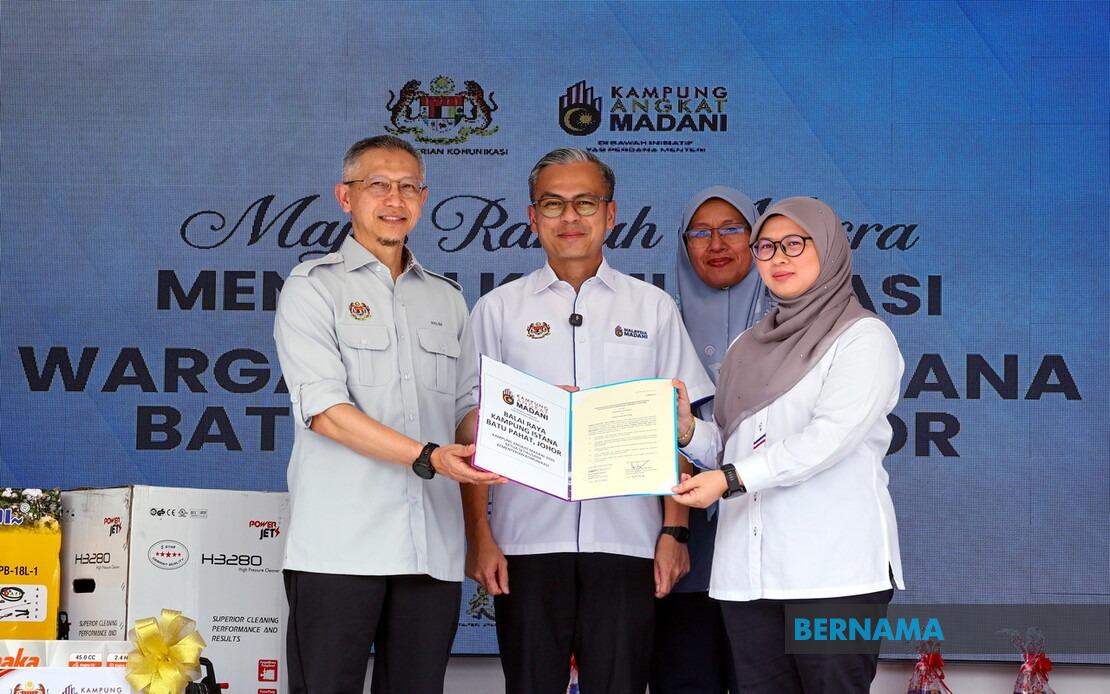
The forthcoming 16th Johor State Election represents a critical moment for voters to select leaders capable of advancing the state, according to Pakatan Harapan Communications Director Datuk Fahmi Fadzil, who has sought to reframe the campaign away from personalities and towards substantive governance questions. Speaking in Batu Pahat after engaging with residents, Fahmi rejected assertions that a Barisan Nasional victory would constitute endorsement of any former leader, characterising such interpretations as a departure from how Malaysians should approach electoral decisions.
The communications minister expressed concern over recent statements linking electoral outcomes to individual figures, viewing them as counterproductive narratives that distract from the genuine issues confronting Johor. Fahmi emphasised that voters make ballot-box choices based on their assessment of who can best serve their communities and advance the state's prosperity, not on personal attachments to particular politicians. His remarks responded directly to claims from Datuk Nazifuddin Mohd Najib, who suggested that a BN triumph would signal public backing for his father, Datuk Seri Najib Razak, to receive a pardon—a framing Fahmi deemed troubling and inconsistent with democratic principles.
Fahmi's intervention reflects broader concerns within Pakatan Harapan that the opposition coalition risks losing control of the electoral narrative if attention remains fixed on individual personalities rather than policy platforms and track records. The Johor contest carries particular significance because it tests whether PH can maintain momentum in a state where Barisan Nasional has traditionally dominated, and where complex inter-communal politics and economic anxieties shape voter behaviour. By insisting the election be judged on its merits as a choice between competing visions for the state, Fahmi aims to position PH as the coalition focused on substantive governance rather than personality cults.
Crucially, Fahmi argued that no political party should assume voter support is permanent or transferable from one election cycle to another. This observation directly addresses longstanding assumptions about the so-called "fixed deposit" phenomenon, whereby certain demographic or geographic constituencies were thought to vote predictably for particular parties. Fahmi contended that Malaysian voters have become more discerning and that parties must continually demonstrate their worth through concrete achievements rather than relying on historical bloc voting patterns. This evolution in electoral behaviour reflects deeper changes in how Malaysians engage with politics following the tumultuous events of recent years, including shifts in federal power and evolving public expectations around accountability and performance.
The communications minister highlighted recent instances of defection or cross-party support as evidence that traditional voting blocs are fragmenting. He referenced the public endorsement by former Rengit assemblyman Datuk Dr Mohd Puad Zarkashi of a PH candidate, suggesting that even figures long associated with UMNO and BN are reconsidering their loyalties. Such developments, Fahmi argued, indicate that Johor UMNO can no longer assume the state functions as its personal fiefdom. The emergence of these cracks in opposition unity, while individually modest in scale, collectively signal to voters that established power arrangements are no longer immutable and that electoral competition genuinely matters.
Fahmi also pointed to endorsements from Bersatu-aligned individuals supporting PH candidates in seats such as Sri Medan as further proof of the coalition's expanding appeal beyond its traditional base. These scattered but visible acts of cross-factional support suggest that concerns about governance quality, economic management, and Johor's development trajectory are transcending party lines and encouraging some opposition figures to consider whether PH offers a more credible path forward. Whether such individual endorsements translate into measurable voter shifts remains uncertain, but they reinforce Fahmi's framing of the election as genuinely competitive and open to persuasion rather than predetermined.
The narrative Fahmi advanced also serves a defensive function for Pakatan Harapan, which faces challenges in a state where it must overcome both Barisan Nasional's incumbency advantage and ingrained patterns of support. By portraying the contest as fundamentally about which leadership team can deliver better economic outcomes, improved public services, and sound administration, PH attempts to elevate the debate beyond the personal character assessments or factional rivalries that have sometimes dominated Malaysian electoral discourse. This strategy reflects confidence that if Johor voters judge the election on competence and vision rather than tribal allegiances, PH has a genuine opportunity to persuade sufficient numbers to switch allegiance.
Fahmi's insistence that voters should view their electoral choice as consequential for the state and nation, rather than as statements about particular individuals, also implicitly challenges a tendency in Malaysian politics toward presidentialism and personality-driven leadership. He argued that the democratic process functions most healthily when citizens evaluate party platforms, policy proposals, and administrative records rather than projecting hope or opposition onto individual figures. This represents a subtle but significant reframing of what elections should accomplish—shifting emphasis from symbolic validation of particular leaders toward institutional and substantive accountability.
The broader context for these remarks includes Malaysia's ongoing economic recovery and the need for state governments to contribute effectively to national development objectives. Johor, as the country's second-largest economy and a crucial industrial and commercial hub, warrants leadership capable of attracting investment, maintaining infrastructure quality, and ensuring competitive advantage in a challenging regional environment. Fahmi's argument that the state election should focus on which coalition possesses the expertise and capacity to navigate these challenges carries real weight for voters concerned about long-term prosperity and job creation. This economic dimension, though less prominent in his immediate remarks, underpins the assertion that the election transcends personality-based politics.
With 172 candidates competing for 56 seats and polling scheduled for July 11, the Johor election will test whether Fahmi's framing resonates with voters or whether more traditional electoral drivers prove decisive. The contrast between Pakatan Harapan's emphasis on forward-looking governance and Barisan Nasional's messaging—whether focused on personalities, communal concerns, or developmental promises—will likely shape the campaign's final weeks. Early voting on July 7 will provide initial signals about turnout and voter sentiment. As these foundational campaign messages take hold, the extent to which Malaysian voters embrace Fahmi's vision of elections as primarily about institutional capacity and state development, rather than personal attachments, will become increasingly apparent.

