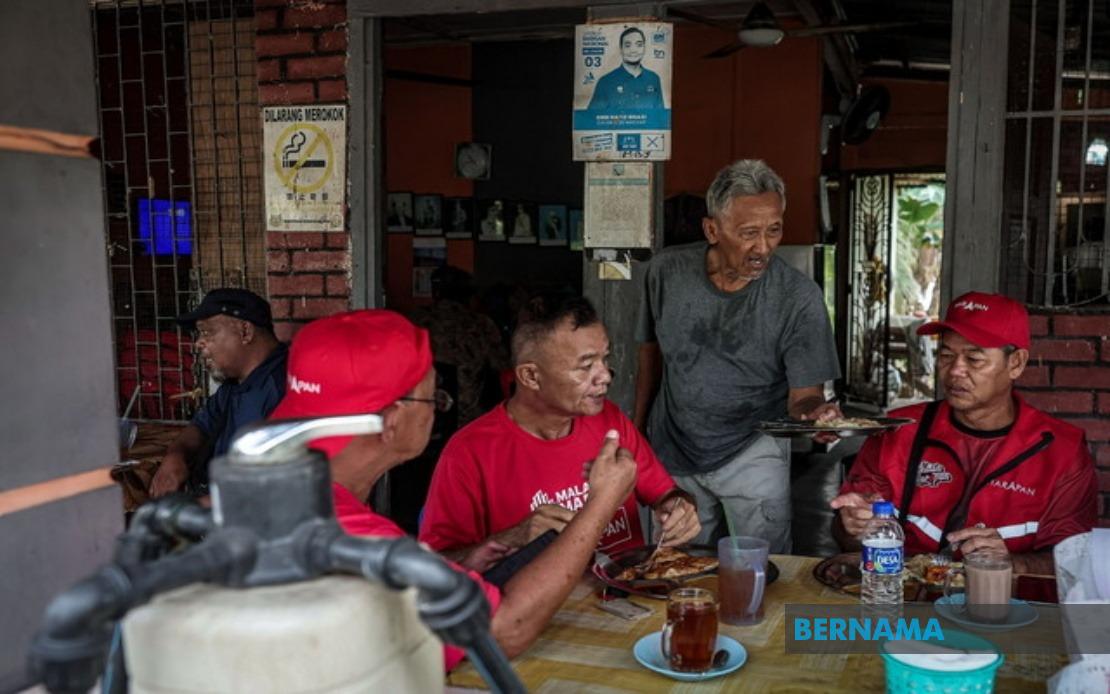
The ongoing Johor state election campaign is delivering tangible economic benefits to small traders and street-level business operators in the state, transforming what is primarily a political event into an unexpected financial windfall for those in the informal food sector. As candidates traverse constituencies and supporters mobilise across the landscape, the increased human traffic flowing through communities has translated into meaningful income opportunities for vendors who depend on daily sales to sustain their livelihoods. This grassroots economic phenomenon offers a glimpse into how major political events create secondary economic effects that ripple beyond the campaign trail itself.
In Felda Layang-Layang, Noorma Zafmeeden operates a modest breakfast warung with her husband Bahari Madiran, selling roti canai and nasi lemak to early morning customers. The 70-year-old has witnessed a dramatic transformation in her daily takings since the election campaign commenced. Whereas ordinary trading days typically yield less than RM400 in morning revenue, the campaign period has produced noticeably stronger sales figures. The couple, who have maintained their operation at the Felda settlement since 1987, begin work before dawn each day, preparing their speciality breakfast items before transitioning to fried dishes during evening hours. Their sustained presence in the community and reputation for consistent quality have positioned them to capitalise on the heightened foot traffic that accompanies election season activity.
Beyond the straightforward commercial advantage, Bahari observes that his warung has assumed a broader social role as a meeting point where visitors from different ethnic and religious backgrounds gather in an inclusive atmosphere. For him, the real value of the election season extends past financial metrics. The opportunity to interact with political workers and supporters arriving from various regions of Malaysia provides personal enrichment and a sense of participation in the broader democratic process. This perspective highlights how small business operators, while primarily motivated by income considerations, simultaneously experience election campaigns as periods of heightened community connection and national engagement.
Similarly positioned in Simpang Renggam, Ahmad Ridzuan Awang operates a nasi campur stall that has experienced even more dramatic revenue swings during the campaign. The 45-year-old trader reports that his sales have doubled relative to typical business volumes. On ordinary days, his prepared dishes remain available until late afternoon, but during the election campaign, he finds his trays emptied by mid-afternoon as bulk orders from various political parties and campaign teams deplete his inventory. This scale of demand represents a significant departure from baseline operations and creates both opportunity and logistical challenges for an operator working within the constraints of a small informal business model.
Ahmad Ridzuan identifies a multiplier effect extending beyond his own stall operations. The influx of what he characterises as "political tourists"—campaign workers, supporters, and observers—creates positive spillover benefits for neighbouring suppliers and local businesses. Local transport operators, material suppliers, and complementary vendors all experience increased demand as election-related activities generate broader economic activity. This ecosystem perspective demonstrates that election seasons function as temporary economic stimulus packages for particular localities, particularly those positioned along campaign routes or near candidate constituencies.
The 2024 Johor state election represents a substantial political undertaking, with 172 candidates competing across 56 seats statewide. Polling day is scheduled for July 11, with early voting opportunities available on July 7. This scale of electoral activity translates into extended periods of campaign-related movement and mobilisation, during which traders remain positioned to capture economic opportunities. The geographic spread of the contest across multiple constituencies ensures that these benefits are not concentrated in a single locality but rather distributed across various communities depending on campaign schedules and candidate movement patterns.
For Malaysian readers, this phenomenon reflects broader economic realities in Southeast Asia where informal and semi-formal sector workers constitute a significant portion of the workforce. These traders operate outside formal employment structures and lack the income stability that salaried positions provide, making seasonal fluctuations and unexpected revenue boosts disproportionately important to their annual earnings. Election campaigns, wedding seasons, and major festivals become critical windows during which these operators can accumulate income reserves to cushion slower periods. Understanding this reality provides important context for policymakers considering how political events affect different economic strata within Malaysian society.
The experiences of vendors like Noorma, Bahari, and Ahmad Ridzuan also illustrate how political participation manifests across different levels of Malaysian society. While election campaigns are often analysed through the lens of candidate competition, messaging, and polling predictions, the ground-level human reality involves countless small entrepreneurs whose own priorities centre on making a living. Their engagement with the election season is simultaneous practical—the opportunity to increase daily earnings—and civic, as they contribute to the infrastructure enabling campaigns to function while also witnessing democratic participation firsthand in their communities.
This economic dimension of elections remains largely unmeasured in official statistics, yet it constitutes a meaningful if temporary addition to the incomes of vulnerable worker populations. State election campaigns that run for extended periods, involve multiple constituencies, and generate sustained human traffic can inject thousands of ringgit into local informal economies. Recognising and understanding these effects matters not only for the traders themselves but for a complete picture of how major political events interact with Malaysia's diverse economic landscape and the livelihoods of ordinary citizens.

