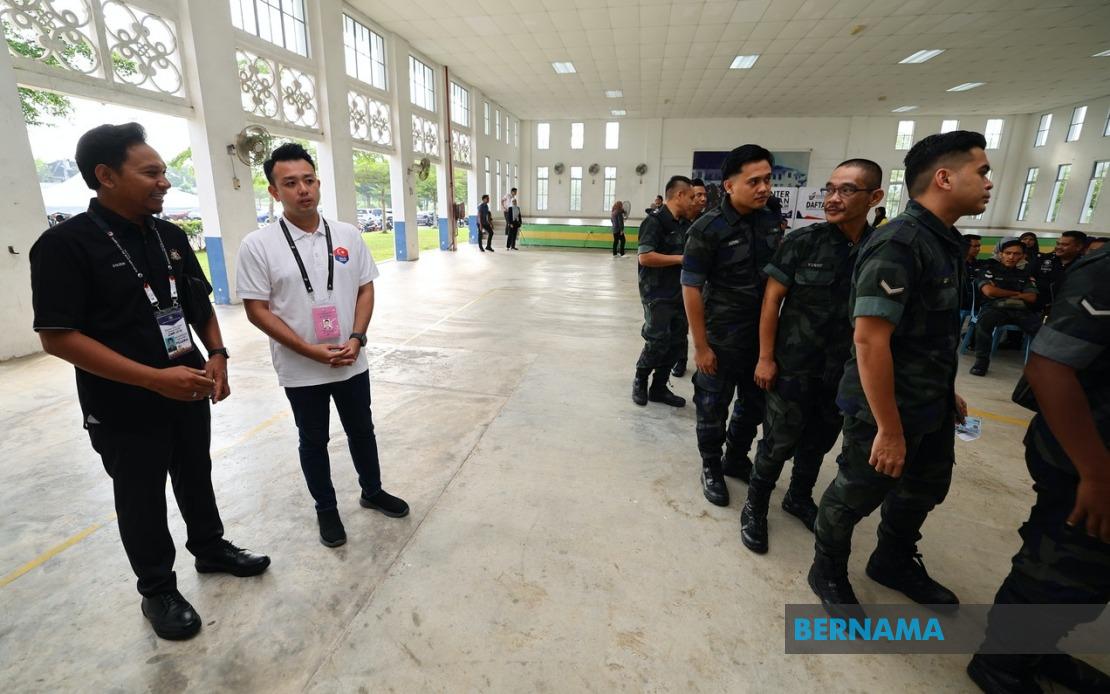
Candidates contesting the Johor state election paused their campaign efforts Thursday to witness the early voting arrangements for armed forces and police personnel, underscoring the transparency and electoral processes governing Malaysia's electoral system. The observations occurred across multiple polling stations in Johor ahead of Saturday's decisive poll, with representatives from all three major political coalitions present to ensure fairness and proper procedure. The engagement demonstrated how election observers maintain oversight throughout the voting period, a practice that bolsters public confidence in democratic processes even as intense campaigning continues.
At the 5th Battalion General Operations Force Camp in Simpang Renggam, the three contenders for the Layang-Layang seat gathered to watch the proceedings. Guna Balakrishnan representing Pakatan Harapan, Chua Jian Boon from Barisan Nasional, and Abd Mutalip Abd Rahim of Perikatan Nasional each attended, reflecting competitive but professional standards in Malaysian electoral culture. Similarly, the three candidates vying for Tenggaroh—Muhamad Amerul Muhamad of Perikatan Nasional, Mohd Youzaimi Yusof of Barisan Nasional, and Md Yusof Dawam of Pakatan Harapan—observed voting at Iskandar Camp in Mersing. These observations across multiple constituencies reveal how seriously candidates take electoral integrity, participating in the system's checks and balances.
Various senior candidates also made appearances at different polling stations. Lim Chin Eng, identified as the oldest candidate in the Johor contest and representing Perikatan Nasional, attended proceedings at the Johor Contingent Police Headquarters. Muhammad Faezuddin Mohd Puad, the Pakatan Harapan hopeful for Kempas, was present at Kempas Police Station, while Datuk Jafni Md Shukor of Barisan Nasional for Bukit Permai visited the Kulai District Police Headquarters. The widespread candidate participation suggests recognition that early voting—traditionally handled by military and law enforcement—requires transparent observation.
Beyond political representatives, Malaysia's security establishment maintained its own oversight role. Army Chief General Tan Sri Azhan Md Othman, together with 21st Special Service Group commander Major General Datuk Ahmad Shuhaimi Mat Wajab, visited Iskandar Camp in Mersing to monitor proceedings. Such high-level presence reflects institutional commitment to ensuring that service personnel can exercise voting rights without impediment or irregularity. The Johor police chief, Datuk Ab Rahaman Arsad, personally voted at Dewan Dato Onn at Johor IPK, demonstrating the inclusive nature of early voting arrangements where officers themselves participate in the democratic process.
The early voting system accommodates the unique circumstances facing Malaysia's military and law enforcement personnel, who cannot always vote on the designated polling day due to operational commitments. A total of 20,607 voters registered for early voting in Johor's 16th State Election, comprising 8,544 members of the Malaysian Armed Forces along with their spouses, and 12,063 police personnel with their families. This figure underscores the substantial portion of the electorate represented by security sector workers and highlights why transparent early voting protocols matter for legitimate electoral outcomes. The Malaysia-wide practice of advance polling for uniformed services ensures no citizen's franchise is compromised by duty rosters or deployment schedules.
The voting process itself demonstrated organisational competence despite challenging weather. Rain fell intermittently at several locations throughout the morning, yet presented no obstacles to the orderly flow of voters. Security personnel arrived in scheduled waves beginning at 8 am, adhering strictly to protocols established by Election Commission officials. The staged arrival system prevented congestion while maintaining security and confidentiality standards. Observers noted that despite weather conditions, voters proceeded methodically through the process, suggesting both strong civic commitment and effective administrative preparation by electoral authorities.
Sixty-four early voting centres opened their doors at 8 am, with staggered closing times between noon and 6 pm dependent upon location and registered voter volumes. This geographic distribution across Johor ensured personnel stationed throughout the state could access polling venues without excessive travel time. The operational choreography required coordination between Election Commission officers, venue hosts, and security force management—a logistical undertaking that proceeding smoothly indicated preparation quality. For candidates observing the process, such efficiency demonstrations become part of public narrative about electoral administration's reliability.
The Johor state election itself involves considerable stakes and complexity. A total of 172 candidates competed for 56 seats in the Johor State Legislative Assembly, meaning multiple contests in most constituencies generated the competitive atmosphere visible through candidate observations at early polling stations. The presence of rival candidates witnessing the same procedures creates mutual accountability—if irregularities occurred, multiple observers would notice and report them. This built-in verification mechanism represents an underappreciated safeguard within Malaysia's electoral framework, one that operates independently of any single authority's commitment to fairness.
For Malaysian voters and international observers alike, early voting transparency carries significance beyond administrative mechanics. The willing participation of political rivals in observing each other's constituencies reflects democratic norms taking root in electoral culture. Rather than viewing opponents' presence as threatening, candidates and their parties accept observation as legitimate. Such acceptance indicates confidence in underlying processes and demonstrates that Malaysian electoral competition occurs within consensual institutional frameworks. Whether voters ultimately support Pakatan Harapan's vision for reform, Barisan Nasional's continuity platform, or Perikatan Nasional's alternative, the process itself commands respect through transparent procedures.

