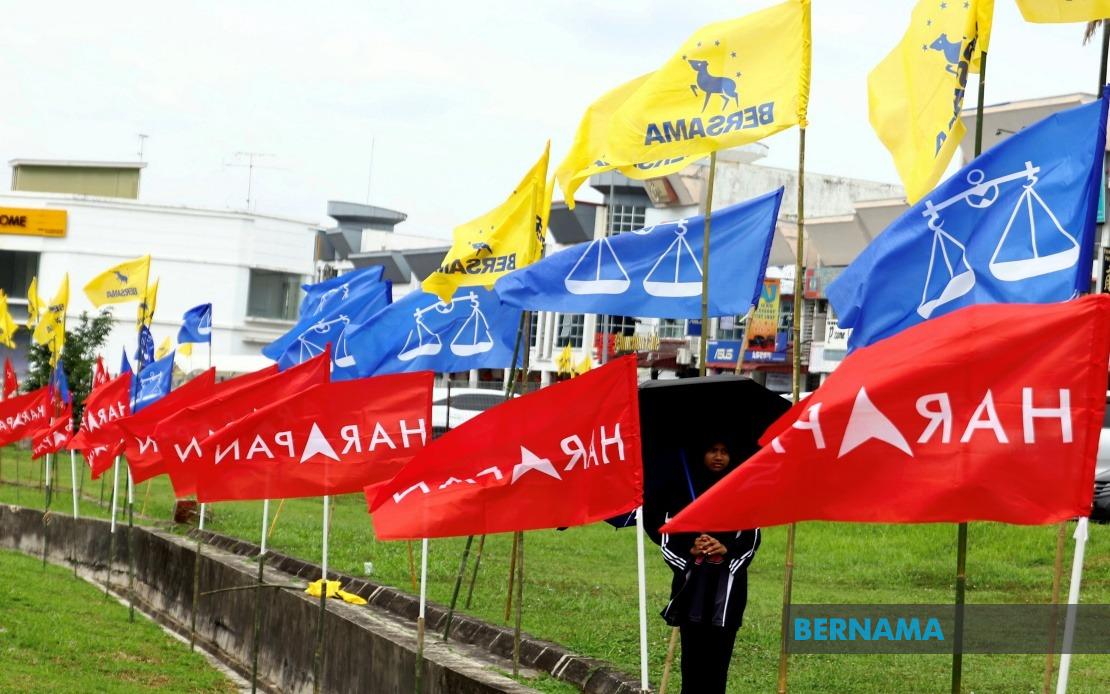
The 16th Johor state election reaches its climax tomorrow as polling stations open their doors to 2.7 million voters across the state. The two-week campaign concludes at 11.59 pm tonight, ending all canvassing activities and closing the window for political mobilisation. Voting will commence at 8 am at 1,076 polling centres, with the Election Commission anticipating full results as early as 10 pm, providing a relatively swift conclusion to the electoral process.
This election features 172 candidates vying for 56 state assembly seats, a notably smaller field than the 239 candidates who contested the previous state election. The reduction reflects refinements in party selection processes and clearer delineation of electoral territories. The major coalitions dominate the race, with Barisan Nasional and Pakatan Harapan each fielding 56 candidates. Perikatan Nasional presents 33 candidates, while smaller parties and independent candidates make up the remainder, creating a fragmented landscape that could prove decisive in closely contested seats.
The campaign itself crystallised around several persistent themes that have dominated Malaysian political discourse. Cost of living, economic recovery, employment generation and public welfare emerged as the primary battlegrounds where political parties sought voter endorsement. These issues transcend partisan divides, reflecting genuine concerns affecting households across Johor's diverse constituencies. Both major coalitions positioned themselves as better equipped to address these challenges, though their proposed solutions differed fundamentally in approach and implementation scope.
Early voting concluded last Tuesday, involving 20,607 members of the Malaysian Armed Forces, Royal Malaysia Police, General Operations Force and their spouses. This preliminary voting mechanism provides security and election personnel advance opportunity to cast ballots, ensuring that those with critical security responsibilities can participate without disruption to their duties. The early voting process historically serves as an initial indicator of sentiment among these institutionalised voter blocs, though its predictive value remains contested among analysts.
The campaign crescendo emerged last night when Prime Minister Datuk Seri Anwar Ibrahim, leading Pakatan Harapan, and Deputy Prime Minister Datuk Seri Dr Ahmad Zahid Hamidi, representing Barisan Nasional, both intensified their presence across the state. These high-profile deployments represent the federal establishment's investment in Johor's outcome, signalling the state's strategic importance to Malaysia's broader political equilibrium. The involvement of federal leadership amplifies the stakes beyond Johor's boundaries, positioning the state election as a referendum on the Unity Government's performance and legitimacy.
Political analysts have identified voter turnout as a critical variable that could reshape electoral outcomes. Dr Nazreena Mohammed Yasin from Universiti Tun Hussein Onn Malaysia emphasises that turnout effects vary considerably across constituencies and demographic segments. Higher participation in particular areas might advantage certain parties whilst having negligible impact elsewhere, making blanket generalisations problematic. The 2022 Johor state election recorded 54.92 per cent voter turnout, establishing a baseline against which tomorrow's participation will be measured. Turnout dynamics prove especially consequential in marginal constituencies where narrow victory margins mean individual votes carry disproportionate weight.
Fence-sitters and undecided voters represent another critical analytical lens. Despite two weeks of campaigning, voters who remain uncommitted until polling day could prove decisive in closely contested seats. Their last-minute choices, often driven by local considerations, candidate credibility or fresh developments, can overturn campaign momentum and polling projections. Political machinery effectiveness in mobilising supporters and managing polling operations assumes heightened importance in these competitive constituencies, where organisational competence translates directly into electoral advantage. Margin shifts compared to previous elections will additionally illuminate whether parties have consolidated or eroded support bases since the 2022 election.
Associate Professor Dr Mazlan Ali from Universiti Teknologi Malaysia observes that both Barisan Nasional and Pakatan Harapan have emphasised political stability as their central campaign narrative. This reflects their positioning within the federal Unity Government and their desire to frame the election within broader governance frameworks rather than narrow partisan contest. However, whilst various manifestos and pledges were presented, voter assessment increasingly focuses on parties' track records in government and their demonstrated capacity to deliver previous promises. Performance evaluations, candidate credibility, political stability maintenance and economic challenges addressability represent the multidimensional criteria through which voters evaluate competing options.
The current parliamentary configuration before assembly dissolution reflected significant fragmentation. Barisan Nasional previously held 40 seats, Pakatan Harapan 12, Perikatan Nasional three and MUDA one. This distribution granted Barisan Nasional commanding influence, though not absolute dominance, whilst smaller parties occupied meaningful positions within the legislative framework. The 56-seat assembly provides mathematics where coalition control represents genuine achievement rather than foregone conclusion, making each seat genuinely competitive and potentially consequential.
International observers and regional analysts are watching Johor closely as an indicator of electoral trends affecting Southeast Asian governance patterns. The state's economic importance as Malaysia's second-largest economy by gross domestic product makes governance outcomes material for regional economic stability and investment confidence. How voters respond to competing visions of development, social welfare provision and economic management could reverberate beyond Johor's borders, influencing strategic decisions by investors, neighbouring states and federal policymakers.
The analytical frameworks employed by observers differ substantially in their emphasis. Some prioritise demographic turnout patterns and organisational efficiency, others focus on policy delivery records and institutional credibility, whilst others still emphasise the stability narrative as paramount. These divergent analytical approaches reflect genuine complexity in predicting electoral outcomes in increasingly polarised, informationally fragmented political environments where traditional indicators prove less reliable.
As Johor voters prepare to exercise their democratic franchise, the convergence of domestic policy concerns, federal political dynamics and regional strategic interests creates an election whose significance extends well beyond state boundaries. The next five years of Johor governance will be shaped by tomorrow's decisions, influencing not merely state-level policy but contributing meaningfully to Malaysia's broader political equilibrium and economic trajectory through the latter half of this decade.

