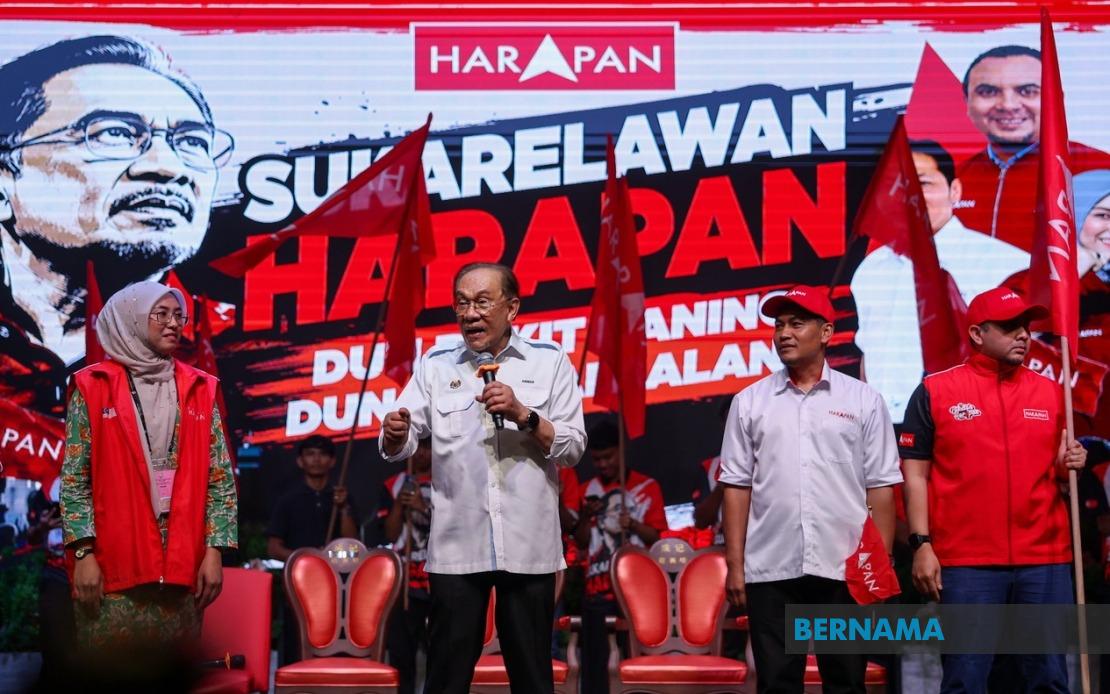
Prime Minister Datuk Seri Anwar Ibrahim has challenged young voters in Johor to break free from race-based political messaging and instead cast ballots for leaders who demonstrate genuine commitment to youth employment, educational advancement and regional development. Addressing crowds in Muar during the lead-up to the July 11 state election, Anwar positioned the contest as a critical moment for Malaysia's younger generation to seize agency over their own destinies rather than becoming passive recipients of inherited political divisions.
The message Anwar delivered carries particular weight given his dual role as Prime Minister and chairman of Pakatan Harapan, the ruling coalition contesting the Johor polls. His remarks signal an intentional pivot away from identity-based campaigning towards a competence-centred framework where leadership credentials are measured against tangible outcomes in the lives of ordinary citizens. This approach suggests a deliberate strategy to mobilise younger voters who may feel alienated by traditional Malaysian political discourse organised around ethnic and religious fault lines.
Anwar articulated his critique with considerable force, describing the peddling of racial fear as a corrupting influence that distracts ordinary citizens while enabling elites to pursue self-enrichment unopposed. He specifically identified three narratives he characterised as poisonous: stoking fear of the Chinese community, cultivating resentment towards Indians, and manufacturing conflict between Malays and Chinese. By naming these tactics directly, Anwar attempted to name the political dynamics that have historically dominated Malaysian electoral contests, particularly in states like Johor where coalition politics have often revolved around ethnic representation and zero-sum competition between communities.
The Prime Minister's assertion that such divisive politics no longer belong in an independent Malaysia represents a broader philosophical statement about the country's political maturity. His argument hinges on the premise that Malaysia's post-colonial trajectory should have moved beyond the need for racial mobilisation, and that continued reliance on such appeals represents a failure of political imagination by what he termed the "old guard." This framing carries implications for Southeast Asia more broadly, where neighbouring democracies including Thailand and Indonesia have similarly grappled with the tension between managing diversity through ethnic federalism versus building cross-cutting political coalitions around shared interests.
The turnout of youth volunteers at the Bukit Naning constituency programme appeared to validate Anwar's assessment of generational appetite for alternative political engagement. His expressed amazement at the youthful participation—contrasted against his more than decade-long experience campaigning—suggested both genuine surprise and an attempt to capture momentum for the coalition narrative. The presence of Pakatan Harapan candidates Nazri Abd Rahman and Md Ysahrudin Kusni alongside these youth mobilisation efforts underscored the coalition's investment in translating enthusiasm into electoral organisation at the grassroots level.
The structural context for Anwar's messaging involves a contest that is unusually competitive for Johor, historically a Barisan Nasional stronghold. With 172 candidates vying for 56 state assembly seats, the election represents a significant test of whether the ruling coalition can consolidate power beyond its peninsular strongholds. Early voting scheduled for July 7, preceding the main polling date by four days, introduces additional variables affecting voter turnout patterns and coalition strategies.
Anwar's invocation of Malaysia's multi-ethnic social peace as something requiring active political stewardship rather than something to take for granted carries particular resonance in the current moment. His reference to the country remaining peaceful despite political pressures subtly acknowledges the fragility of communal harmony and the responsibility that political leaders bear in either reinforcing or eroding it. This framing appeals to voters who may prioritise stability and social cohesion over more confrontational political approaches that exploit grievances.
The Prime Minister's challenge to young people to "not remain mere bystanders" functions as both a moral appeal and a strategic call for organised volunteer mobilisation. Rather than casting youth merely as voters to be persuaded, this rhetoric positions them as agents whose active participation in village-to-village and neighbourhood-by-neighbourhood campaigning constitutes the mechanism through which political change materialises. This grassroots emphasis reflects recognition that Malaysian electoral outcomes increasingly depend on ground-level organising rather than traditional media or top-down party machinery.
Anwar's repeated emphasis on the intersection of economic concerns and political choice—education, employment and development opportunities—acknowledges that youth political orientation in Malaysia increasingly turns on material considerations rather than inherited partisan or communal loyalties. Young voters entering a labour market facing skills mismatches, wage stagnation and limited opportunities in certain sectors may be more responsive to arguments about economic competence than to appeals rooted in historical grievances or ethnic representation.
The campaign setting in Johor gains added significance given the state's economic importance as a manufacturing and logistics hub for the broader region. Development trajectories in Johor influence not only state-level outcomes but also regional dynamics affecting cross-border trade and investment patterns that Malaysian and Singaporean businesses carefully monitor. Electoral choices about which parties govern Johor therefore carry implications extending beyond Malaysian borders.
Anwar's consistent return to the theme of inclusion and mutual respect across communal lines, framed explicitly as an optimistic vision of Malaysia's future rather than a defensive accommodation of diversity, attempts to reposition multiethnic coexistence as an asset generating shared prosperity rather than as a constraint limiting any group's advancement. This rhetorical move inverts traditional identity-based political logic where one community's gain is implicitly framed as another's loss.
Looking forward to July 11, the electoral test will reveal whether such messaging can effectively compete against more traditional appeals to communal identity and grievance. The degree to which younger voters, in particular, respond to Anwar's framework offers important signals about whether Malaysian political competition is genuinely shifting towards merit and performance-based differentiation or whether racial and religious considerations retain their historical salience in shaping electoral behaviour even among newer voters.

