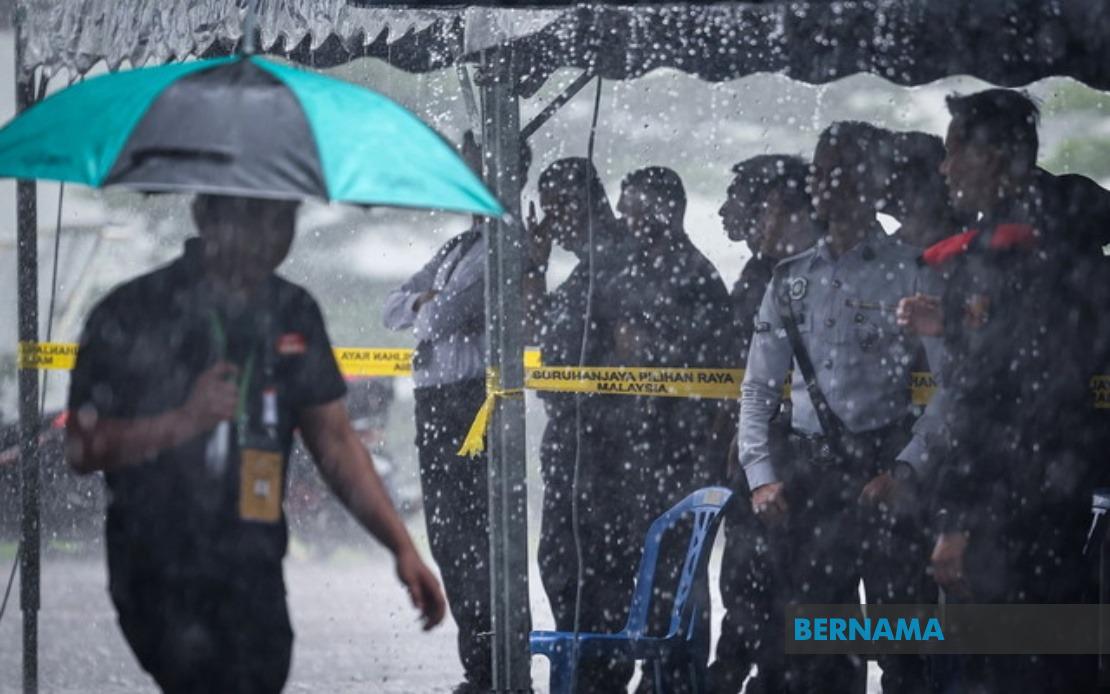
The 16th Johor state election got underway with its early voting phase on July 7, with law enforcement personnel casting their ballots at the State Police Contingent Headquarters in Johor Bahru. A significant downpour that began around 9.40 am posed a temporary challenge to proceedings, yet the voting process continued uninterrupted throughout the morning, demonstrating the resilience of electoral logistics in the state.
While heavy rainfall typically presents logistical hurdles for large-scale voting operations, police officers arriving at the polling centre simply adjusted their movements, hastening through the rain to complete their constitutional duties. The scene reflected the disciplined approach typical of law enforcement personnel navigating adverse weather conditions, and observers noted that the downpour did not create queues or bottlenecks that might have delayed the process.
Mounting evidence throughout the morning indicated sustained participation despite atmospheric challenges. A continuous flow of officers and personnel arrived sequentially to participate in voting, suggesting that despite the inclement weather, there was no reluctance among the force to engage in the early voting opportunity. The sight of voting booths operating at normal capacity underscored the commitment to maintaining electoral timelines regardless of environmental obstacles.
Media representatives covering the electoral activities were forced to seek refuge under temporary shelters as they monitored the proceedings, creating an additional layer of logistical coordination at the venue. Their presence highlighted the significance attributed to this phase of the election cycle, even before the main polling day commenced, reflecting public and institutional interest in tracking the integrity and efficiency of the voting process across all demographic segments.
The police contingent's early voting participation was substantial in scope. Approximately 12,067 police personnel and their eligible spouses exercised their right to vote in person at designated polling centres throughout July 7, while an additional 643 opted for postal voting arrangements. This combined figure of nearly 12,700 law enforcement-related voters underscores the significant electoral weight of the security sector within Johor's broader voting population, a consideration that election planners must account for when structuring voting modalities and timelines.
Johor's 16th state election represents a substantial democratic exercise extending well beyond the early voting phase. The election features 172 candidates competing across 56 state assembly seats, a configuration that will ultimately be determined by the larger voting public. This breadth of contestation indicates a competitive political landscape with multiple perspectives and interests seeking representation at the state legislative level.
The main polling day scheduled for Saturday will involve participation from more than 2.7 million ordinary voters across the state, making it a comprehensive exercise in democratic participation. This figure dwarfs even the combined early voting figures and underscores the magnitude of logistical coordination required to manage the polling process across multiple venues, constituencies, and geographic regions throughout Johor. The state's electoral machinery must therefore function seamlessly across a prolonged timeframe to accommodate this substantial voter base.
For Malaysian readers, the Johor election carries particular significance given the state's political importance within the federation. As one of the most populous states and a traditional stronghold of political influence, developments in Johor electoral politics often reverberate across national political discourse and coalition-building at the federal level. The conduct and outcomes of this election may therefore influence broader political alignments and governance structures affecting the wider Southeast Asian region.
The successful navigation of early voting procedures in challenging weather conditions provides encouraging indicators regarding the state's electoral preparedness for the main polling day. Election observers and administrators will have drawn valuable lessons from how polling centres, security personnel, and voters responded to logistical pressures, information that can be integrated into final preparations for Saturday's main exercise. Such operational learning is essential in maintaining electoral credibility and public confidence in democratic processes.
The decision to conduct early voting for police personnel reflects recognition of the sector's operational demands and scheduling constraints that might otherwise impede participation. This institutional accommodation demonstrates how electoral systems can maintain inclusivity while respecting the professional obligations of essential services personnel. The model followed in Johor may serve as a template for other states considering similar arrangements to enhance participation among uniformed services and other groups with irregular work schedules.
Weather-related challenges to electoral processes are a recurring concern in Southeast Asia's tropical climate, where monsoons and sudden downpours are seasonal phenomena. Johor's management of the July 7 rainfall provides pragmatic evidence that well-designed polling infrastructure and trained personnel can maintain voting integrity despite atmospheric obstacles. This adaptability will be particularly relevant for Saturday's main polling day, when weather patterns may again present challenges to a vastly larger voting population spread across the state.

