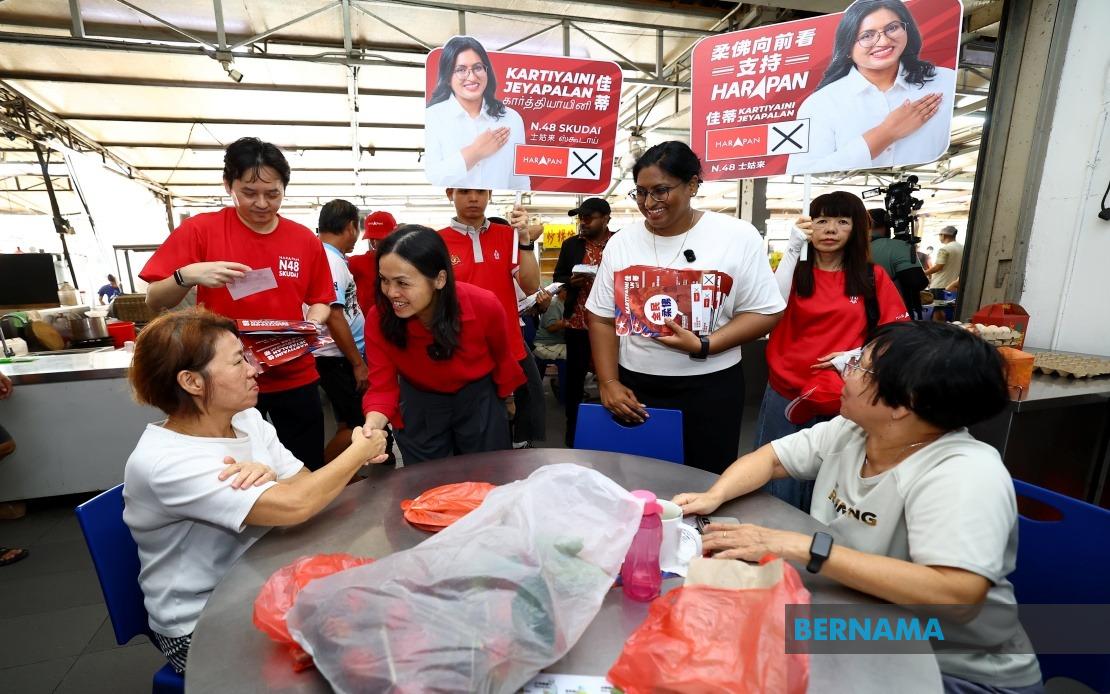
Johor DAP chairman Teo Nie Ching has made an impassioned appeal to voters ahead of Saturday's state election, particularly targeting those who have temporarily relocated to other parts of Malaysia or abroad. Speaking in Johor Bahru on July 9, Teo—who doubles as Deputy Communications Minister—emphasised that exercising the right to vote represents a fundamental democratic privilege that should not be taken lightly. Her message came as the campaign entered its final stretch before polling day, with 2.7 million registered voters preparing to select 56 state assembly representatives across 16 constituencies.
Central to Teo's appeal was a series of compelling narratives illustrating the lengths to which overseas Malaysians were willing to go to ensure their voices were heard. She highlighted the story of a voter in Queensland, Australia, who had resorted to waiting at the airport in hopes of finding someone willing to hand-carry his postal ballot back to Malaysia after courier services proved unable to guarantee timely delivery by the July 11 deadline. These accounts, Teo suggested, should serve as a powerful reminder to voters based in nearby cities that voting demands far less sacrifice. A master's student studying in China had reportedly rebooked a flight at additional personal expense exceeding RM1,000 to return home for the election, while a voter in the United States had undertaken significant effort to locate a Malaysian citizen capable of witnessing the postal voting procedure. Such dedication, Teo asserted, reflected a profound understanding of voting's significance that domestic voters ought to emulate.
The appeal was particularly directed at Malaysians working in Kuala Lumpur and Singapore, where significant portions of Johor's workforce have relocated in search of employment opportunities. Teo appealed to this constituency to mirror the commitment demonstrated by their overseas counterparts, arguing that a single vote carried the same weight regardless of whether cast by someone returning from another state or from halfway across the world. This framing sought to reframe voting not as a routine civic duty but as a valuable democratic entitlement that merited personal inconvenience and effort.
Teo made her remarks following a community engagement session in Kampung Baru Skudai alongside Kartiyaini Jeyapalan, the Pakatan Harapan candidate contesting the Skudai state seat. The meeting was part of broader grassroots campaign activities aimed at reconnecting with voters in the final days before the election. For Teo and the DAP, mobilising voter turnout represents a critical element of their electoral strategy, particularly given Johor's historical significance as a competitive battleground in Malaysian politics.
Beyond the mobilisation message, Teo sounded a stern warning about the proliferation of false information during the campaign period. She cautioned the public against the deliberate creation of fake social media accounts and fabricated news stories designed to mislead voters at precisely the moment when electoral decision-making was occurring. The spread of misinformation, Teo warned, posed a tangible threat to the integrity of democratic processes and could distort voters' understanding of the issues and candidates they were evaluating.
Teo advocated for enhanced digital literacy among Malaysian voters, promoting what she termed a 'verify before you share' cultural norm. She acknowledged that while the internet's capacity to rapidly disseminate information represented an advancement for democratic communication, this same infrastructure facilitated the equally rapid spread of falsehoods. Her message essentially encouraged voters to exercise critical thinking before amplifying content through their own networks, recognising that well-intentioned sharing of unverified claims could inadvertently contribute to an information ecosystem poisoned by falsehood.
The emphasis on combating misinformation reflected broader concerns within Malaysia's political landscape about the influence of false narratives on electoral outcomes. State elections, which determine local governance and development priorities, have become increasingly vulnerable to coordinated disinformation campaigns in recent years. By explicitly raising this issue days before voters went to the polls, Teo sought to inoculate the electorate against manipulation while simultaneously elevating awareness of the election's importance.
Kartiyaini reinforced this mobilisation effort by emphasising that Pakatan Harapan's campaign machinery was intensifying outreach specifically targeting the substantial population of Johor workers employed in Singapore. She stressed that the campaign extended beyond mere logistical encouragement to return home, aiming instead to cultivate awareness of the state election's significance in shaping Johor's development trajectory over the coming years. The distinction Kartiyaini drew between state and general elections represented an attempt to counter perceptions that state-level contests merit less voter attention than federal parliamentary elections.
To translate this messaging into action, Kartiyaini and other Pakatan Harapan leaders positioned themselves at the Sultan Iskandar Building Customs, Immigration and Quarantine Complex at 5 am on the day of her remarks, deliberately timing their appearance to coincide with peak cross-border commuter traffic. This early mobilisation strategy sought to catch workers heading to Singapore before their workday commenced, presenting an opportune moment for direct voter engagement. Additionally, PH volunteers reportedly boarded buses transporting workers across the causeway, leveraging confined spaces to deliver their campaign message to a captive, relevant audience.
Kartiyaini reported that the response from cross-border workers had been overwhelmingly positive, suggesting receptiveness to the campaign's call for voter participation. She expressed confidence that the campaign momentum observed during these ground-level interactions would ultimately translate into increased turnout at the ballot box, though she acknowledged that such electoral predictions carry inherent uncertainty.
The 16th Johor state election represented a significant political moment in Malaysia's electoral calendar, with implications extending beyond the state's borders. As a large, economically important state with considerable cross-border movement and a diverse electorate, Johor's electoral outcome could influence broader national political dynamics. The campaign's focus on voter turnout among migrant workers illustrated how contemporary elections operate across geographical boundaries, requiring political parties to develop strategies addressing voters' complex mobility patterns and competing demands on their time.
For Malaysian readers considering the implications of this campaign, the emphasis on voting accessibility and the fight against misinformation speaks to evolving challenges facing Southeast Asian democracies. As nations across the region grapple with digital-era information warfare and increasingly mobile populations, the frameworks developed by Malaysian political actors may offer instructive lessons. The Johor election thus transcended its immediate local significance, serving as a microcosm of broader democratic concerns resonating throughout the region.

