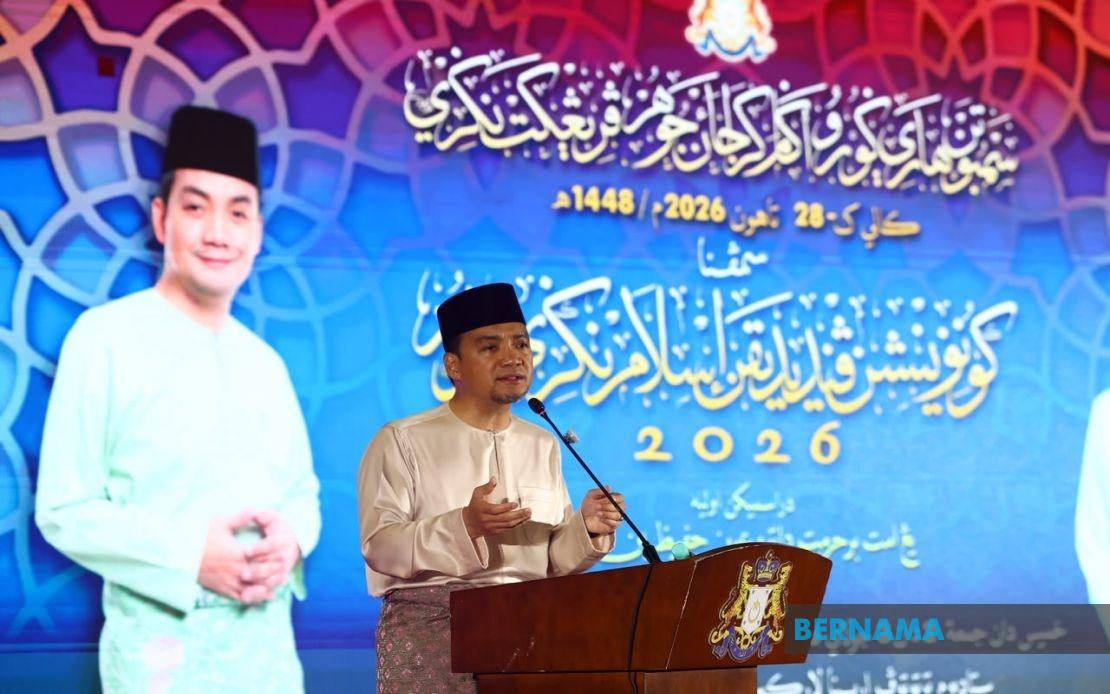
Johor's education transformation agenda has entered a new phase with the government's decision to bring its acclaimed school improvement framework into the religious education sector. At the 28th Johor Government Religious Teachers' Day celebration held at Arena Larkin Indoor Stadium, Menteri Besar Datuk Onn Hafiz Ghazi announced that the state would establish the first Sekolah Agama Rintis Bangsa Johor (SARBJ) this year, marking a significant expansion of the Sekolah Rintis Bangsa Johor (SRBJ) initiative beyond conventional schools into faith-based institutions.
The SRBJ framework, which originated as a strategic vision of Johor's Regent, Tunku Mahkota Ismail, has already demonstrated measurable impact across the state's conventional school system. Four pilot schools now operate under the programme—two primary and two secondary institutions positioned across key locations. Sekolah Kebangsaan Seri Kota Puteri 4 and Sekolah Menengah Kebangsaan Seri Kota Puteri 2, both situated in Pasir Gudang, serve as primary education anchors, while Sekolah Kebangsaan Tasek Utara and Sekolah Menengah Kebangsaan Tasek Utara in Johor Bahru provide secondary benchmarks for the model's effectiveness.
The extension to religious education represents a deliberate attempt to ensure that faith-based schooling benefits from the same comprehensive modernisation standards being applied elsewhere. Rather than treating religious schools as separate from broader educational reform, Johor's leadership has recognised that Islamic institutions serve a crucial role in shaping values and competencies among younger generations. By creating parallel pilot structures within the religious education system, the state government signals commitment to raising standards uniformly across all educational pathways available to students.
State Islamic Religious Affairs Committee chairman Mohd Fared Mohd Khalid confirmed that the government had greenlit construction of the inaugural SARBJ facility in Kota Iskandar, the administrative heart of Johor's development agenda. This location choice underscores the state's intention to position religious education reform at the centre of its broader governance vision, rather than treating it as peripheral to mainstream policy concerns. The timing aligns with Johor's multi-year development strategy and reflects confidence in the pilot model's ability to deliver results within the religious education domain.
The SRBJ methodology itself rests on five interconnected pillars designed to produce holistically developed graduates equipped for contemporary challenges. Digital learning capabilities form the foundation, ensuring students engage with technology as both tool and subject of critical analysis rather than passive consumers of digital content. Multilingual proficiency stands as a second pillar, recognising that Malaysia's regional position and economic integration demand graduates capable of navigating multiple linguistic and cultural contexts with confidence. Character development constitutes the third element, addressing concerns that purely academic achievement may mask deficiencies in ethical reasoning and social responsibility.
Teacher empowerment represents the fourth dimension, reflecting growing recognition that sustainable educational improvement depends fundamentally on investing in educators themselves rather than assuming existing capacity can be stretched indefinitely. The fifth pillar emphasises providing world-class physical infrastructure and learning resources, acknowledging that pedagogical excellence cannot flourish in environments marked by inadequate facilities or outdated equipment. Together, these five components create a comprehensive framework applicable across different school types and governance structures.
For religious schools specifically, incorporating this framework presents particular opportunities and considerations. Islamic education institutions traditionally emphasise moral and spiritual development alongside academic learning, creating natural alignment with the character development pillar. However, integrating digital learning and multilingual competencies requires thoughtful adaptation to ensure religious content remains central rather than marginalised within expanded curricula. The SARBJ model must therefore balance innovation with preservation of the distinctive identity and mission that religious schools serve within Malaysia's plural education ecosystem.
Johor's approach carries implications extending beyond the state's borders. Religious schools operate across Southeast Asia within diverse governance contexts, yet face broadly similar pressures to modernise while maintaining pedagogical distinctiveness. As Malaysia's second-largest state and a significant economic centre, Johor's experiments with religious school transformation may inform policy discussions in other states grappling with similar tensions between tradition and adaptation. If the SARBJ demonstrates that religious institutions can embrace comprehensive modernisation without compromising their foundational purpose, this could reshape assumptions about what is possible within faith-based education.
The Menteri Besar's announcement that pilot kindergartens would follow the school expansion suggests the government envisions this initiative as spanning the entire educational trajectory from early childhood through secondary completion. This longitudinal approach, if successfully implemented, could create pipeline effects where graduates of SRBJ primary schools feed naturally into SRBJ secondary institutions, and eventually into religious schools operating under similar modernisation principles. Such structural coherence would represent a significant departure from the fragmented, institutional approach that typically characterises education reform efforts.
Immediate implementation timelines remain somewhat undefined, though construction approval for the Kota Iskandar facility suggests that physical infrastructure development could commence within the current fiscal year. The Johor government will need to address recruitment and training of educators committed to the SARBJ model, potential curriculum revisions reflecting both religious education requirements and the five core SRBJ pillars, and measurement frameworks capable of tracking outcomes across the expanded approach. These logistical and pedagogical challenges should not be underestimated, particularly given the specialised knowledge demands of religious education instruction.
The investment Johor is making in this expanded framework reflects broader regional trends toward comprehensive education system review and modernisation. Neighbouring states and other Southeast Asian jurisdictions closely monitor such initiatives, particularly when they address education's intersection with religious and cultural identity. Should the SARBJ model prove effective in producing graduates who demonstrate both strong Islamic understanding and contemporary competencies across digital, linguistic, and character dimensions, demand for replication could accelerate across Malaysia's religious education sector.

