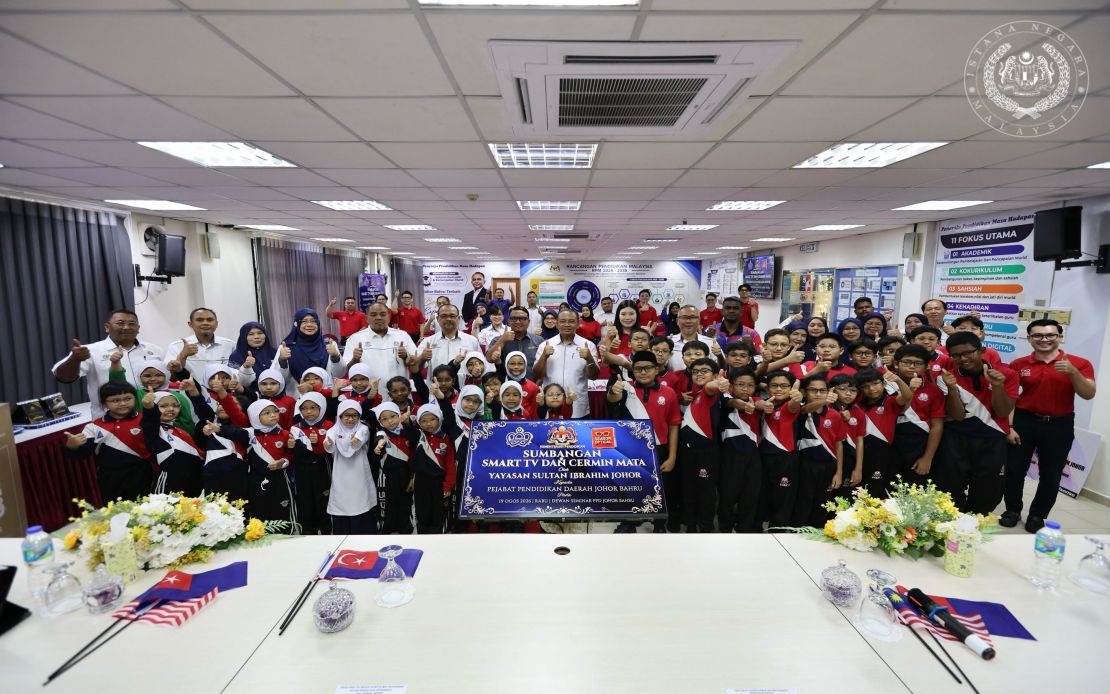
The Yayasan Sultan Ibrahim Johor (YSIJ) has reinforced its commitment to educational advancement and pupil welfare by delivering substantial assistance to institutions under the Johor Bahru District Education Office. The initiative, announced through Sultan Ibrahim Sultan Iskandar's social media channels, encompasses the provision of ten 75-inch smart televisions alongside 2,000 pairs of spectacles to eligible schools and low-income households classified as B40 across twenty educational establishments in the district.
The smart television donations represent a targeted investment in classroom infrastructure modernisation. By supplying large-format display technology to ten schools, the foundation seeks to facilitate the transition towards digital-first instruction methods. This aligns with Malaysia's broader push to integrate technology into pedagogical practice, particularly as educational institutions nationwide enhance their capacity to deliver multimedia content and interactive learning experiences. The devices support educators in presenting complex concepts through visual media, a proven methodology for improving student comprehension and engagement.
Complementing the hardware provisions, the spectacles distribution programme addresses a frequently overlooked barrier to academic performance. Vision impairment remains an undiagnosed condition affecting substantial numbers of Malaysian schoolchildren, particularly those from economically disadvantaged backgrounds who lack the financial resources for optical examination and corrective lenses. The B40 demographic targeted in this initiative often cannot afford preventive healthcare services, creating a compounding disadvantage whereby undiagnosed refractive errors impede classroom learning before education officials and parents recognise the underlying cause.
Central to the programme's innovation is the deployment of Columba Vision Screener technology, a device donated by the King of Malaysia. This automated eye-scanning apparatus constitutes a significant advancement in school-based vision screening procedures. Capable of delivering preliminary vision assessments within ten seconds per student, the technology dramatically reduces the time required for comprehensive optical evaluation. This efficiency gains particular importance in the Malaysian context, where education districts operate under resource constraints that limit access to professional optometrists during school hours.
The spectacles themselves reflect a commitment to durability and practicality suited to the student population. Rather than providing minimal-quality frames unsuitable for daily school wear, the partnership with Season Optical ensures that distributed eyewear meets standards for comfort, aesthetic appeal to young wearers, and longevity. This consideration recognises that spectacles provided through institutional programmes must withstand the wear patterns of active schoolchildren while maintaining optical effectiveness over extended use periods. Poor-quality provision risks abandonment by recipients, thereby nullifying the intended benefit.
The strategic partnership with Season Optical, a private optical retailer, represents an interesting model of public-private collaboration in social service delivery. Rather than attempting to provide all components through government or foundation resources alone, the arrangement leverages commercial expertise and supply chains. Season Optical managing director Sally Loh's participation in the handover ceremony underscores institutional investment in programme success. This collaborative approach has become increasingly prevalent in Malaysian social initiatives, recognising that private sector entities frequently possess specialised capabilities and distribution networks advantageous for reaching dispersed rural and urban communities.
The ceremony formalising the donation transfer involved multiple layers of education administration. YSIJ senior manager Shah Reza Md Kanafe presented materials to officials representing both state and district levels, specifically the Johor Education Department's Student Development Sector and the Johor Bahru District Education Office leadership. This multi-tiered administrative involvement ensures that distribution protocols follow established channels and that institutional accountability mechanisms remain intact throughout the implementation process.
For Malaysian readers, this initiative carries particular significance given the ongoing discourse surrounding educational equity and resource allocation. Malaysia's education system, whilst performing competitively at regional benchmarks, experiences notable disparities in infrastructure quality between well-funded urban schools and under-resourced facilities in rural areas. Targeted foundation assistance helps narrow these gaps, though such interventions necessarily remain limited compared to systematic government investment. The vision screening component additionally highlights preventive healthcare's role in educational attainment—an intersection frequently overlooked in policy discussions that segregate health and education portfolios.
The Johor context amplifies the initiative's relevance. As Malaysia's southernmost state experiencing rapid urbanisation whilst maintaining substantial rural populations, Johor contains communities with considerable socioeconomic diversity. The B40-targeted approach acknowledges this heterogeneity, directing resources toward the most economically vulnerable households that state resources alone may not reach through standard programmes. The programme demonstrates how state-level foundations, backed by royal patronage and institutional credibility, can mobilise both public sector cooperation and private sector participation to address welfare gaps.
Moreover, the technological dimension reflects evolving expectations regarding educational standards. While Malaysian schools increasingly integrate digital tools, provision remains uneven. Foundation donations of this scale and specificity help accelerate the technological transition, though they cannot substitute for comprehensive government planning. The inclusion of advanced screening technology similarly signals expectations that contemporary educational institutions should incorporate cutting-edge diagnostic tools, positioning Malaysian schools within international best-practice frameworks.
Looking forward, the success of this initiative will likely influence future philanthropic interventions in Malaysian education. Should tracking mechanisms demonstrate measurable improvements in academic outcomes or attendance rates correlating with the provision of spectacles, the model may encourage expanded vision screening and optical assistance programmes. Similarly, data on whether smart television deployment genuinely enhances learning outcomes could inform technology donation strategies across foundation networks supporting Malaysian schools.

