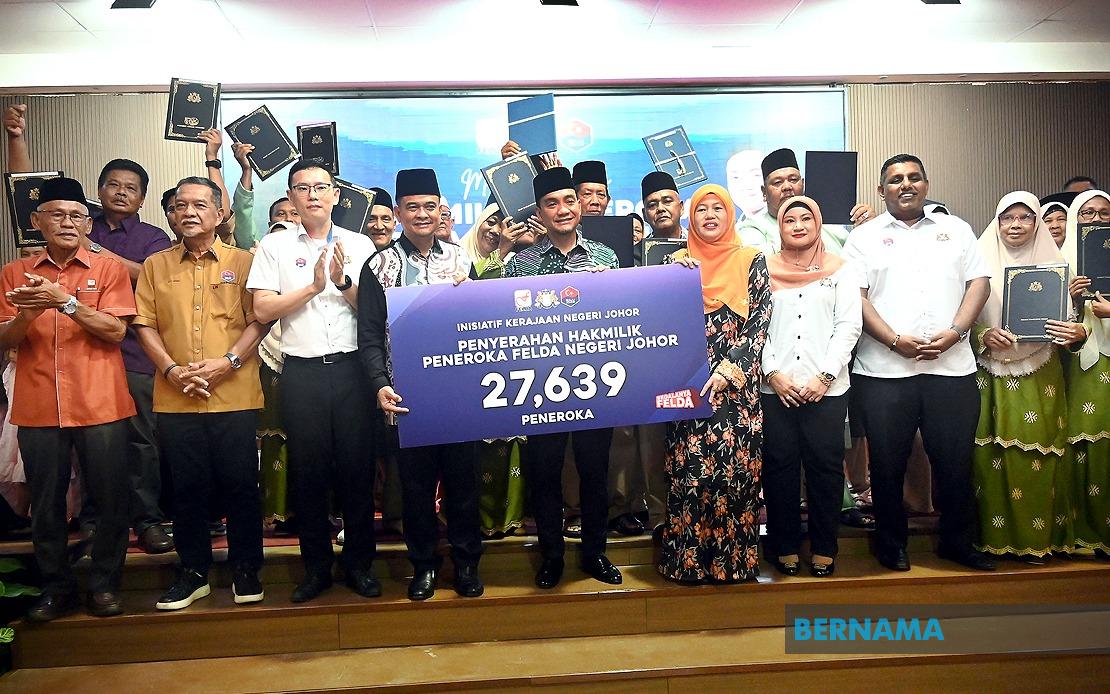
The Johor government has substantially concluded a decades-old property ownership dispute that has affected thousands of Federal Land Development Authority (FELDA) settlers throughout the state. State Menteri Besar Datuk Onn Hafiz Ghazi announced the achievement at a ceremony in Kluang on June 23, where 210 settlers formally received their long-awaited land titles, marking a symbolic conclusion to administrative hurdles that have plagued rural communities for generations.
The resolution encompasses an overwhelming majority of outstanding cases, with authorities confirming that 27,639 applications out of 27,642 have been successfully processed and approved. This 99.99 per cent completion rate represents the culmination of systematic administrative work undertaken by the state government, addressing grievances that have festered within FELDA settlements across Kluang, Kota Tinggi, and Mersing. The three districts receiving certificates during the ceremony represent the tail end of a comprehensive clearing operation that has touched virtually every affected household.
For Malaysian readers familiar with rural land administration, this resolution carries substantial weight. FELDA settlers, who form the backbone of Malaysia's agricultural sector and represent a significant voting constituency, have historically faced bureaucratic delays in securing formal ownership documentation. These land titles represent far more than paperwork—they constitute collateral for loans, inheritance security, and proof of legitimate occupancy that determines access to developmental initiatives. The near-complete resolution of this backlog therefore addresses a fundamental economic grievance affecting rural livelihoods across Johor's agricultural heartland.
Menteri Besar Onn Hafiz Ghazi framed the initiative as central to the state government's broader rural development philosophy, emphasizing that resolving land ownership security forms the foundation for sustainable community development. His remarks indicate that property title uncertainty has been treated as a systemic impediment to rural progress, not merely an administrative inconvenience. By prioritizing FELDA settlements as a governance focus, the state administration acknowledges that smallholder farmers require stable property rights to participate effectively in modern agricultural markets and access developmental credit.
The practical implications extend beyond individual settlers. Secure land titles enable FELDA communities to leverage their assets for business expansion, provide collateral for crop financing schemes, and facilitate smoother intergenerational property transfers. In the context of Southeast Asia's agricultural modernization, where smallholder productivity increasingly depends on access to formal credit markets, this administrative resolution removes a critical barrier to rural economic advancement. Malaysian financial institutions have long cited unclear land tenure as a constraint in expanding agricultural lending to smallholders, a concern now substantially mitigated across Johor's FELDA zones.
The ceremony's emphasis on three specific districts reflects the geographic concentration of FELDA settlements in southern Johor, where plantation agriculture remains economically significant. Kluang, Kota Tinggi, and Mersing represent zones where colonial-era land schemes were extensively developed, meaning cumulative title processing had accumulated considerable backlogs. By targeting these localities for ceremonial presentation, the state government was able to provide visible, concentrated evidence of administrative completion, generating local impact that demonstrates governance responsiveness to rural constituencies.
Johor Agriculture, Agro-based Industry and Rural Development Committee chairman Datuk Zahari Sarip's attendance underscores the institutional coordination required to achieve such comprehensive administrative outcomes. Land title resolution typically involves coordination across multiple agencies—survey departments, land registries, FELDA administrative structures, and state government revenue offices. The presence of specialized committee leadership suggests this achievement required sustained bureaucratic coordination and resource allocation dedicated specifically to processing accumulated cases.
For Malaysian policymakers evaluating administrative efficiency, this outcome provides a instructive case study in how systematic attention to rural grievances can generate measurable results. The 99.99 per cent resolution rate demonstrates that even long-standing property disputes affecting thousands of individuals can be substantially eliminated through dedicated governmental effort and institutional coordination. This proves particularly relevant for states managing inherited colonial land systems and multiple overlapping jurisdictional claims common across Malaysian territory.
The unresolved 0.01 per cent of applications—representing approximately three cases—likely involve complications requiring individual legal investigation or settlement. Such residual cases typically stem from disputed claims, deceased applicants, or boundary discrepancies that demand specialized resolution rather than standardized processing. Their small proportion indicates that most straightforward cases have been successfully concluded, with only genuinely complex matters remaining in the administrative pipeline.
Beyond immediate settlement benefits, this resolution carries political significance for Johor's governance narrative. FELDA communities represent an established, organized constituency with longstanding expectations for government responsiveness. Delivering tangible resolution of a persistent grievance reinforces governmental credibility among rural voters and demonstrates that institutional attention can translate inherited disputes into concrete outcomes. In Malaysia's federal context, where state governments compete for voter confidence, such visible administrative achievements in rural areas carry substantial political weight.
Looking forward, the Johor administration's commitment to treating FELDA settlements as a priority governance focus suggests sustained attention to rural constituencies beyond this initial resolution. The announcement that emerging issues will continue receiving immediate attention indicates a shift toward proactive rather than reactive rural administration, potentially preventing accumulation of future grievances. This approach reflects evolving expectations that state governments should maintain dedicated mechanisms for addressing smallholder concerns rather than allowing disputes to accumulate across decades.
The resolution also carries implications for other Malaysian states managing comparable FELDA settlements and rural land disputes. Johor's demonstration that comprehensive title processing is administratively achievable provides a potential template for neighbouring states facing similar backlogs. As Malaysia continues rural modernization and seeks to integrate smallholder farmers more fully into formal credit markets, clearing property title uncertainties represents a prerequisite for broader economic objectives. Johor's achievement, therefore, extends beyond state boundaries as evidence that systematic governmental attention can effectively resolve even deeply embedded rural administrative challenges.