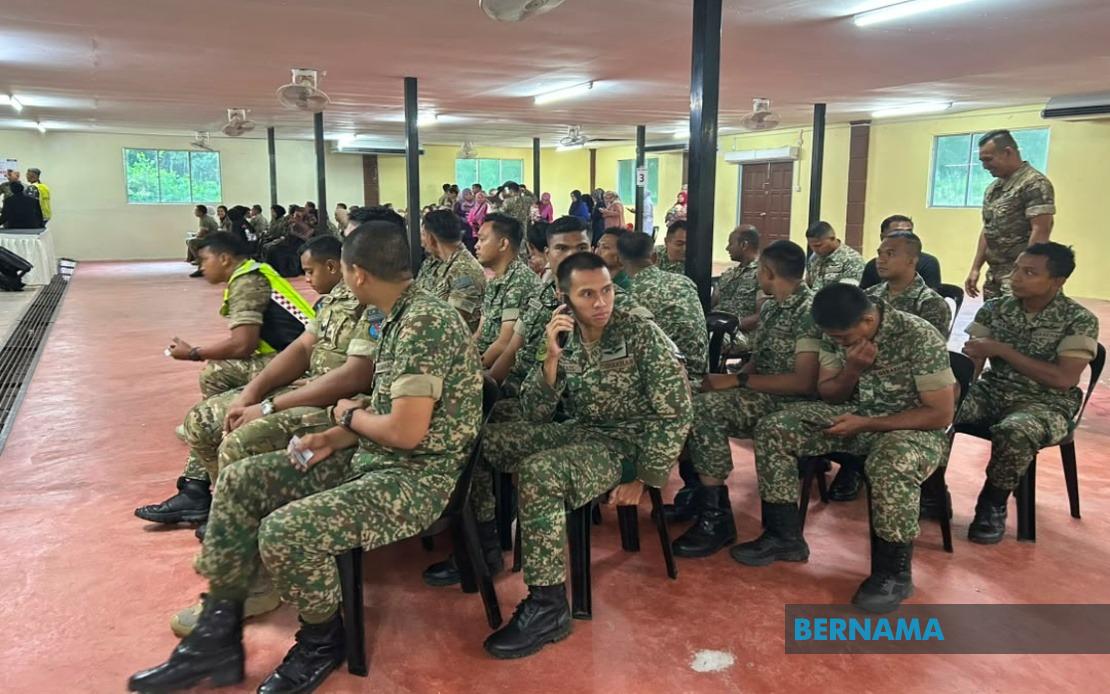
Security personnel participating in the early voting phase of Johor's 16th state election have received appeals from top government figures to approach the ballot box with civic consciousness and respect for democratic principles. The messages from Home Minister Datuk Seri Saifuddin Nasution Ismail and Defence Minister Datuk Seri Mohamed Khaled Nordin underscore the significance placed on the participation of military and police personnel, who comprise the bulk of early voters in this electoral cycle.
Saifuddin Nasution, who additionally serves as secretary-general of Pakatan Harapan, directed his message toward the 24,751 eligible early voters assembled across the state. In an address shared through social media, he encouraged all participants to exercise their voting rights while maintaining a steadfast commitment to democratic values. Beyond the immediate call to vote, Saifuddin Nasution tasked the broader PH campaign machinery with sustaining momentum through to the conclusion of the campaign period, emphasising sustained grassroots engagement and mature conduct throughout the electoral process.
Mohammed Khaled, speaking from his ministerial position, contextualised the voting act within Johor's broader development trajectory. He framed the early voting exercise as an opportunity for security personnel to reaffirm their commitment to the state's continued progression, linking individual electoral participation to collective state-level advancement. This messaging strategy connects personal civic duty to tangible outcomes for Johor's future governance and development agenda.
Meanwhile, Johor's Menteri Besar Datuk Onn Hafiz Ghazi deployed a different rhetorical approach, appealing to early voters to place confidence in Barisan Nasional candidates across all 56 contested seats. Onn Hafiz articulated BN's platform around stability, development initiatives, and public welfare considerations, positioning the coalition's electoral success as essential to sustaining these priorities in the state.
The administrative machinery for early voting demonstrated significant scale and coordination. Across 64 designated voting centres, military personnel and their spouses numbering 12,041, alongside 12,710 police officers and their families, proceeded through staggered polling operations. The centres commenced operations at 8 am, with staged closures occurring between noon and 6 pm to accommodate varying voter concentrations at different locations. This logistical arrangement reflects the challenge of managing electoral participation among geographically dispersed security force members while maintaining operational readiness.
The early voting window provided security personnel an opportunity to participate outside the main polling schedule, accommodating their professional commitments and operational duties. For Malaysia's armed forces and police personnel, who frequently maintain demanding schedules and may face deployment uncertainties, early voting mechanisms ensure their electoral voice remains audible in state-level decision-making. This administrative accommodation recognises the practical constraints faced by those in uniform while preserving their democratic participation rights.
Pakatan Harapan and Barisan Nasional are engaging in a comprehensive contest across all 56 parliamentary-equivalent seats at stake in this election, with 172 candidates competing for voter support. The comprehensive nature of the contest, combined with competitive intensity at this state level, underscores the significance of Johor within Malaysia's broader political landscape. State-level elections in Johor traditionally attract national attention due to the state's demographic weight, economic importance, and symbolic value within Malaysia's federal system.
Saturday's polling day will determine the composition of the 16th Johor State Assembly, with implications extending beyond state governance to influence broader coalition dynamics and federal-state relations. The early voting process served as a preliminary indicator of voter engagement and administrative efficiency ahead of the main electoral exercise. For observers tracking coalition performance, security force voting patterns may offer preliminary signals regarding electoral sentiment within these traditionally organised constituencies.
The three leaders' parallel appeals, though originating from different political coalitions, reflected shared commitment to preserving electoral integrity and democratic decorum. Their emphasis on responsibility, democracy, and orderly process execution conveyed messaging that transcended partisan boundaries, grounding their interventions in principles of democratic governance rather than purely electoral advantage. This rhetorical positioning sought to elevate the discussion beyond campaign mechanics toward foundational democratic values.
The convergence of these appeals also highlighted the particular significance attached to security force participation in Malaysian elections. Military and police personnel occupy distinctive positions within the electoral system, their participation symbolising institutional support for democratic processes while their professionalism and discipline lending credibility to election administration itself. Appeals directed toward these constituencies thus carry weight beyond mere vote counts, touching on broader institutional legitimacy and democratic health.

