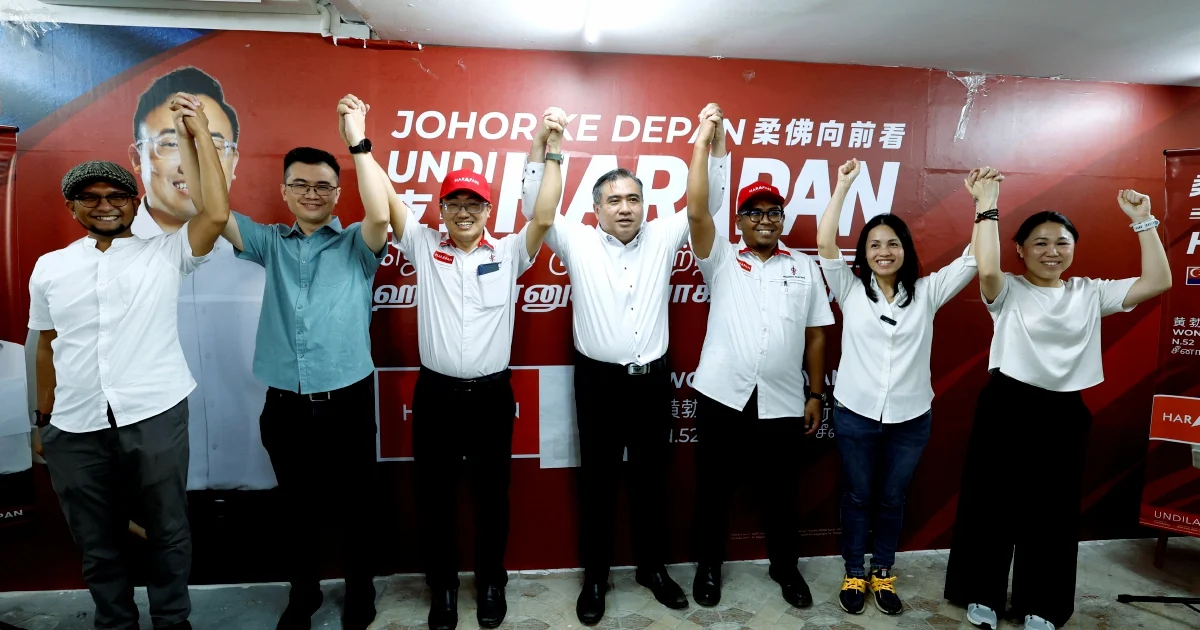
Pakatan Harapan has signalled that determining who will lead Johor as Menteri Besar—should the opposition coalition win the forthcoming state election—will remain a matter for future deliberation rather than immediate announcement. The decision to postpone leadership selection reflects a strategic calculation that the coalition must first secure electoral victory before settling internal power arrangements, according to statements from senior PH figures.
The deferral of the candidate naming process underscores a deliberate choice by the coalition to keep its campaign messaging focused on broader policy and governance platforms rather than personalised leadership contests. By withholding the identity of its prospective chief minister, Pakatan Harapan can theoretically avoid sectional rivalries that might alienate certain voter demographics or weaken the unified campaign message needed to overcome the incumbent. This tactical approach mirrors broader opposition strategy across Malaysia, where coalition cohesion during campaigns has historically proven more valuable than pre-election leadership clarity.
The announcement that Johor's next PH-backed Menteri Besar—assuming electoral success—will be determined by the coalition's apex leadership council represents a centralisation of decision-making authority. Rather than allowing individual component parties within Pakatan Harapan to advance candidates or stake territorial claims during the campaign period, this arrangement concentrates selection power at the top. Such structures exist in various democracies to prevent factionalism during critical electoral phases, though they also raise questions about grassroots party involvement in leadership selection.
For Malaysian political observers, this situation reflects recurring patterns in how opposition coalitions navigate the tension between internal party democracy and strategic campaign imperatives. The Democratic Action Party, Amanah, and People's Justice Party—Pakatan Harapan's three primary components—have historically sparred over portfolio allocation and chief minister positions in states they control. By deferring the decision, coalition leaders buy time to manage these sensitivities beyond the campaign spotlight.
Johor's electoral dynamics present particular complexity. The state has traditionally been a Barisan Nasional stronghold, and any PH government would represent a significant political realignment. This context makes coalition unity even more critical, as fragmentation over leadership selection could prove fatal to opposition prospects. Voters uncertain about coalition reliability need reassurance of unified governance intent rather than early signals of internal power struggles.
The approach also allows flexibility for post-election coalition negotiations. Should Pakatan Harapan fall short of a majority but retain enough seats to form government through partnerships with independent legislators or other aligned parties, having withheld leadership designation preserves negotiating leverage. A pre-announced candidate might become a stumbling block in such talks, whereas maintaining flexibility permits political arithmetic to guide final arrangements.
Regionally, this reflects broader Southeast Asian patterns where opposition coalitions often defer leadership selection until victory appears assured. Thailand, Cambodia, and Indonesia have all witnessed instances where opposition groups prioritise campaign unity over early designation of chief executives. The Malaysian context is particularly sensitive given the multi-ethnic, multi-religious composition of the electorate and the significance of Menteri Besar appointments for federal-state power dynamics.
For Johor voters, the deferral means campaign voting decisions will occur without knowing definitively who the PH-backed chief executive would be. This approach presents both advantages and disadvantages. Proponents argue it emphasises policy and vision over personalities, encouraging issue-based voting. Critics contend it reduces voter transparency and may indicate internal uncertainty within the coalition about its leadership depth or consensus.
The forthcoming state election will test whether this strategic ambiguity enhances or damages Pakatan Harapan's prospects. Historical precedent suggests that voters often prove forgiving of delayed leadership decisions when campaigns succeed electorally, but punitive when such deferral masks deeper coalition fractures. The coalition's task involves demonstrating unified purpose and forward momentum while maintaining sufficient internal flexibility to accommodate component party interests post-victory.
This situation also carries implications for federal-state relations. A new Johor government would operate within Malaysia's constitutional framework that defines state and federal authority boundaries. The eventual Menteri Besar appointment will inevitably influence how the state interfaces with federal Pakatan Harapan leadership should the coalition control Putrajaya, or alternatively, how state opposition dynamics interact with federal Barisan governance should the current arrangements persist.
As the election campaign progresses, questions about the eventual chief minister will likely intensify from media, rival parties, and political analysts. The coalition's willingness to maintain candidate confidentiality throughout the campaign period will serve as an acid test of disciplined campaign management. Component parties must resist pressure to publicly jockey for position—a difficult requirement in Malaysian politics where state patronage and ministerial appointments carry substantial rewards.
The decision reflects broader lessons from recent state and federal elections across Malaysia. Coalition governments that entered office with unclear leadership arrangements sometimes faced legitimacy questions or post-election governance complications. Conversely, those that maintained campaign unity through deliberate ambiguity about power-sharing sometimes demonstrated greater stability once governing commenced. Johor voters and Malaysian political observers will ultimately assess whether Pakatan Harapan's strategy represents prudent campaign discipline or evasive lack of preparedness for governance responsibility.

%22%2F%3E%3C%2Fpattern%3E%3C%2Fdefs%3E%3Crect%20width%3D%22100%25%22%20height%3D%22100%25%22%20fill%3D%22url(%23phf3lfg)%22%2F%3E%3Crect%20width%3D%22100%25%22%20height%3D%22100%25%22%20fill%3D%22url(%23phf3lfp)%22%2F%3E%3Ctext%20x%3D%2250%25%22%20y%3D%2250%25%22%20text-anchor%3D%22middle%22%20dominant-baseline%3D%22central%22%20fill%3D%22rgba(255%2C255%2C255%2C0.95)%22%20font-family%3D%22Georgia%2C%20'Times%20New%20Roman'%2C%20serif%22%20font-weight%3D%22700%22%20font-size%3D%22272%22%20letter-spacing%3D%22-0.02em%22%3EAnwar%3C%2Ftext%3E%3C%2Fsvg%3E)