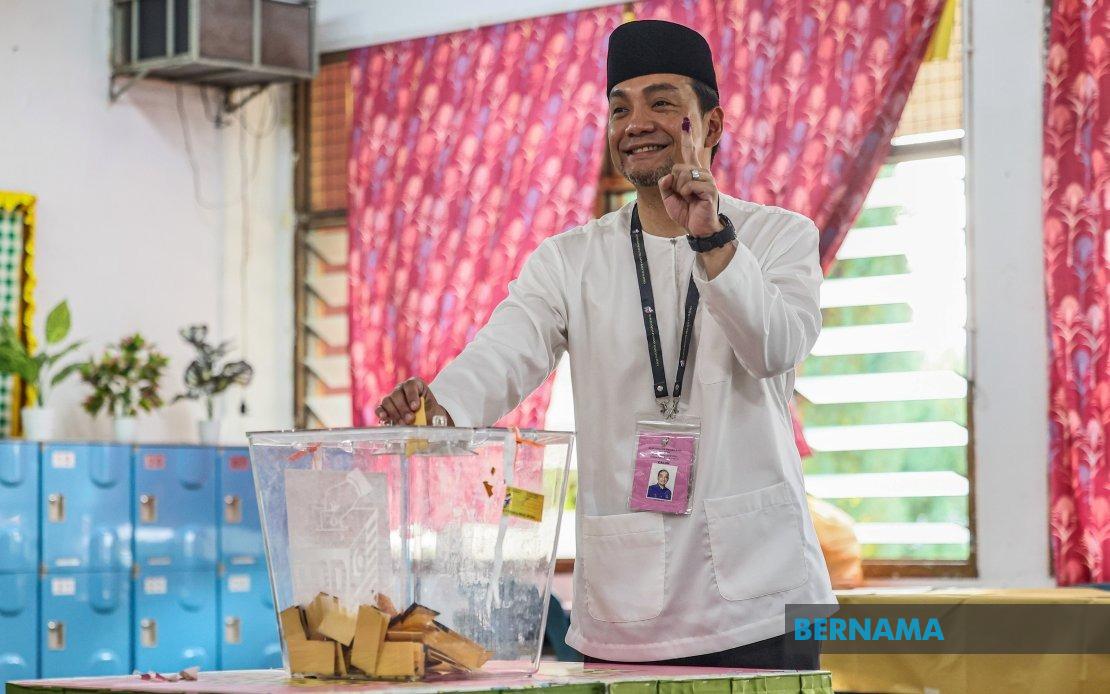
Johor's political leadership cast its ballot early on polling day as the state embarked on its 16th election cycle, with Menteri Besar Datuk Onn Hafiz Ghazi voting at Sekolah Kebangsaan Simpang Renggam in the morning. The incumbent leader, who heads Johor's Barisan Nasional machinery, arrived at the polling station before 8.35 am and proceeded through the voting process in an orderly fashion, stopping to acknowledge and engage with fellow electors who had assembled to participate in the democratic exercise.
Onn Hafiz's presence at the polls carried particular significance given his pursuit of a consecutive mandate. The Menteri Besar, who chairs the state-level BN coalition, confronts a direct challenge from Nur Hafiz Roslan representing the Pakatan Harapan alliance. This straight contest encapsulates the broader binary competition that has come to define Malaysian electoral politics at the state level, with established government structures pitted against reform-minded opposition coalitions seeking to redirect state governance.
Following his participation in the voting process, Onn Hafiz addressed gathered media representatives with a call for robust citizen engagement throughout the polling day. He emphasised the importance of early voter turnout, framing participation as both a civic obligation and a practical measure to facilitate efficient electoral administration. The emphasis on smooth operations underscored concerns about potential bottlenecks in processing large numbers of electors, a recurring challenge in Malaysian elections where tight scheduling and logistical coordination often determine public satisfaction with the democratic process.
Elsewhere in the Simpang Renggam district, Pakatan Harapan's contender for the Puteri Wangsa constituency, Dr Maszlee Malik, entered the voting arena shortly after nine in the morning. Maszlee's candidacy carries resonance given his previous role as federal education minister, a position that granted him national profile and experience in one of Malaysia's most contentious policy domains. His transition from national office to state-level contestation reflects the fluid career trajectories common among Malaysian politicians, who frequently migrate between federal and state spheres depending on electoral opportunity and party positioning.
The Puteri Wangsa seat presents a considerably more fragmented electoral landscape than the Menteri Besar's contest. Rather than a binary confrontation, the seat has attracted five separate candidacies, with Maszlee competing against Rashifa Aljunied from MUDA, Teow Chia Ling representing the BN slate, Nicholas Paul Vincent of Parti Bersama Malaysia, and independent entrant Wang Wee Siong. This splintering of the vote reflects a broader trend in Malaysian politics where micro-parties and independent candidates increasingly contest state elections, complicating the traditional two-coalition framework that previously dominated electoral competition.
The emergence of MUDA as a genuine electoral competitor represents a notable shift in Johor's political dynamics. The youth-oriented party, which has gained traction particularly among younger and urban voters, typically campaigns on anti-establishment messaging and promises of generational change. Such parties create strategic headaches for both BN and PH, potentially fragmenting vote shares and producing unpredictable outcomes that neither major coalition can confidently forecast. The presence of Parti Bersama Malaysia alongside MUDA indicates that dissatisfaction with traditional political options extends across ideological spectrums.
Johor's elections carry implications that ripple well beyond the state's borders. As one of Malaysia's most economically significant states and home to a substantial population, developments in Johor influence the broader calculation of federal political balance. A Menteri Besar who commands strong state authority and a reliable BN machinery contributes substantially to federal coalition stability, whereas a change in state administration could shift political momentum and create leverage for alternative coalitions in national negotiations. The stakes in Johor elections thus transcend purely state-level governance and intersect with Malaysia's complex system of federalism and coalition politics.
The electoral contest also reflects evolving voter preferences regarding state governance priorities. Economic management, particularly questions surrounding Johor's port operations and industrial development, alongside social welfare provision and infrastructure spending, typically dominate state-level campaign discourse. These bread-and-butter issues often matter more to voters than ideological grand narratives, though education and religion-related matters frequently emerge as mobilising factors in Malaysian state elections. The balance between these competing concerns shapes electoral outcomes and governs which party combinations can assemble sufficient support to govern.
The timing of Johor's election within Malaysia's broader political calendar also warrants consideration. State elections create valuable data points for assessing public sentiment and testing campaign messaging ahead of eventual federal contests. Both BN and PH consequently deploy substantial resources in Johor contests, treating them as crucial barometers of national political health. Victories or defeats in high-profile state elections such as those in Johor can generate momentum that influences subsequent electoral contests, creating a cascade effect through Malaysia's political system.
The incumbent administration's performance record during the preceding term forms the implicit backdrop against which voters evaluate alternatives. Onn Hafiz's first tenure as Menteri Besar occurred during periods of significant disruption, including the global pandemic and its economic consequences, which constrained state governments' capacity to deliver programmes and created public frustration. Whether voters attribute these constraints to circumstances beyond state control or to leadership inadequacy fundamentally shapes their willingness to grant continuation of mandate. The electoral arithmetic that emerges from polling day will provide clarity on this question and chart Johor's political direction for the ensuing term.

