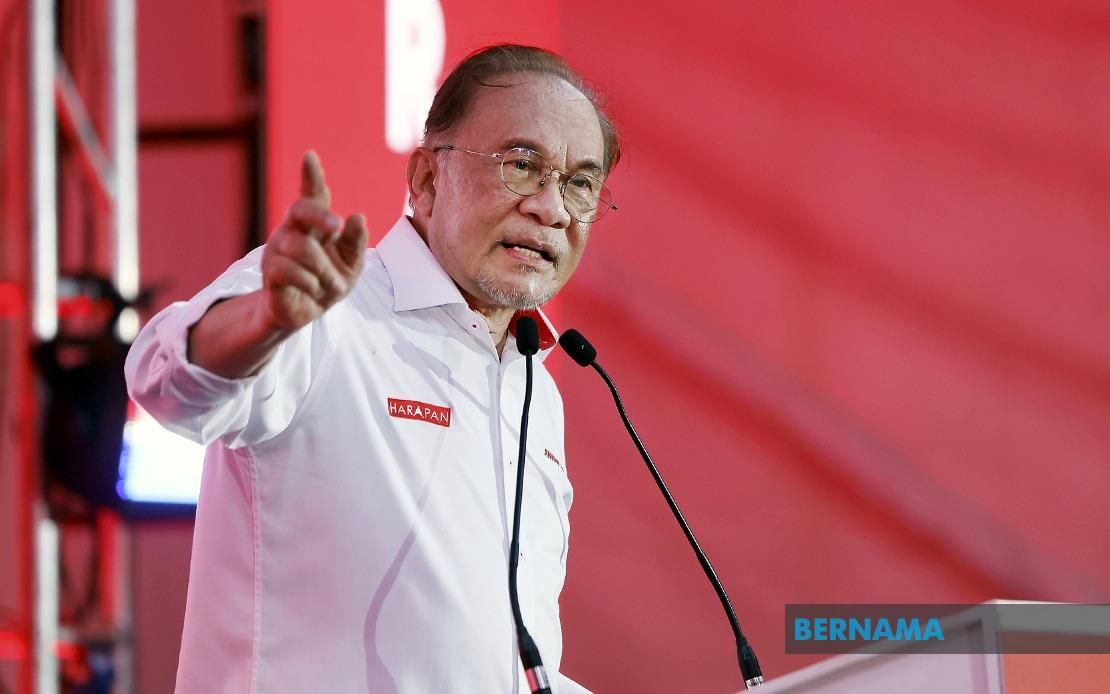
Prime Minister Datuk Seri Anwar Ibrahim has called on Johor voters to elect representatives who combine sound judgment with decisive action and a genuine grasp of public sentiment, during the opening day of campaigning for the 16th Johor state election. The Pakatan Harapan chairman stressed that the state deserves leaders capable of identifying genuine priorities and having the courage to implement necessary changes, while remaining attuned to the aspirations and concerns of ordinary citizens.
Addressing supporters through a campaign video posted on his official Facebook account, Anwar outlined the coalition's vision for Johor's future, encapsulating the message "Johor Progresses. Vote HARAPAN." This framing positions the election as a choice between transformative leadership and the status quo, with PH presenting itself as the vehicle for meaningful development across the state. The emphasis on progress reflects broader concerns among Johor voters about economic opportunities, infrastructure development, and responsive governance in Malaysia's second-largest state by population.
Anwar's messaging stressed the importance of elected representatives who serve all communities within Johor, deliberately highlighting the multiethnic character of the state's electorate. His call for leaders who work collaboratively across racial and religious lines resonates with Malaysia's foundational commitment to inclusive nation-building, while also addressing historical tensions within Johor's political landscape. By emphasising that representatives must champion the interests of Malays, Chinese, and Indians working in concert, Anwar positioned PH as defending the broader national project rather than pursuing narrow factional interests.
The Prime Minister made multiple campaign stops across Johor on the first day of formally campaigning, conducting seven separate events designed to connect PH candidates with voters at the grassroots level. These engagements included community forums, informal discussions, and attendance at local activities—a strategy intended to demonstrate the coalition's commitment to listening and engagement rather than merely broadcasting pre-determined messages. Such ground-level campaigning also allows candidates to address specific local grievances and present tailored solutions, a tactical approach increasingly important in state elections where local concerns often outweigh national narratives.
Pakatan Harapan has mounted an ambitious challenge in Johor by fielding candidates across all 56 state constituencies, signalling confidence and comprehensive ambition despite the state's traditionally complex political dynamics. The coalition's candidate distribution reflects its internal composition, with PKR contributing 20 nominees, Amanah fielding 19, and DAP presenting 17 candidates. This distribution maintains broad representation across PH's three major components while acknowledging differences in party strength and ground presence across various Johor constituencies.
The broader electoral contest involves 172 candidates competing for the 56 available seats, indicating vigorous competition beyond just Pakatan Harapan. This crowded field reflects Johor's politically diverse environment, where multiple coalitions and independent challengers seek voter support. The number of candidates per seat underscores how competitive Malaysian state elections have become, particularly in peninsular states where voting patterns have shifted significantly over recent election cycles. For voters, such competition theoretically offers greater choice, though it also fragments the electorate across multiple options.
Poll day is scheduled for July 11, with early voting opportunities available on July 7 for those unable to vote on the primary election date. These compressed timelines mean campaigns operate at intensity, with limited weeks to reach and persuade voters. Early voting provisions acknowledge the reality that many Malaysians work across state lines or have mobility constraints during standard polling hours, though uptake of early voting opportunities remains variable across the country. The electoral calendar effectively concentrates political messaging and activity into a concentrated period.
For Malaysian observers, the Johor election carries significance beyond the state itself. As the nation's largest state by population and a crucial economic contributor, Johor's political direction influences national coalitional calculations and policy directions. The state has historically been a battleground where opposition forces have mounted competitive challenges against long-established governance structures, making it a testing ground for shifting voter preferences and emerging political alignments. Results in Johor often signal broader patterns that become relevant in subsequent national elections.
Anwar's emphasis on competent, courageous leadership addresses a persistent theme in Malaysian electoral discourse: frustration with representatives perceived as lacking initiative, understanding, or accountability to constituents. This messaging taps into genuine voter concerns about governance quality and representative responsiveness that transcend typical left-right political divides. By framing the election around leadership qualities rather than solely party affiliation, PH seeks to broaden its appeal beyond committed supporters to persuadeable voters concerned primarily with effective administration. Whether such framing translates into electoral gains will depend on how effectively PH candidates translate these abstract leadership qualities into concrete local solutions during the remaining campaign period.

