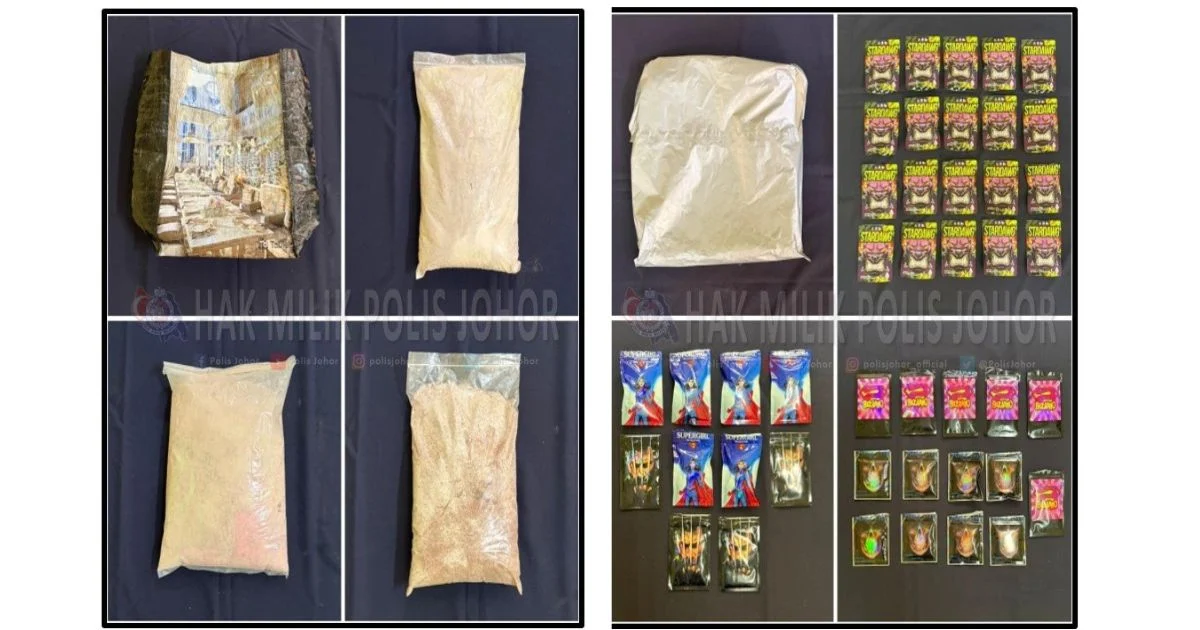
Authorities in Johor have successfully broken up an organised drug syndicate operating from Kulai, resulting in the arrest of a married couple and the recovery of illicit substances with an estimated street value of RM3.59 million. The operation represents a significant enforcement achievement for state police, who have intensified their focus on dismantling trafficking networks that threaten communities across the southern region.
The takedown followed targeted investigation and surveillance work that allowed officers to identify the couple's involvement in the distribution and supply of controlled drugs within Johor. The coordinated police action demonstrates the growing sophistication of enforcement tactics being deployed to combat organised narcotics operations that have proliferated across the country in recent years.
For Malaysian readers, drug-related arrests in Johor carry particular significance given the state's strategic location along major trafficking corridors. The Johor-Singapore border and proximity to international maritime routes make the state vulnerable to becoming a transit point for narcotics destined for regional markets. Localised drug operations often feed larger supply chains, making even household-level busts indicative of broader systemic issues requiring sustained attention.
The arrested couple's involvement underscores an evolving pattern in Malaysian drug enforcement: the increasing participation of domestic partnerships in trafficking activities. Unlike traditional syndicate structures with clear hierarchies, spousal operations often provide operational advantages, including shared residential spaces, built-in trust mechanisms, and reduced suspicion from neighbours. Police investigations frequently reveal that such arrangements enable couples to operate with reduced detection risk while maintaining flexibility in their distribution networks.
The RM3.59 million valuation reflects market-rate assessments of the seized narcotics rather than raw material costs, highlighting the substantial profit margins that motivate trafficking operations. These economics explain why enforcement alone, without addressing upstream production facilities and international supply chains, struggles to produce lasting deterrents. The attractiveness of drug trafficking to participants stems from returns that dwarf legitimate income opportunities available to many Malaysians, particularly in smaller towns and rural areas where employment options remain limited.
Johor's law enforcement agencies have progressively enhanced their operational capabilities in recent years, incorporating intelligence-sharing protocols, advanced forensic analysis, and cross-border coordination mechanisms. The Kulai syndicate dismantling reflects these institutional improvements, though success remains episodic rather than systematic. Police acknowledge that for every operation shut down, alternative networks often emerge to meet sustained demand from consumers throughout Peninsular Malaysia and neighbouring regions.
The arrest and seizure occur within Malaysia's broader legal framework governing drug offences, which carries stringent penalties including lengthy prison sentences and, in trafficking cases, capital punishment. The severity of these measures reflects government commitment to treating narcotics distribution as a serious security threat rather than purely a public health matter. However, enforcement-focused approaches have not substantially reduced drug availability or user populations, suggesting that supply-side interventions alone prove insufficient without complementary demand reduction and rehabilitation initiatives.
For communities in Kulai and surrounding areas, the operation may provide temporary relief from immediate local drug activity. However, regional context suggests that demand for illicit substances remains robust, particularly among certain demographic cohorts. Without sustained investment in prevention, treatment infrastructure, and economic development that creates legitimate pathways for income generation, new suppliers will likely emerge to service existing customer bases.
The seizure quantity and estimated value indicate relatively sophisticated operations, likely involving multiple suppliers and distribution points beyond what police encountered during the arrest. Subsequent investigation will presumably focus on identifying upstream sources and downstream customer networks, potentially unravelling larger supply chain segments. Intelligence gathered from interrogating the arrested couple could generate leads for parallel investigations throughout Johor and neighbouring states.
This enforcement action occurs as Malaysian authorities confront persistent challenges in controlling drug flows across porous land and maritime borders. The effectiveness of targeted operations like the Kulai bust depends partly on sustained resource allocation, operational continuity, and willingness to pursue investigations through prosecution to conviction. Success metrics in drug enforcement remain contested, however, with some analysts arguing that quantity-based seizure targets incentivise capturing low-value retail operations rather than disrupting high-impact trafficking infrastructure.
From a regional perspective, Johor's enforcement activities contribute to broader Southeast Asian efforts to combat transnational narcotics trafficking. Cooperation with Singaporean authorities and engagement with ASEAN frameworks for drug control represent important complementary mechanisms, though coordination remains uneven. Malaysia's position as a major transit corridor for drugs sourced from the Golden Triangle and destined for multiple markets underscores the interdependence of national enforcement strategies across the region.
Looking forward, the Johor bust exemplifies ongoing police operations that will continue across the state and nation. Authorities have signalled renewed commitment to targeting mid-level traffickers and organised syndicates, recognising that retail-level enforcement, while politically visible, produces limited aggregate impact on drug availability. The arrested couple's case will proceed through Malaysia's criminal justice system, though ultimate court outcomes remain uncertain pending investigation completion and prosecution.

