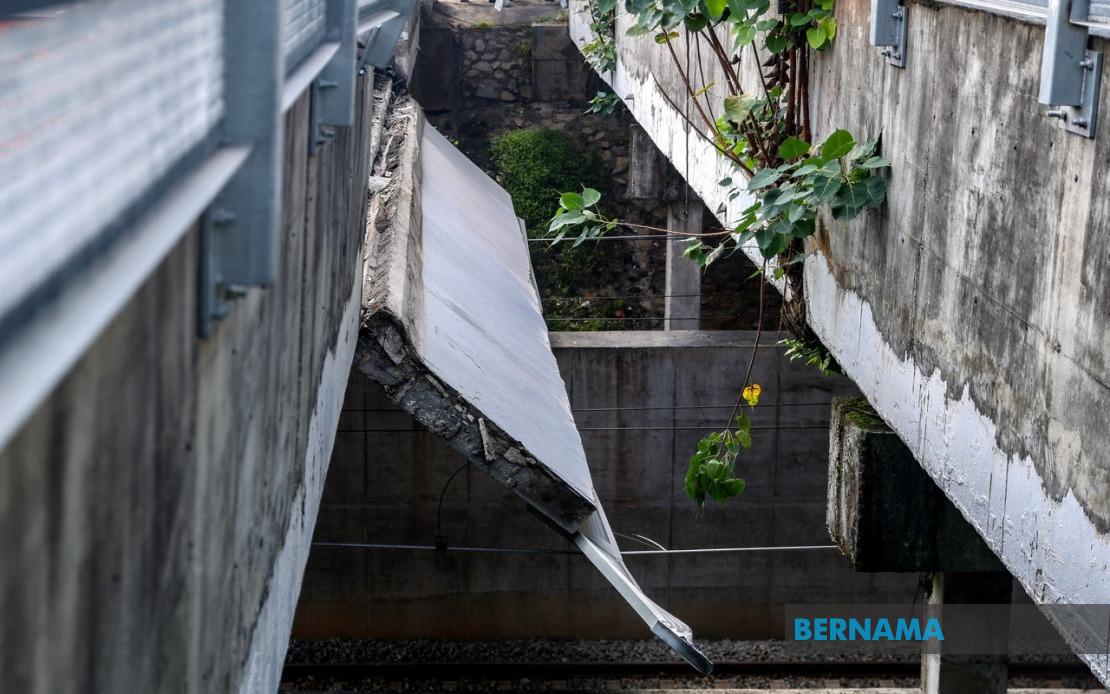
The Kulai-Kempas Baru rail corridor in Johor ground to a halt on Wednesday morning after a heavy lorry collided with track infrastructure, prompting Keretapi Tanah Melayu Berhad to implement a shuttle bus replacement service for stranded passengers. The incident underscores the vulnerability of Malaysia's critical rail infrastructure to external impacts and the cascading operational challenges that follow such accidents in the southern transport corridor.
Three major Electric Train Service routes originating from JB Sentral Station were impacted by the disruption, affecting morning commuters and intercity travellers bound for Padang Besar, Kuala Lumpur Sentral, and Butterworth. KTMB responded by establishing shuttle bus services linking JB Sentral and Kempas Baru stations directly to Kulai Station, where passengers could transfer onto operational trains to complete their journeys. This contingency approach, while mitigating immediate passenger stranding, highlighted the logistical complexity of managing transport disruptions across a busy regional hub.
The specific damage—a fallen concrete parapet structure that made contact with the overhead line system supplying electricity to trains—required specialised heavy machinery for removal. KTMB reported at the time that the crane needed for lifting operations, a 120-tonne apparatus, had not yet been secured by Transmare-Chemie (M) Sdn Bhd, the transport company responsible for the vehicle involved in the initial incident. This delay in resource mobilisation exemplified how private sector response times can constrain public transport recovery efforts.
The company indicated that once the crane became available, removal operations would commence around mid-morning, though officials cautioned that the actual timeline for reopening remained uncertain. The restoration process would demand not only physical debris removal but also comprehensive technical inspections of both the track infrastructure and the overhead electrical system, followed by mandatory safety certification before trains could resume full service. Such multi-stage clearance requirements, though essential for passenger safety, meant that even optimistic completion estimates could stretch beyond initial projections.
For regional connectivity, the impact extended beyond ETS services. The Shuttle Selatan local rail network, which serves commuters on the Johor corridor, suspended its Kulai-Kempas Baru-Kulai route entirely while maintaining operations on the Pasir Gudang-JB Sentral and cross-town Kempas Baru-JB Sentral services. This partial suspension strategy allowed KTMB to preserve some local mobility even as the higher-capacity intercity rail line remained offline, though it still meant significant inconvenience for daily travellers on the affected segment.
The incident itself traced back to the previous day when a lorry transporting flammable liquid had skidded near the rail alignment, triggering an automatic power supply disconnection as a safety precaution. That initial accident set off a chain reaction: power disruptions cascaded across services, causing cascading delays that persisted into the following morning even after emergency repairs. The compounding nature of the disruption illustrated how a single vehicle mishap can metastasise into a multi-day transport crisis affecting thousands of passengers across the crucial Johor-Klang Valley corridor.
KTMB assured affected passengers that those choosing not to continue their journeys would receive full refunds, and customer service staff remained stationed at affected stations to provide assistance and information. This passenger care approach reflected standard practice in managing service failures, though it offered little consolation to commuters facing unpredictable travel times or missed appointments. The need to provide such remedial services underscored the real economic and social costs of infrastructure vulnerability.
The restoration coordination involved multiple stakeholders—the private lorry company, KTMB engineering teams, crane service providers, and regulatory inspectors—creating a complex chain of dependencies that could only move as quickly as the slowest participant. This fragmented responsibility structure, common in Malaysia's mixed private-public infrastructure landscape, sometimes impedes swift resolution compared to fully integrated systems where a single organisation controls all response assets.
For Malaysian rail users and logistics planners, the incident offered fresh evidence of the sector's susceptibility to external shocks. Unlike aviation, where restricted access and automated safety systems reduce interface points with external hazards, railway corridors remain subject to regular vehicle incursions at grade crossings and adjacent areas. The cost of such incidents—measured in passenger inconvenience, missed economic productivity, and emergency response expenses—continues to accumulate across the national rail network.
Looking at regional implications, Malaysia's growing dependence on ETS services for intercity mobility, particularly in the high-density Klang Valley-Johor corridor, means that single-point infrastructure failures disproportionately affect economic activity and public confidence. Similar rail networks across Southeast Asia face comparable vulnerabilities, suggesting that investment in redundancy, automated monitoring systems, and coordinated emergency response protocols remains essential for infrastructure resilience across the region.
The broader context reveals ongoing challenges in maintaining aging rail infrastructure while managing external pressures. The concrete parapet failure points to potential maintenance or structural design issues that may require systemic review across the network. As Malaysia pursues its vision of expanding rail capacity and frequency, integrating robust asset management with external risk mitigation becomes increasingly critical for service reliability and public acceptance of rail as a primary transport mode.

