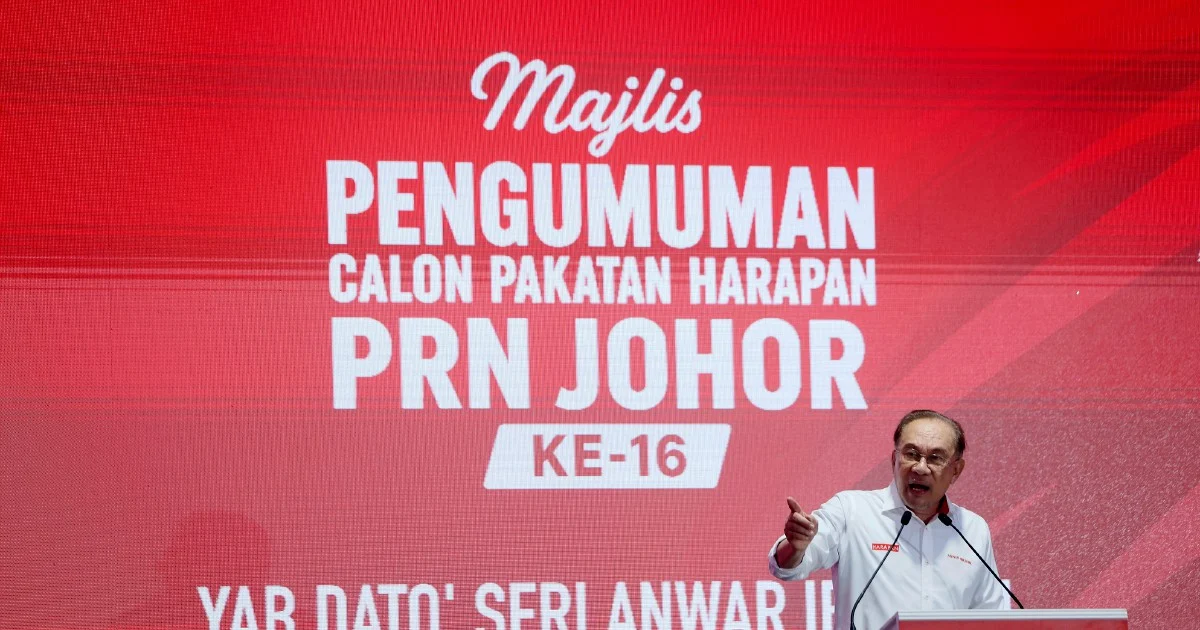
Prime Minister Datuk Seri Anwar Ibrahim has shed light on the financial flows between Johor and the federal government, revealing that the state has received significantly higher funding allocations than the revenue it generates. Speaking in Tangkak, the Prime Minister stated that over the past three years, Johor contributed RM14 billion to federal coffers while receiving RM16 billion in federal allocations and development funding, demonstrating a net benefit of RM2 billion to the state.
The disclosure offers a window into how the federal government distributes resources across states, a key mechanism through which the central authority attempts to balance development priorities and ensure equitable economic growth. The figures suggest that despite Johor's substantial economic output, the federal system is designed to channel additional capital back to states for infrastructure, social services, and development projects. This arrangement reflects the constitutional framework whereby states collect certain taxes and levies that are consolidated at the federal level, then redistributed according to agreed formulae and government policy priorities.
Johor's position as a major economic contributor places it among Malaysia's more developed states, with significant manufacturing, agriculture, tourism, and port-related industries. The state's contribution of RM14 billion in revenue over three years underscores its ongoing role in powering the national economy. However, the decision to allocate RM16 billion back to the state indicates that federal policy continues to invest heavily in Johor's infrastructure and public services, likely recognising the state's strategic importance to regional and national economic corridors.
Prime Minister Anwar's public articulation of these financial figures carries political significance beyond mere accounting. By emphasizing that Johor receives more federal support than it contributes in direct revenue, the government is signalling commitment to the state's development and potentially addressing perceptions of federal-state financial imbalance. This messaging is particularly important given Johor's electoral significance and its position as a gateway state linking Malaysia to Singapore and the broader Southeast Asian region.
The redistribution model reflected in these figures aligns with broader federal government strategy to ensure no state is left behind in Malaysia's development journey. States like Johor, which generate substantial economic output, are expected to contribute proportionally to federal revenues while simultaneously receiving substantial allocations for maintaining and upgrading critical infrastructure. This creates a cycle wherein economically vibrant states fund national priorities while also benefiting from federal investment in local development.
Understanding Johor's fiscal relationship with the federal government matters for Malaysian investors and policymakers tracking regional development trajectories. The allocation patterns suggest that major industrial and commercial zones within the state can expect continued federal support for transportation networks, utilities, and business infrastructure. For companies operating in Johor or considering expansion there, the federal government's demonstrated commitment to channelling resources into the state provides confidence in long-term stability and public sector investment in enabling infrastructure.
The three-year period referenced by the Prime Minister coincides with the Pakatan Harapan administration's tenure, during which the government implemented various fiscal consolidation measures and shifted spending priorities toward targeted development projects. The emphasis on Johor specifically reflects the administration's engagement with state-level governance and the political importance of demonstrating tangible federal support in key electoral regions. Johor, as a state with substantial population and economic clout, naturally features prominently in federal development planning.
These financial flows also reflect Malaysia's ongoing fiscal challenges and the government's attempts to manage federal revenues while meeting development commitments across all states. With federal revenues constrained by various factors including lower crude oil prices and global economic headwinds, the ability to allocate more to Johor than it contributes demonstrates either surplus management or deliberate policy prioritisation. The disclosure suggests confidence in the state's economic trajectory and the government's assessment that investment in Johor yields meaningful returns through economic growth and revenue generation.
For other Malaysian states seeking to understand their own federal allocations and contribution patterns, the Johor figures provide a benchmark for comparative analysis. States with smaller economic bases may receive proportionally higher federal support relative to their revenue contributions, reflecting equalisation principles embedded in Malaysia's federal structure. The data underscores how the federal system operates as both a consolidation mechanism for national revenues and a redistribution apparatus ensuring development reaches beyond the most economically concentrated regions.
Looking forward, the financial dynamics between Johor and the federal government will likely continue evolving as Malaysia pursues economic diversification and regional development initiatives. Ongoing infrastructure projects, including high-speed rail connectivity, port expansion, and special economic zones, will shape future federal allocations to the state. The Prime Minister's articulation of Johor's financial relationship with Kuala Lumpur serves as both transparency on government spending patterns and implicit acknowledgement of the state's strategic position within Malaysia's federal structure and economic architecture.