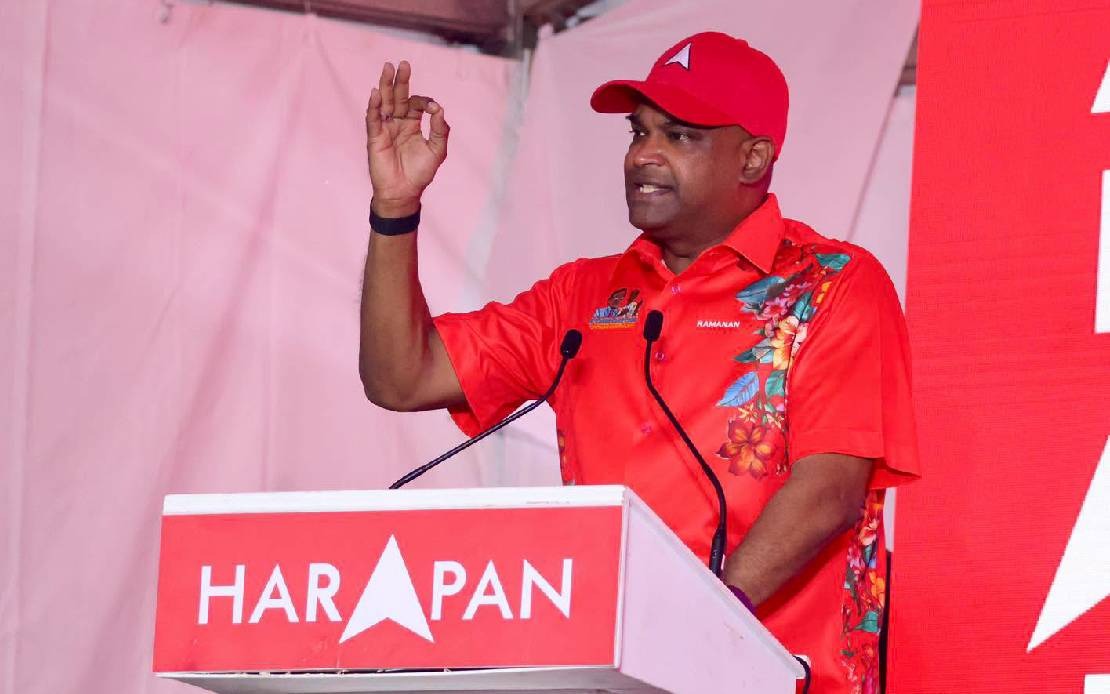
The Federal Government continues to prioritise Johor through an extensive portfolio of major investments and large-scale infrastructure developments designed to enhance living standards across the state, according to PKR Vice-President Datuk Seri R Ramanan. Speaking at a Johor Ke Depan campaign event in Simpang Renggam, Ramanan underscored the administration's commitment to ensuring that development benefits reach households throughout the state through targeted assistance schemes and economic initiatives.
Ramanan's remarks reflect the coalition's strategy of emphasising continuity and synchronisation between federal and state governance structures as the Pakatan Harapan campaign builds momentum ahead of the July 11 election. The messaging appears calibrated to reassure Johor voters that choosing a state government aligned with the federal administration would facilitate faster project implementation and reduce bureaucratic friction that might otherwise delay benefits from Kuala Lumpur's investment pipeline.
The campaign event drew several senior coalition figures, including PKR Vice-President Datuk Seri Amirudin Shari, Amanah Secretary-General Faiz Fadzil, and three Pakatan Harapan candidates contesting state seats in Machap, Benut, and Layang-Layang respectively. This multi-party representation underscores the coalition's joint approach to the election and suggests a coordinated effort to present unified messaging across different voter constituencies within Johor.
Johor's electoral significance within the Malaysian political landscape cannot be understated. As the nation's second-most populous state and a significant economic contributor, developments in Johor often reverberate across national political calculations. The state's industrial base, manufacturing sector, and strategic location along the Singapore-Malaysia corridor make it particularly important for federal planning. Investment announcements and infrastructure projects in Johor therefore carry weight beyond the state's borders, influencing investor confidence and regional competitiveness across Southeast Asia.
The timing of Ramanan's remarks—coming during an active campaign period—reflects broader coalition strategy to link federal economic performance with state-level electoral prospects. By highlighting infrastructure achievements and assistance programmes, Pakatan Harapan seeks to translate federal government accomplishments into electoral support at the state level. This approach assumes that voters will reward the coalition for tangible development outcomes, though political dynamics in Malaysia have sometimes proven more complex than simple cost-benefit calculations.
The July 11 election will see 172 candidates competing across state seats, with early voting scheduled for July 7. This turnout suggests a competitive electoral environment where mobilisation and messaging will significantly influence outcomes. The emphasis on development and administrative alignment suggests that Pakatan Harapan intends to differentiate itself through claims of governance efficiency and coordinated planning, contrasting this approach with potential fragmentation that might result from opposition control.
From a developmental perspective, the Federal Government's stated prioritisation of Johor aligns with Malaysia's broader regional development strategies. The state serves as a crucial component of the Greater Southern Economic Zone and maintains strategic significance for connectivity initiatives spanning the Klang Valley and Penang. Infrastructure investments in Johor consequently support national economic integration objectives beyond the state's immediate boundaries, making federal commitment to the state's development rationally aligned with national economic interests.
The assistance programmes referenced by Ramanan likely encompass social safety net initiatives, agricultural support, skills training, and small business development schemes. These programmes function simultaneously as economic interventions and electoral tools, reaching voters with tangible support while demonstrating government responsiveness to household concerns. The effectiveness of such programmes in translating into electoral support depends partly on implementation quality and public awareness—factors that campaign events like the Simpang Renggam roadshow attempt to address through direct engagement.
For Malaysian voters in other states, the Johor election carries implications beyond state boundaries. A Pakatan Harapan victory would reinforce coalition control of Malaysia's most significant states and strengthen the federal government's negotiating position with any remaining opposition-controlled territories. Conversely, an opposition success in Johor would signal potential cracks in coalition support and complicate federal policy implementation. These considerations explain the intensive federal-level engagement in what might otherwise appear as a routine state election.
The campaign narrative emphasising administrative alignment reflects lessons from previous Malaysian elections where governance friction between differently-controlled state and federal authorities created implementation bottlenecks. By explicitly arguing for coordinated administration, Pakatan Harapan attempts to position itself as the efficiency candidate while implicitly warning of coordination challenges should opposition parties assume state control. This framing resonates particularly in developed states like Johor where voters may prioritise service delivery and economic performance over ideological considerations.

