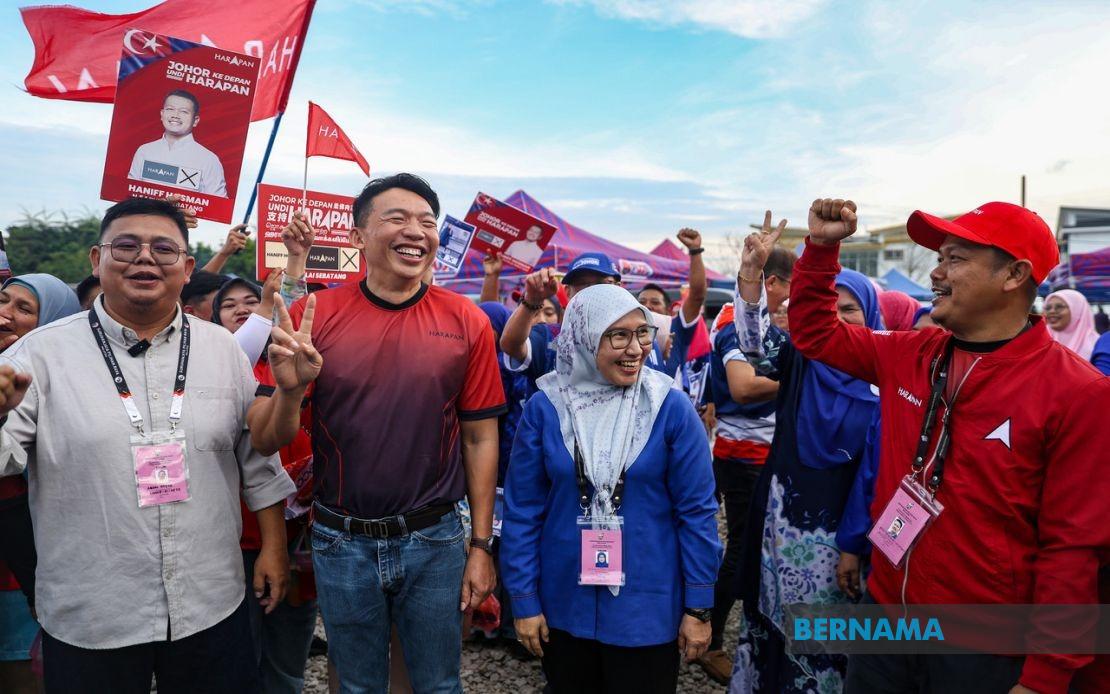
The Johor state election campaign demonstrated its capacity for civility when four candidates from opposing political coalitions crossed paths at the Taman Megah night market in Pontian on June 29. What began as a potentially tense moment—two campaign teams carrying distinctive red and blue flags meeting at a market junction—evolved into a cordial exchange that drew the attention of shoppers, many of whom paused to observe the interaction between representatives from Pakatan Harapan and Barisan Nasional.
The PH delegation comprised three candidates contesting seats across the state: Haniff @ Ghazali Hosman, who is campaigning in Pulai Sebatang; Abd Razak Ismail from Benut; and Cheah Chee Hong representing Kukup. Their appearance at the market was part of a coordinated campaign effort to connect with voters across their respective constituencies. They encountered Hasrunizah Hassan, the BN candidate also vying for the Pulai Sebatang seat—a direct contest that might have suggested tension between the two figures.
Instead of escalating the encounter into a confrontational moment, all four candidates acknowledged one another warmly, greeting visitors together and maintaining the informal atmosphere of the night market. This interaction occurred during what both sides acknowledged was an intensifying campaign period, yet neither coalition sought to weaponise the moment or create artificial discord. The scene underscored how Malaysian electoral politics, particularly at the state level in Johor, has matured in recent election cycles to accommodate coexistence between rival camps during the campaigning phase.
When approached by journalists following the encounter, Haniff characterised the meeting as entirely consistent with democratic principles. He emphasised that the Pontian constituency was experiencing a campaign period marked by peace and the absence of disturbances or inflammatory rhetoric. His comments reflected a broader narrative being promoted by both coalitions—that Johor's voters could expect a competitive but respectful electoral contest. The candidate highlighted that friendly relations between opponents do not diminish the vigour of campaigning but rather demonstrate political maturity.
Cheah, speaking as the Kukup representative, expressed satisfaction at campaigning alongside his coalition colleagues and used the platform to appeal directly to voters across all three constituencies represented in the group. His remarks focused on the PH agenda and urged continued support for the coalition's candidates, indicating that civility between opponents does not require candidates to abandon their partisan messaging or electoral objectives. The balance between friendly interpersonal relations and robust political competition was thus maintained.
Hasharunizah's response to the encounter provided the BN perspective on what such moments signify for Johor's political climate. She framed the meeting as unremarkable—a normal occurrence reflecting the democratic maturity that has developed within the state. Rather than viewing the interaction as problematic, she suggested it actually energised BN's campaign efforts and reinforced her coalition's commitment to winning the election under its Maju Johor banner. Her willingness to characterise the encounter positively, despite representing the rival coalition, demonstrated that both sides had aligned interests in projecting stability and civility.
The backdrop to this encounter is significant for understanding Malaysian electoral politics more broadly. Johor, as the nation's second-largest state by population and a traditional stronghold for BN, has witnessed intensifying competition from PH in recent election cycles. The state election scheduled for July 11, with early voting beginning July 7, represents a major test for both coalitions. The peaceful campaign atmosphere being highlighted by candidates from both sides suggests an effort to maintain public confidence in democratic processes while conducting genuinely competitive contests for power.
The presence of night market visitors observing the candidates' interaction reveals something important about how electoral campaigns function in Malaysian communities. These informal settings—where voters shop, socialise, and move through daily routines—become spaces where political engagement occurs naturally rather than through staged events. Candidates who can navigate these spaces with grace and demonstrate respectful behaviour toward opponents are likely to benefit from positive word-of-mouth among constituents who value civility in public life.
The comments made by both Haniff and Hasrunizah emphasising the absence of disturbances or untoward incidents carry particular weight given Malaysia's history of occasionally contentious election campaigns. The ability of rival candidates to share space, exchange pleasantries, and continue campaigning vigorously without resorting to inflammatory rhetoric or confrontation reflects lessons learned from previous contests. This maturation of electoral conduct has practical implications for how campaigns unfold across Malaysian constituencies and states.
For voters in Pulai Sebatang, Benut, and Kukup, this encounter offers reassurance that their choice between candidates will occur within a stable, respectful environment. The direct competition between Haniff and Hasrunizah for Pulai Sebatang, despite their apparent personal cordiality, underscores that electoral contests need not be bitter or divisive to be meaningful. Voters can expect both candidates to present their cases vigorously while maintaining the civility demonstrated at the night market.
The broader context of the Johor election carries significance for the entire Southeast Asian region, where Malaysia serves as a model of democratic electoral practice. States conducting elections are observing how Johor manages the balance between competitive political campaigns and social cohesion. The peaceful atmosphere and courteous interactions between candidates contribute to a narrative of institutional strength and democratic maturity that extends beyond state borders.
As the July 11 election date approaches, the tone set by these candidates and their interactions will likely influence how the campaign unfolds across Johor's constituencies. The willingness of rival candidates to treat one another with respect while competing fiercely for voter support establishes a model that other contestants may follow. This approach to electoral competition—vigorous in messaging but civil in interpersonal relations—may become characteristic of the Johor campaign narrative.

