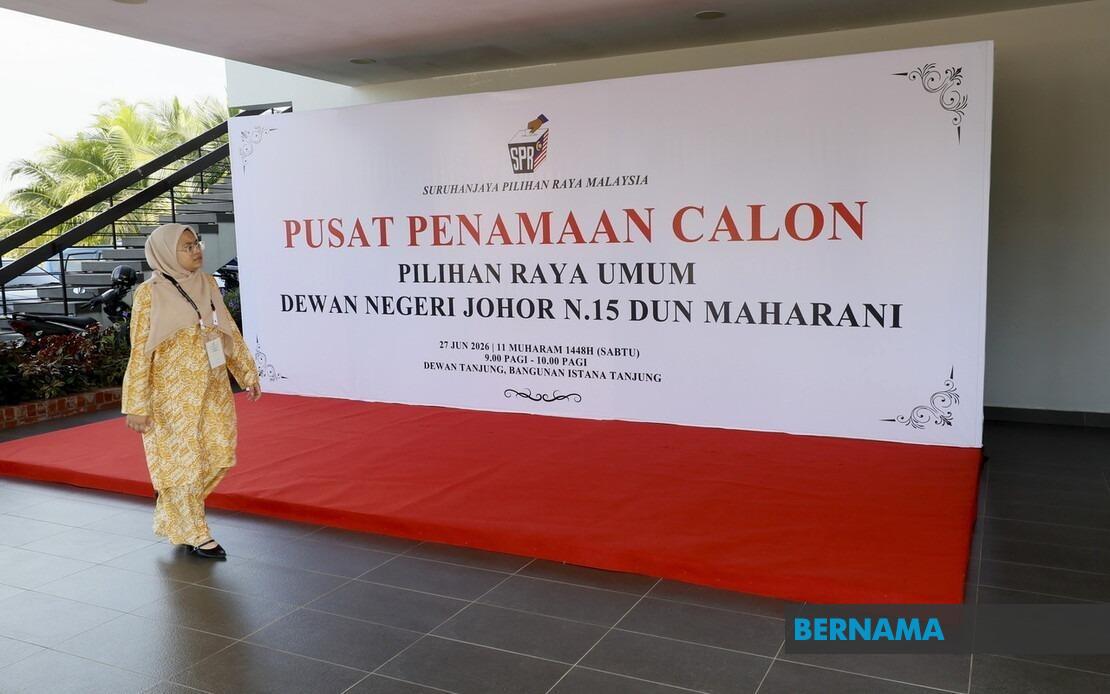
The machinery for Johor's 16th state election was formally set in motion on June 27, with nomination centres across all 56 state constituencies opening their doors to receive candidates' application papers. From 9 am onwards, prospective contenders rushed to secure their candidacy through a streamlined one-hour window, with the Returning Officers at each centre tasked with processing submissions until 10 am sharp. The tight timeframe reflects the Election Commission's aim to move swiftly through administrative procedures, allowing the electoral process to advance without delay into the intense campaigning phase that would define the fortnight ahead.
The scale of participation reflects Johor's political significance within the Malaysian federation. The Election Commission registered 2,727,926 eligible voters across the state, comprising 2,703,175 ordinary citizens alongside 12,041 military personnel and their spouses and 12,710 police personnel and their families. This substantial electorate underscores why Johor, as one of Malaysia's largest states by population and economic output, remains a bellwether for national political trends. The distribution of voters across 56 constituencies meant that nomination day would be a complex logistical exercise requiring coordination among the state's election machinery and local law enforcement.
By the close of business on June 26, a day before nominations opened, 593 nomination forms had been distributed to interested parties, whilst 133 prospective candidates had already confirmed their intent to contest by paying the necessary election deposits. This advance preparation signalled confidence among political parties and independent candidates that the election would proceed as scheduled following the dissolution of the State Legislative Assembly on June 1. The readiness of candidates to commit financially and administratively to their campaigns suggested that all major political coalitions viewed the Johor contest as a consequential electoral battle worth contesting comprehensively.
Pakatan Harapan mounted a united challenge across the entirety of Johor's constituencies, fielding a coalition slate drawing 20 candidates from PKR, 19 from Amanah, and 17 from DAP. This complete contest represented the opposition's commitment to competing for every available seat rather than concentrating resources selectively. Barisan Nasional similarly adopted an all-seats strategy, mobilising 36 UMNO candidates, 16 from MCA, and 4 from MIC across the state. The comprehensive nature of both coalitions' participation reflected the high stakes attached to the election, given that BN had controlled 40 of 56 seats in the outgoing assembly, making the state a crucial hold for the ruling coalition.
Perikatan Nasional's campaign architecture proved more differentiated, with PAS fielding 11 candidates, Bersatu contesting 16 seats, the Malaysian Indian People's Party presenting 5 candidates, and Parti Pejuang Tanah Air fielding a single representative. This distribution within the PN coalition suggested strategic seat-sharing negotiations designed to maximise electoral efficiency and avoid internal vote-splitting in battleground constituencies. The approach differed markedly from the broader coalitional strategies of PH and BN, reflecting PN's relatively more recent consolidation and its component parties' varying levels of organisational reach across Johor's diverse districts.
The election also witnessed the emergence of newer political entrants seeking to disrupt the established three-coalition dynamic. MUDA contested four seats, positioning itself as an alternative for voters seeking fresh political voices, whilst Parti Sosialis Malaysia fielded a single candidate representing the ideological left. Most notably, Parti Bersama Malaysia made its electoral debut, reportedly preparing to contest 15 seats and signalling ambitions to establish itself as a consequential player in Malaysian electoral politics. The multiplicity of contenders transformed the contest into a fragmented battlefield where traditional two-coalition competition would be complicated by spoiler effects and vote dispersal across numerous options.
The campaign period, commencing immediately after the noon announcement of eligible candidates on June 27, would extend for precisely 14 days until 11:59 pm on July 10, providing parties and candidates with a defined window for intensive political mobilisation. This fortnight would see the state saturated with campaign rallies, door-to-door canvassing, social media messaging, and public addresses as the various coalitions and independent contenders endeavoured to persuade Johor voters. The Election Commission's enforcement of restrictions on loudspeaker-mounted vehicles and musical instruments during campaigning aimed to prevent public nuisance whilst maintaining electoral fairness through standardised campaign regulations applicable uniformly across all contestants.
Logistical preparations extended beyond the nomination process to encompass security and traffic management on a considerable scale. The police force mobilised 4,832 personnel across the state to maintain order at nomination centres and elsewhere, whilst coordinating road closures and diversions affecting 19 major thoroughfares to accommodate the anticipated convergence of party supporters and campaign vehicles. This substantial security deployment reflected the Election Commission and law enforcement agencies' determination to ensure that nomination day, traditionally characterised by boisterous scenes of partisan enthusiasm, would proceed without incident or disruption. The coordination between electoral authorities and police demonstrated the institutional capacity mobilised for managing large-scale democratic exercises in Malaysia.
Weather considerations added another variable to the nomination day planning. Meteorological forecasts indicated that rainfall would affect portions of Johor during morning hours, with thunderstorms anticipated in the afternoon. Such conditions were not unusual for June in Johor's tropical climate, yet posed potential complications for the movement of supporters to nomination centres and the outdoor activities typical of nomination day spectacles. Nonetheless, such weather patterns were unlikely to materially deter the expected turnout of candidates and partisan supporters eager to register their participation in what many perceived as a significant electoral contest.
The baseline from which the contest commenced heavily favoured the incumbent BN coalition. The outgoing assembly composition reflected BN's substantial majority, with the coalition holding 40 of 56 seats prior to dissolution, compared to 12 held by PH, 3 by PN, and 1 by MUDA. This commanding position suggested that BN entered the election campaign as the defensive incumbent seeking to retain its majority, whilst opposition coalitions confronted the formidable challenge of dislodging an entrenched governing coalition. However, the emergence of multiple new contestants and PN's respectable tally of three outgoing seats indicated that the electoral landscape had become more competitive and unpredictable than simple seat counts might suggest, with various factors potentially reshaping voter preferences during the fortnight-long campaign.
For Malaysian voters and political observers, the Johor election carried implications extending beyond the state's boundaries. As one of Malaysia's most economically significant and demographically substantial states, Johor's electoral outcome would inevitably influence national political calculations and coalition dynamics ahead of any potential federal election. The performance of PH's unity coalition, PN's electoral appeal, and the viability of new entrants like Bersama would provide early indicators of shifting voter preferences at the national level. Similarly, BN's ability to defend its dominance in Johor would demonstrate the resilience of the traditional ruling coalition or conversely, signal emerging vulnerabilities requiring strategic recalibration. The election therefore transcended parochial state politics to constitute a meaningful barometer of Malaysia's broader political trajectory.

