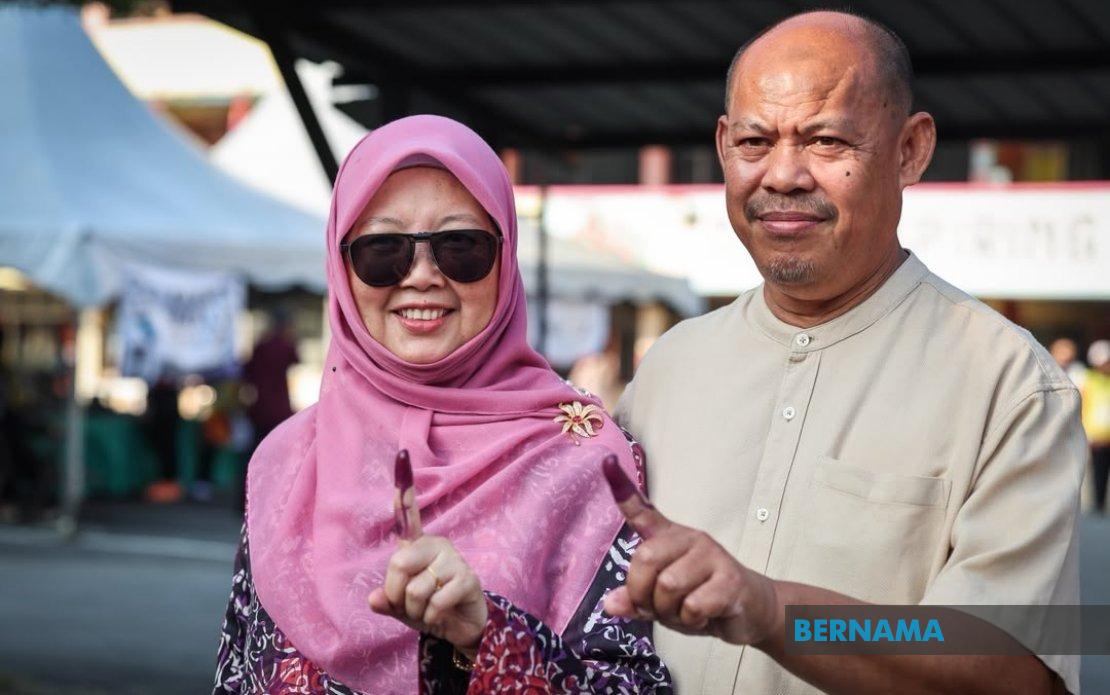
Senior figures from Malaysia's major political coalitions turned up at polling stations across Johor on July 11 to cast their ballots in the 16th state election, setting an example for voters nationwide. The visibility of prominent party leaders voting early in the morning underscored the significance of the state poll and reflected efforts to boost participation levels during what was expected to be a competitive electoral contest. Their appearance at polling centres also sent a symbolic message about the democratic process, even as political parties continued their final campaign pushes.
Datuk Seri Dr Zaliha Mustafa, who chairs the Johor chapter of Parti Keadilan Rakyat, voted at 9 am at Sekolah Menengah Kebangsaan Bandar Baru Uda in Johor Bahru. Alongside her was her spouse, Dr Ahmad Adzlan Musa, and the couple cast their votes in the Larkin state seat. The Larkin constituency has historically been a focal point in Johor politics, representing one of the key battlegrounds in the state assembly.
Dr Zaliha's political background carries considerable weight in the electoral narrative. As a former Minister in the Prime Minister's Department with responsibility for Federal Territories, she brings national-level experience to Johor PKR's campaign efforts. Her early participation at the polling station conveyed confidence in the voting process and served as a public relations gesture aimed at mobilising the broader electorate.
Despite the early hour, Dr Zaliha paused to address the assembled media representatives at the polling location. She appealed directly to Johor residents to follow the example set by early voters and make their way to ballot stations before weather conditions deteriorated. Meteorological forecasts had predicted significant rainfall from midday through the afternoon, a factor that could suppress turnout if voters chose to remain indoors rather than navigate wet conditions to reach polling stations.
The timing of her remarks proved strategically astute. Weather-related barriers to voting can measurably reduce participation rates, particularly in constituencies where transportation challenges already exist or where the electorate skews elderly or less mobile. By publicly urging early participation, Dr Zaliha attempted to counter potential apathy driven by weather concerns, framing early voting not as an inconvenience but as a prudent civic action.
Meanwhile, Teo Nie Ching, the Johor chairman of the Democratic Action Party, participated in the electoral process by voting at Sekolah Jenis Kebangsaan Cina Kulai Besar in the Kulai district roughly half an hour after Dr Zaliha. The DAP's presence in Johor, though traditionally stronger in urban and semi-urban Chinese-majority areas, represents an important component of the broader opposition coalition's electoral machinery in the state.
Kulai, located in the northern portion of Johor, has emerged as a politically significant constituency in recent years. The presence of a DAP chairman voting there highlighted the party's organisational focus on consolidating support within constituencies where it maintains competitive strength. The timing of her appearance also aligned with the broader strategy of encouraging early turnout before weather forecasts could discourage participation.
The dual messaging from PKR and DAP leaders—both voting early and publicly requesting constituents to do likewise—reflected a coordinated approach to managing electoral logistics. Opposition coalitions in Malaysia often emphasise turnout strategies, recognising that higher participation rates can shift electoral mathematics in competitive races. The Johor state election represented a significant contest within Malaysia's broader political landscape, and coalition partners appeared intent on maximising votes cast for their candidates.
State elections in Johor carry particular importance within Malaysian politics due to the state's size, economic output, and demographic complexity. The results influence not only local governance but also national political calculations, as Johor has historically served as a bellwether for broader electoral trends. The visibility of senior party figures during voting day, therefore, extended beyond symbolic gestures—it represented a genuine investment in ensuring their parties' organisational machinery functioned effectively throughout the polling period.
Weather considerations aside, the early participation by party leaders also demonstrated confidence in their respective candidates and platforms. Elections feature numerous variables beyond parties' control, yet their ability to encourage supporters to vote early and decisively represents a tangible measure of organisational effectiveness. By appearing at polling stations themselves, senior figures provided visible evidence of their commitment to the electoral process, potentially reinforcing party discipline and volunteer motivation among lower-level activists.
The Johor state election ultimately reflected broader patterns within Malaysian democracy, where electoral participation remains influenced by multiple factors including weather, accessibility, political confidence, and voting day logistics. Party leaders' early participation and their public statements regarding participation rates thus occupied an important intersection between symbolic political communication and practical electoral strategy. Their actions on voting day would feature prominently in post-election analysis, particularly if turnout figures deviated significantly from historical patterns or if weather did indeed suppress participation in certain areas.

