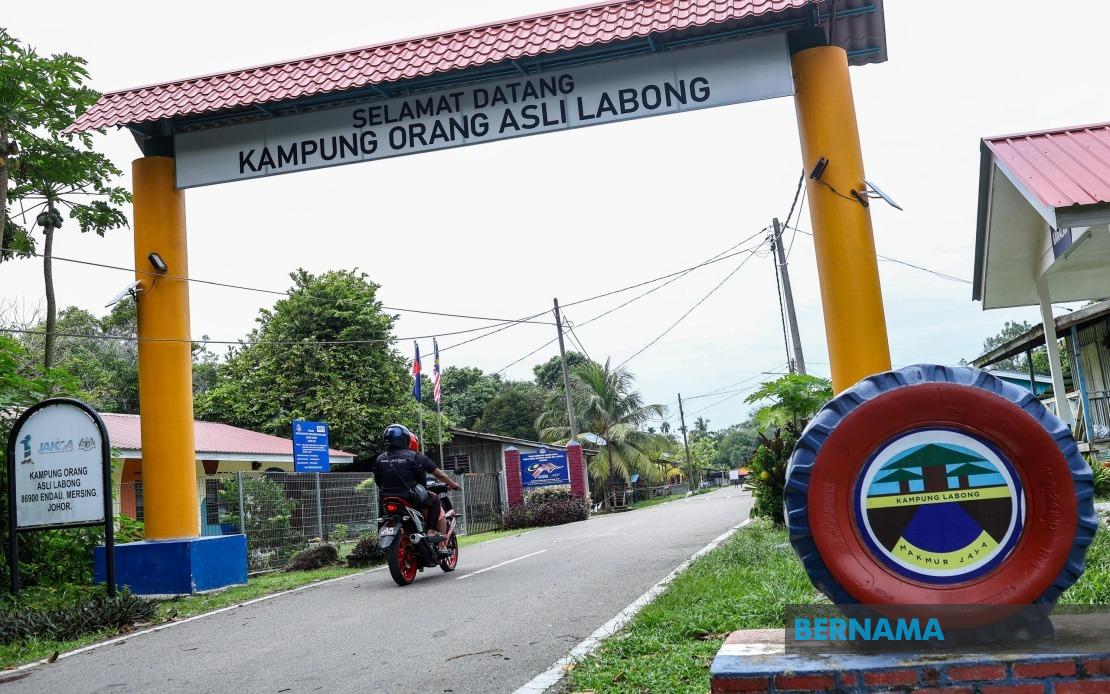
The Johor state government's sustained commitment to uplifting indigenous communities is yielding demonstrable results on the ground, with collaborative efforts between state authorities and the Department of Orang Asli Development (JAKOA) translating into tangible improvements in the lives of Orang Asli residents across the state. In Kampung Orang Asli Labong in Mersing, the impacts of these initiatives are being felt directly by community members who are experiencing enhanced leadership capacity and improved financial support for their daily needs.
Mabot Sela, the 80-year-old Tok Batin of Kampung Orang Asli Labong, has emerged as a vocal advocate for these developments, having personally benefited from the state's multifaceted approach to indigenous welfare. Throughout his leadership of the village, Mabot has maintained a steadfast focus on channelling government assistance and agency resources toward addressing his community's pressing requirements. His effectiveness in this intermediary role has been substantially strengthened by formal training opportunities, which have equipped him with contemporary administrative and governance skills previously unavailable to village leaders in the region.
The leadership development programmes administered by JAKOA represent a significant departure from traditional approaches to indigenous governance. These structured courses have provided Mabot and other community leaders with practical knowledge spanning village administration, resource management, and effective communication with government bodies. Such capacity-building initiatives address a long-standing gap in institutional support for Orang Asli leadership structures, recognising that sustainable development requires empowered local governance rather than top-down implementation alone.
Complementing these leadership interventions, the state government has taken the decisive step of raising monthly allowances provided to village heads and Orang Asli administrators. For someone in Mabot's circumstances, this financial uplift carries immediate practical significance, particularly in managing healthcare expenses and medication costs that frequently strain household budgets in remote communities. The recognition that village leadership roles carry genuine responsibilities has prompted this overdue adjustment to compensation structures, acknowledging the essential service these individuals provide in bridging their communities and state institutions.
Despite these advances, residents of Kampung Orang Asli Labong continue to grapple with environmental challenges that threaten their livelihoods and safety. Mabot has consistently highlighted the recurring problem of crop damage inflicted by wild elephants straying from protected forest areas, as well as the hazards posed by loose cattle wandering through settlements and roadways. These wildlife-related difficulties underscore the complex reality facing Orang Asli communities situated at the interface between conservation zones and human settlement, requiring integrated solutions that balance ecological preservation with community protection.
Among younger residents, perspectives on development reflect both appreciation for current progress and aspirations for further advancement. Sekoi Janja, a 68-year-old resident, articulated a generational consciousness, observing the dramatic transformation in Orang Asli livelihoods from forest-dependent subsistence to more diversified economic engagement. Her hope that younger family members will inherit substantially improved opportunities captures the developmental trajectory many indigenous communities across Southeast Asia are experiencing, though with considerable variability in outcomes.
The skills development imperative emerges clearly from community voices. Norma Lonchai, a 44-year-old trader, articulated a widely-held sentiment that welfare assistance, whilst important, requires complementation through vocational and entrepreneurial training programmes. This perspective reflects sophisticated understanding among Orang Asli communities that sustainable prosperity depends on income-generating capacity rather than indefinite reliance on government transfers. The demand for skills-building opportunities that enhance economic participation signals readiness within these communities to engage more directly in formal economic sectors.
Quantifying the state government's commitment, Johor allocated RM3.8 million during the preceding year to execute nine separate initiatives targeting the approximately 18,000 Orang Asli inhabitants across the state. This budgetary commitment translates to roughly RM211 per capita annually, acknowledging the relatively modest absolute resources devoted to indigenous welfare despite the political priority ascribed to these communities. The allocation encompasses welfare disbursements, educational support, physical infrastructure development, and social cohesion programming, reflecting a comprehensive rather than siloed approach to community advancement.
The breadth of assistance categories approved for Orang Asli communities demonstrates recognition that sustainable development requires multifaceted interventions rather than singular programmatic focus. Education support addresses the historical disadvantage in formal schooling access, whilst infrastructure development tackles the geographic isolation that constrains economic participation. Welfare provisions offer immediate relief, and community development activities strengthen social capital and local institutional capacity. This integrated framework represents best practice in indigenous development policy, though implementation consistency and resource adequacy remain persistent challenges across Malaysia and the broader region.
For Malaysian policymakers and administrators, the Johor experience offers instructive lessons in translating indigenous empowerment rhetoric into concrete institutional practice. The emphasis on leadership capacity-building addresses a frequently overlooked dimension of development—that communities equipped with effective local governance structures can better articulate needs and navigate bureaucratic systems to secure their rightful entitlements. The willingness to enhance financial support to community leaders, though symbolically and practically important, requires scaling across multiple states to achieve meaningful equity outcomes for Malaysia's approximately 180,000 Orang Asli population.
The persistent challenges articulated by Kampung Orang Asli Labong residents—wildlife conflicts, livelihood vulnerabilities, and skills gaps—resonate across Orang Asli settlements throughout Peninsular Malaysia and mirror difficulties faced by indigenous populations across Southeast Asia. Solutions will require not merely increased resource allocation but institutional innovation that genuinely incorporates community perspectives into programme design. The receptiveness expressed by residents to development opportunities, contingent upon quality and relevance, suggests considerable potential for impact if programmes are shaped through genuine community consultation rather than bureaucratic prescription.
Moving forward, Johor's trajectory in indigenous community development warrants close monitoring as a potential model for other states. The combination of leadership development, financial support enhancement, and multi-sector assistance provisions creates a potentially replicable framework. However, translating pilot successes into sustainable, scalable systems requires sustained political commitment beyond electoral cycles and adequate long-term funding mechanisms independent of annual budgetary fluctuations. For Orang Asli communities navigating rapid societal change, the difference between rhetorical commitment and substantive institutional support remains consequential.

