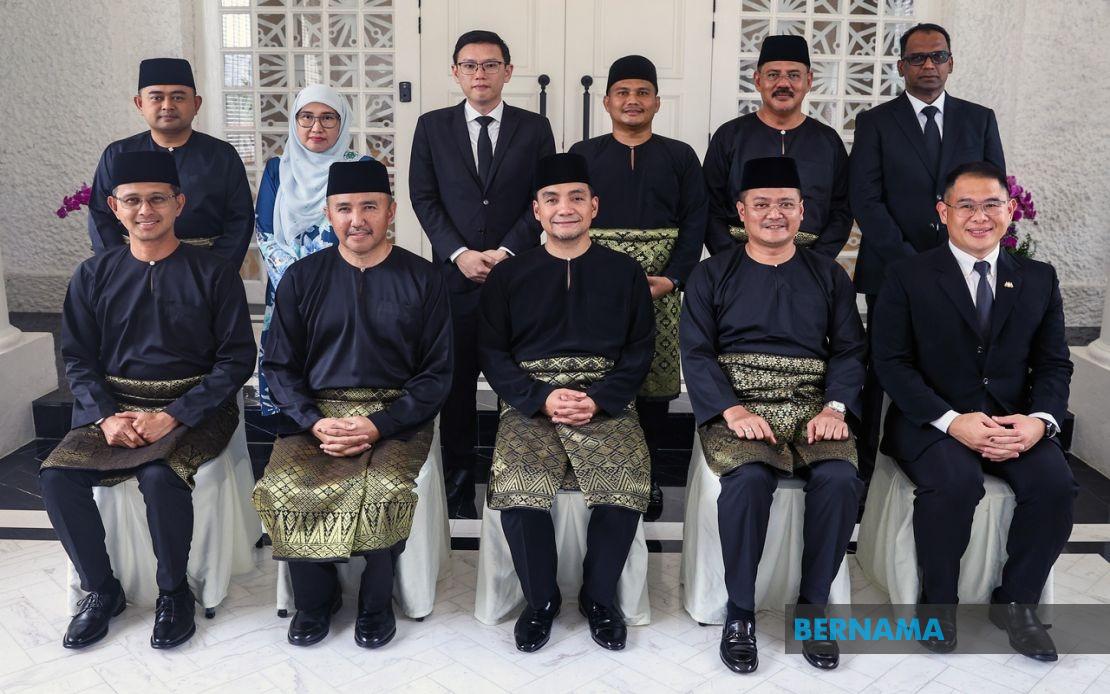
Johor's newly constituted State Executive Council took office in a formal ceremony at Istana Bukit Serene, with all ten members sworn in before Tunku Mahkota Ismail. The cabinet restructuring represents the state administration's response to Barisan Nasional's decisive electoral victory, which secured a substantial majority and the mandate to govern for the new term.
Four portfolio holders are entering the executive council for the first time, bringing fresh perspectives to key ministerial roles. Md Israk Abdullah, representing the Kukup constituency, assumes responsibility for Agriculture, Agro-Based Industry and Rural Development. P. Pannir Selvam, the Perling assemblyman, takes charge of Unity, Heritage and Culture matters. Meanwhile, Hasrunizah Hassan, who represents Pulai Sebatang, will oversee the Women, Family and Community Development portfolio. Rounding out the newcomers is Dr Muhammad Naqib Md Ghazali, whose appointment to the Education and Information Committee marks his entry into state-level governance.
The six continuing members ensure institutional continuity despite the administrative reshuffle. These experienced officials retain their existing portfolios, maintaining consistency in ongoing policy implementation and departmental management. Datuk Mohd Jafni Md Shukor continues steering Housing and Local Government affairs from his Bukit Permai base, while Mohd Hairi Mad Shah persists with Youth, Sports, Entrepreneur and Cooperative Development responsibilities. Mohd Fared Mohd Khalid maintains his position overseeing Islamic Religious Affairs, and Ling Tian Soon continues managing Health and Environment concerns. Lee Ting Han remains focused on Investment, Trade, Consumer Affairs and Human Resources, whilst Mohamad Fazli Mohamad Salleh continues directing the Public Works, Transport, Infrastructure and Communications portfolio.
The cabinet formation follows Onn Hafiz's reconfirmation as Johor Menteri Besar, a position he secured for a consecutive second term following his personal victory in the Machap constituency with a commanding majority of 15,375 votes. The Menteri Besar, who simultaneously chairs Barisan Nasional's Johor operations, presides over a cabinet assembled to reflect both continuity and renewal in state governance. His reinstatement was formally completed in a separate ceremony conducted last Sunday.
Barisan Nasional's performance in the recent state election provided the electoral foundation for this cabinet configuration. The coalition captured 48 of the 56 available state seats, translating into a dominant parliamentary position that extends considerably beyond a simple majority. This commanding electoral mandate affords the state administration substantial latitude in implementing its legislative agenda and policy initiatives across the four-year term. The winning margin represents a significant expression of voter confidence in the coalition's vision for Johor's development.
The distribution of portfolios across the cabinet reflects careful consideration of developmental priorities and constituency representation. The emphasis on portfolio diversity—spanning education, agriculture, investment, and social development—suggests an attempt to address multiple dimensions of state advancement simultaneously. The inclusion of four newcomers potentially signals an intention to inject energetic leadership into specific priority areas whilst leveraging experienced hands to manage established departmental operations.
For Malaysian observers, the Johor cabinet structure carries implications extending beyond state boundaries. As Malaysia's second-most economically significant state after Selangor, Johor's administrative decisions influence regional investment patterns, infrastructure development, and intergovernmental coordination across Southeast Asia's economic corridor. The cabinet's composition and policy priorities will shape the competitive environment for investors considering southern Malaysian locations and influence bilateral relationships with Singapore and other regional partners.
The appointment of Pannir Selvam to cultural affairs carries particular significance given Johor's multicultural composition and its role as a gateway between Peninsular Malaysia and Singapore. Heritage and culture matters increasingly intersect with tourism development and community cohesion strategies, making this portfolio assignment strategically consequential. Similarly, Hasrunizah Hassan's Women, Family and Community Development portfolio placement reflects contemporary governance trends prioritizing gender considerations within development frameworks—an alignment with both domestic policy emphasis and international development standards.
The swearing-in ceremony at Istana Bukit Serene formalised what amounts to Johor's administrative transition following electoral renewal. This institutional moment, whilst ceremonial in appearance, represents the practical embodiment of electoral outcomes translating into governmental structure. The ceremony's formal nature, conducted before the Regent with appointment letters presented and oaths administered, underscores the constitutional propriety governing Johor's governance transitions and the continued observance of constitutional monarchy protocols within the state system.
Looking forward, this cabinet's composition will be tested against the performance expectations established by Barisan Nasional's campaign promises and the specific developmental needs identified in Johor's constituencies. The balance between new appointments and retained experienced officials will likely influence how rapidly new initiatives can be implemented and how effectively departmental operations maintain momentum. The next phase involves translating administrative structure into tangible policy outcomes across the agricultural, industrial, educational, and social development sectors where these portfolios exercise direct influence.

