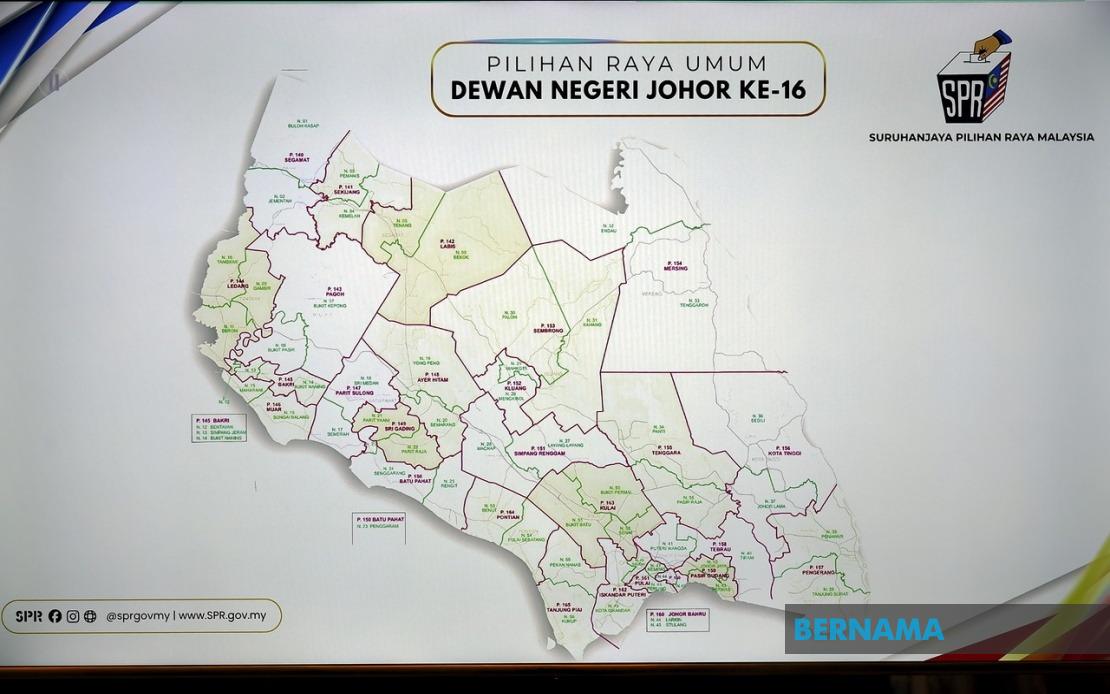
The 16th Johor state election moves into its decisive phase tomorrow when nomination day formally launches the campaign across all 56 state assembly seats. This marks the beginning of an intense political struggle that will reshape the composition of Southeast Asia's most developed state legislature. Candidates will file their nomination papers between 9 am and 10 am at designated registration centres throughout Johor, with the official roster of contenders released following completion of the screening process. The actual polling will occur on July 11, preceded by early voting opportunities on July 7 for those unable to vote on election day.
Johor's electoral landscape has fundamentally transformed since the 2022 state election, reflected in the dramatically altered coalition alignments and candidate selections announced by competing parties. Nearly 2.73 million voters are eligible to cast ballots according to the Election Commission, encompassing over 2.7 million ordinary voters along with 12,041 military personnel and their spouses and 12,710 police officers and their spouses. This substantial electorate will determine control of one of Malaysia's economically vital and politically influential states, making the stakes considerably higher than typical state contests. The size and composition of the voter base suggests that campaigns will necessarily appeal to both urban and rural constituencies, balancing considerations of economic development, social services, and traditional concerns.
Pakatan Harapan has committed maximum resources by fielding candidates across every available seat, distributing its slate between Parti Keadilan Rakyat with 20 nominations, Amanah with 19, and DAP with 17 candidates. This comprehensive approach signals the coalition's determination to reclaim territory lost during the previous election and capitalize on perceived shifts in voter sentiment since 2022. Barisan Nasional has matched this aggressive posture by also contesting all 56 seats through its component parties, deploying 36 UMNO candidates alongside 16 from MCA and 4 from MIC. The decision by both traditional heavyweights to contest every seat intensifies competition and suggests neither coalition expects a repeat of 2022's decisive outcome favoring BN.
Perikatan Nasional, the relative newcomer to Johor's electoral landscape, has established a more selective presence through PAS contesting 11 seats, Bersatu fielding 16 candidates, and the Malaysian Indian People's Party presenting 5 nominees. This targeted approach reflects PN's strategic calculation that certain constituencies represent more fertile ground for its particular appeal, contrasting with the saturation strategy employed by PH and BN. The emergence of Parti Bersama Malaysia preparing to contest 15 seats marks a significant development, as the party makes its electoral debut in Johor and attempts to establish itself as a meaningful political force in state politics. MUDA's presence across 4 seats, while geographically limited, demonstrates how splinter movements have fragmented Malaysia's electoral competition since the dramatic realignments of 2022.
The Election Commission has issued comprehensive guidance to ensure smooth nomination procedures, emphasizing the importance of early verification and timely payment of candidate deposits. Prospective candidates are being encouraged to validate their nomination forms at the Returning Officer's Office or State Election Office well before submission deadlines to avoid procedural rejections that could eliminate candidates from contention. This administrative emphasis reflects lessons learned from previous elections and attempts to minimize disputes arising from technical disqualifications rather than electoral judgment. The requirement that candidates retain deposit payment receipts as proof of compliance creates a clear paper trail establishing compliance with legal requirements, reducing opportunities for later contestation.
Corruption prevention mechanisms have been placed on heightened alert as the Malaysian Anti-Corruption Commission has issued explicit warnings to all candidates and parties regarding prohibited conduct under the MACC Act 2009 and the Election Offences Act 1954. The deployment of five 24-hour operations rooms in Tampoi, Batu Pahat, Kluang, Segamat, and Mersing establishes infrastructure for public reporting of suspected violations throughout the campaign period. This visible anti-corruption posture serves both genuine enforcement purposes and symbolic reassurance to voters that authorities are monitoring electoral fairness. The geographic distribution of operations rooms across different parts of Johor indicates official recognition that corruption risks manifest differently across urban centres, industrial areas, and rural constituencies.
Johor's 2022 election results established the baseline against which the coming contest will be measured. Barisan Nasional achieved commanding dominance by securing 40 of 56 seats, while Pakatan Harapan captured 12, Perikatan Nasional won 3, and MUDA obtained 1 seat. This distribution granted BN clear governance authority while excluding PH from meaningful legislative leverage and limiting both PN and MUDA to marginal roles. The substantial gap between BN's commanding plurality and PH's significantly diminished presence transformed Johor from a competitive battleground into a BN stronghold, a development with implications extending beyond state-level politics to national coalition calculations.
The dissolution of the Johor State Legislative Assembly on June 1 initiated the formal election process, establishing the temporal framework within which campaigns must operate and candidates must organize. This timing, occurring in early June and culminating in July, positions the Johor election as a significant political event occurring during Malaysia's transitional period following national election cycles. The concentration of nomination day, campaigning, early voting, and election day across a compressed timeframe creates intensity that may favor well-organized parties with established machinery while disadvantaging newer entrants attempting to build organizational capacity. The scheduling also occurs during monsoon season considerations and potential public holiday effects that may influence voter participation and campaign logistics.
For Malaysian and Southeast Asian observers, the Johor election carries significance beyond state boundaries. As Malaysia's most developed state by infrastructure and economic indicators, Johor's political direction influences not only its 4.8 million residents but reverberates through national coalition dynamics and regional positioning within ASEAN's economic architecture. The contest between established BN dominance and PH's attempt at resurgence will provide early indicators regarding voter sentiment following the 2022 national election and suggest trajectories for the 2026 federal contest. The performance of Bersama Malaysia and other newer political vehicles will indicate whether Malaysian voters continue fragmenting across traditional coalition structures or whether new political organizing principles are gaining traction. Results will likely influence strategic calculations by all major parties regarding coalition composition, candidate selection methodologies, and campaign messaging for contests yet to come throughout the region.

