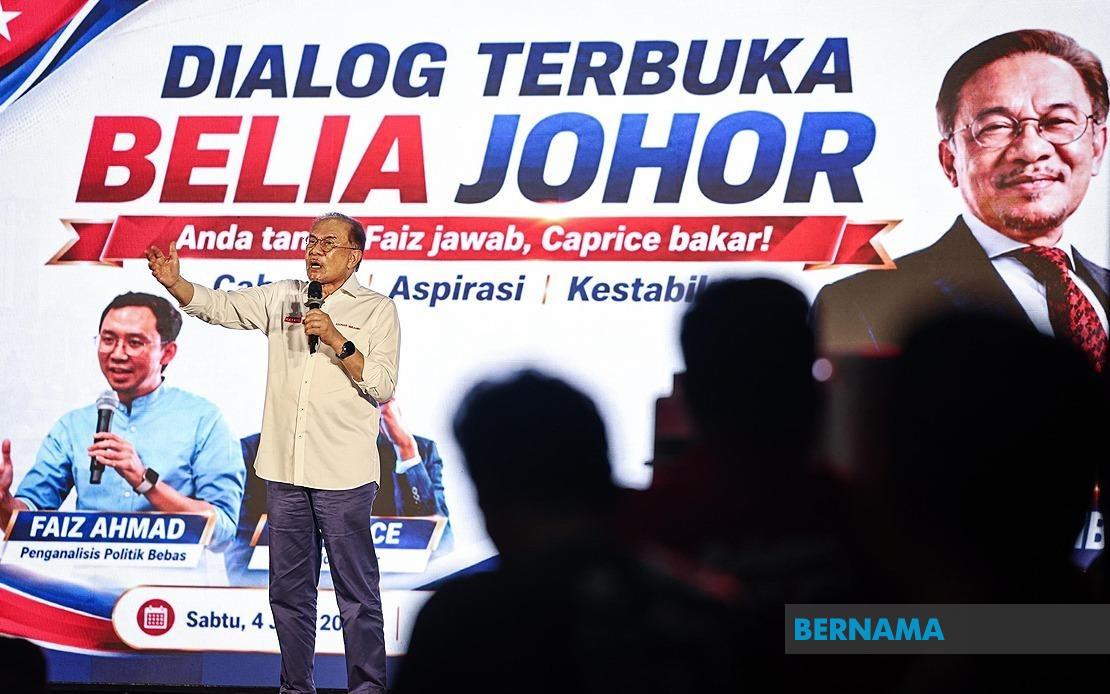
Prime Minister Datuk Seri Anwar Ibrahim has called for a more inclusive approach to development in Johor, one that deliberately addresses the disparities between thriving urban centres and neglected outlying districts. Speaking at a youth-focused gathering in Johor Bahru, he highlighted the urgent need to rebalance investment priorities so that both rural communities and the urban poor benefit from government spending, rather than concentrating resources on prestige projects that primarily serve commercial interests.
The premier's remarks underscore a fundamental tension in Malaysia's development strategy. While mega-projects capture headlines and attract foreign investment, they often bypass the constituencies where basic infrastructure remains inadequate. Anwar's intervention suggests growing recognition within government that this imbalance threatens social cohesion and creates fertile ground for political discontent in peripheral areas. His comments carry particular weight given his position as both PM and, historically, an advocate for the marginalised.
Anwar illustrated his point with a stark geographical comparison: Johor Bahru and its immediate surroundings enjoy sophisticated amenities, yet less than thirty minutes away in areas like Ulu Tebrau, residents lack access to fundamental services. This proximity makes the disparities all the more visible and politically contentious. Such contrasts are common across Malaysia and the broader Southeast Asia region, where rapid urbanisation and development have created enclaves of modernity surrounded by communities with crumbling infrastructure and minimal public investment.
He explicitly cautioned against pursuing glamorous architectural landmarks when communities lack essential facilities. A thirty-storey building in a rural area serves little practical purpose if the surrounding population cannot access quality schools, adequate places of worship, or community gathering spaces. This pragmatic observation challenges the conventional wisdom that equates development with vertical construction and density, suggesting instead that true development is measured by its tangible impact on daily living standards.
The Premier's vision prioritises what he termed "high-impact projects"—those delivering immediate, measurable improvements to people's lives. Affordable housing that families can actually purchase, educational facilities that serve regional populations, modest commercial spaces for vendors, and community halls where residents can organise and gather represent the building blocks of functional societies. These investments generate fewer dramatic visuals for government announcements but produce sustained improvements in quality of life.
Anwar's remarks carry implicit criticism of past development approaches in Johor that concentrated on flagship projects and urban renewal. While such initiatives generate economic activity and tax revenue, they can inadvertently marginalise rural populations who see little tangible benefit. By emphasising basic amenities, the Prime Minister is essentially repositioning development as fundamentally about equity and inclusion rather than mere economic growth figures.
The intervention occurs within the context of a broader Malaysian debate about regional inequality. Johor, as a large and economically significant state, faces particular pressures to maintain growth while addressing persistent spatial disparities. The state's proximity to Singapore creates an export-oriented economy concentrated in urban and port areas, potentially starving interior regions of investment. Anwar's call implicitly acknowledges that market forces alone will not distribute development equitably and that government must actively redirect resources toward underserved communities.
This position also reflects evolving political dynamics within Johor's governance. The presence of Pakatan Harapan's Kempas candidate Faezuddin Puad and PKR Youth chief Muhammad Kamil Abdul Munim at the event signals coordinated messaging around equitable development—a theme likely to resonate with younger voters and rural constituencies. For PKR, which draws significant support from areas outside major cities, emphasising inclusive growth serves both principled and electoral purposes.
The challenge facing Johor and comparable states lies in translating this rhetoric into concrete policy and budgetary allocation. Identifying which rural areas merit priority investment, securing adequate funding without compromising urban infrastructure maintenance, and ensuring effective implementation of distributed projects across dispersed communities requires sophisticated planning and coordination. Half-finished schools and abandoned community centres are as much political liabilities as underinvested areas, making execution critical.
Regionally, Anwar's comments reflect broader Southeast Asian concerns about inclusive growth. As countries across the region experience rapid urbanisation and development concentration, political tensions emerge between thriving cities and struggling hinterlands. Malaysia's experience in managing these tensions—with varying degrees of success—carries lessons for neighbouring countries pursuing similar development paths. Thailand, Indonesia, and the Philippines all grapple with comparable spatial inequalities.
The Prime Minister's framing also addresses a subtle but important psychological dimension of development inequality. When rural communities witness gleaming towers rising in distant cities while their own areas receive minimal investment, perceptions of neglect and marginalisation take root regardless of absolute poverty levels. Conversely, visible investment in local schools, health facilities, and markets signals that government recognises and values these communities. Anwar appears to understand this dynamic of political and social significance beyond mere economic metrics.
Looking forward, the substantive test of these statements will emerge through the budget allocation process and project approvals in coming quarters. Should Johor's administration translate this rhetoric into systematically reweighting investment toward rural infrastructure and community facilities, it could establish a model for more equitable regional development. Conversely, if mega-projects continue dominating the development agenda while peripheral areas receive token investments, the gap between stated policy and actual practice will further erode public trust in government commitments to inclusive growth.

