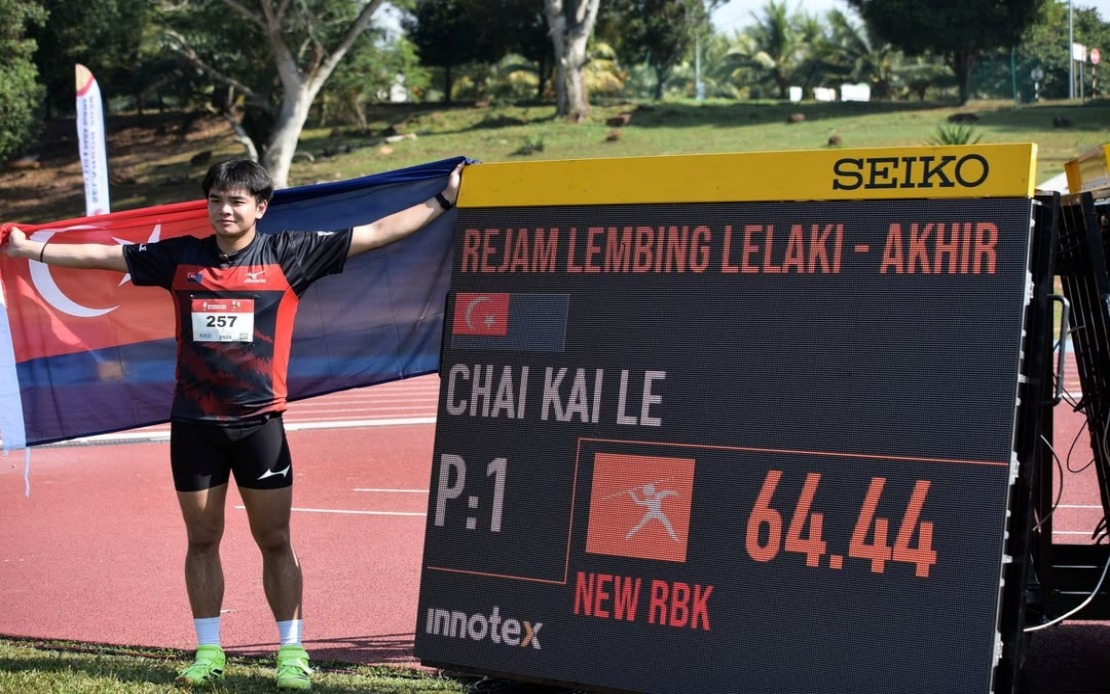
Johor's Chai Kai Le has become the newest name etched into Malaysian sporting history after hurling the javelin 64.44 metres at the Selangor 2026 Malaysia Games held at the Universiti Putra Malaysia Sports Centre in Serdang, demolishing a record that had stood untouched for more than a quarter-century. The 18-year-old's second-attempt throw on August 17 surpassed the longstanding benchmark of 62.33 metres established by Sarawak's Kho Mei Kuan at the 2000 SUKMA in Penang, signalling a generational shift in Malaysian javelin prowess and establishing Kai Le as a prospect with genuine potential on the regional and international stage.
This achievement represents the culmination of a deliberate two-year preparation cycle that Kai Le and his support team invested specifically for the Selangor Games. The young athlete had entered the competition with realistic expectations grounded in his rigorous training regimen, viewing the record as an attainable goal rather than a distant aspiration. His composure and professional approach to competition reflect a maturing attitude increasingly common among Malaysia's younger sporting talents, who are adopting structured, science-based training methodologies rather than relying solely on innate ability.
Kai Le's performance at SUKMA, while impressive, actually falls short of his personal best. The athlete holds the national under-20 record of 65.65 metres, meaning there remains room for further development and improvement even at this early stage of his career. This gap between his personal record and his SUKMA victory suggests that with continued refinement and maturation, particularly as his physique and technique continue to evolve through his late teens and early twenties, significantly greater distances remain within reach for the Johor prospect.
The physical toll of competition became evident following Kai Le's medal-winning throw. He disclosed to reporters that a technical error during his second attempt triggered lower back discomfort, prompting a strategic decision to prioritise injury management over pursuing additional records. This pragmatic approach, where an athlete recognises the risks and chooses to protect long-term wellbeing rather than chase marginal gains, demonstrates maturity that extends beyond technical proficiency. In the demanding throwing disciplines, such decision-making often proves more valuable to career longevity than momentary glory.
The men's javelin podium reflected Johor's dominance in the event, with Kai Le's state teammate Mohd Noor Iman Norman claiming the bronze medal at 59.04 metres. Penang's Tan Chun Wei secured the silver with a respectable 60.43-metre effort, indicating competitive depth across Malaysian states in this track and field discipline. The presence of multiple athletes capable of exceeding 59 metres demonstrates that Malaysian javelin has developed a stronger base of competitive talent, a necessary foundation for identifying and nurturing elite performers capable of competing at Southeast Asian and international levels.
Parallel to Kai Le's javelin triumph, the SUKMA athletics programme witnessed another significant performance in the men's 10,000 metres race walk. Penang's Mohammad Aiman Haikal Sahrudin captured the gold medal with a time of 47 minutes 28.84 seconds, improving markedly on his previous SUKMA campaign when he claimed silver at the Sarawak edition. His victory at Selangor 2026 reflects genuine progression, suggesting his training methodology has yielded tangible improvements and that he has successfully translated preparation into competitive outcomes.
Ahmad Farish Irfan Ahmad Fahmi of Kelantan secured the silver medal in the race walk competition with a time of 47 minutes 37.17 seconds, establishing himself as the nation's second-ranked performer in this discipline. The Federal Territories' Khor Jing Hong rounded out the podium with a bronze medal in 47 minutes 49.27 seconds. Race walking, while not commanding the popular attention accorded to sprints or distance running, represents an increasingly important discipline within Malaysian athletics, offering pathways for athletes whose physiological profiles suit this distinctive event.
Mohammad Aiman's aspirations extend well beyond the SUKMA stage, as he has articulated ambitions to join the national squad and subsequently qualify for the 2027 Southeast Asian Games. Notably, the 18-year-old from Kampung Tanah Liat in Penang has identified a strategic tactical adjustment for his future competitive pathway. The 10,000 metres race walk, while his current SUKMA focus, does not feature on the SEA Games programme, prompting him to redirect his medium-term goals toward the 20,000 metres walk, an event he plans to contest during the remainder of the Selangor Games. This forward-thinking approach demonstrates how elite young Malaysian athletes are strategically mapping their progression through various competitive levels and designing training programmes with specific international targets in mind.
The emergence of quality performances across these SUKMA athletics events carries broader implications for Malaysian sport development. The javelin and race walk disciplines, while not capturing mainstream media attention in the manner of sprinting or football, serve as indicators of the pipeline quality feeding into national sports systems. Kai Le's record-breaking javelin throw and Mohammad Aiman's continuous improvement in race walking suggest that investment in coaching infrastructure, training facilities, and athlete development programmes is yielding measurable returns, even in less high-profile disciplines.
These SUKMA 2026 achievements occur within a regional context where Southeast Asian countries maintain increasingly competitive athletics programmes. Malaysia's capacity to nurture young talents like Kai Le and Mohammad Aiman who can achieve Games records and demonstrate clear pathways toward higher competitive levels remains crucial for maintaining regional sporting credibility. The development of depth in multiple disciplines, rather than concentration in a handful of events, strengthens the overall national athletics portfolio and creates a healthier competitive environment.
For Malaysian sports administrators and coaches, these performances underscore the value of sustained, systematically planned athlete development. Kai Le's two-year preparation specifically targeting SUKMA success, combined with his retention of a personal best well above his Games record, illustrates how structured programmes can balance short-term competitive goals with long-term athlete development objectives. Similarly, Mohammad Aiman's progression from silver to gold across consecutive SUKMA editions, coupled with his deliberate strategic positioning toward SEA Games qualification, demonstrates how talented young athletes benefit from comprehensive guidance extending beyond immediate competition.
Looking forward, both Kai Le and Mohammad Aiman represent the calibre of emerging talent that Malaysia requires to sustain competitive athletics at regional level. Their willingness to engage with professional training structures, accept coaching guidance, and strategically plan career trajectories suggests a generational shift toward more systematic athlete development. As these young competitors mature and potentially achieve greater heights at SEA Games, Asian Games, or international world championship circuits, they will carry forward the momentum established at the Selangor SUKMA edition, potentially inspiring additional cohorts of Malaysian youth to pursue excellence in track and field disciplines traditionally less visible than mainstream sports.

