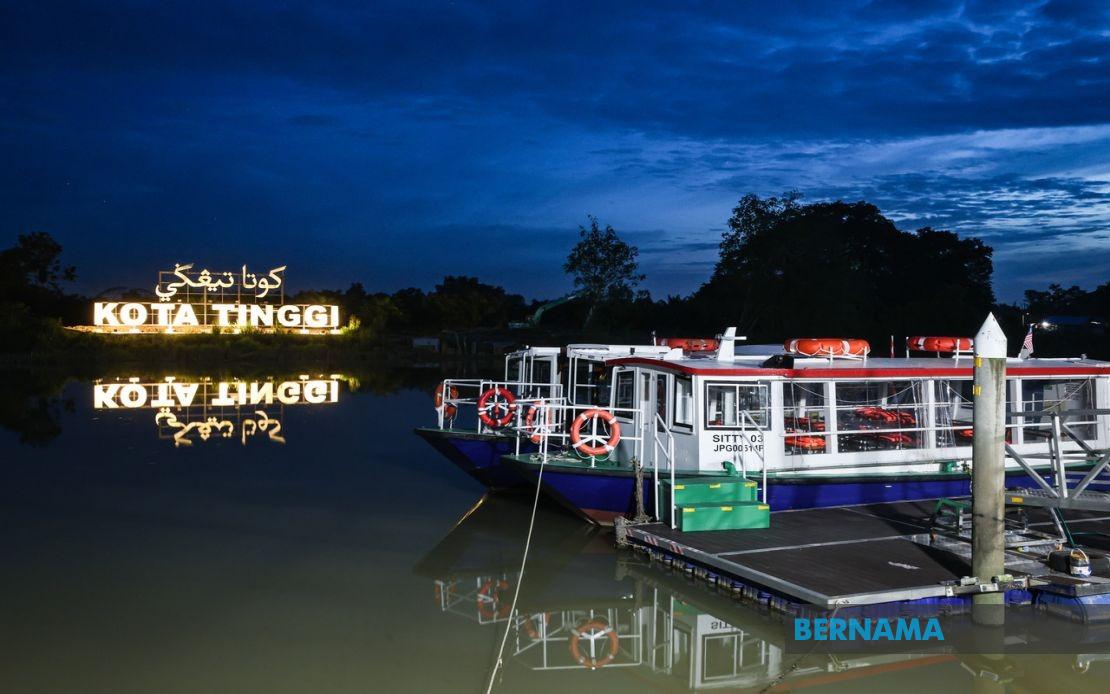
The gentle progression of a motorised vessel across Sungai Johor signals the beginning of an exploration that seamlessly intertwines natural splendour with the forgotten chapters of Johor's imperial past. Departing from Pangkalan Kota Jetty, passengers leave behind the commercial vibrancy of Kota Tinggi town as verdant riverbanks slowly envelop the waterway, creating an immersive sanctuary removed from contemporary urban rhythms. This transition from modern settlement to wilderness forms the conceptual heart of Kota Tinggi River Cruise, an enterprise that has crystallised into one of Johor's most compelling ecotourism propositions ahead of the Visit Johor 2026 campaign.
The 6.7-kilometre voyage operated by Kota Tinggi River Cruise (KTRC) transcends conventional tourism by situating Sungai Johor within its proper historical context. According to KTRC operations manager Aiman Haikal Mohd Azmi, the river functioned as the arterial system sustaining the Johor-Riau Sultanate after Malacca's collapse in the sixteenth century. This historical dimension distinguishes the cruise from purely recreational waterway experiences found elsewhere in Southeast Asia. The river witnessed the establishment of early centres of authority including Johor Lama and Kampung Makam, where numerous sultans from Johor's royal line were interred. Such layered historical significance transforms the journey into an educational expedition through sultanate archaeology.
The commercial response to this offering has exceeded expectations since operations commenced. Within the first seven months, the cruise attracted more than 10,000 passengers, a figure encompassing both domestic and international travellers. Visitors have journeyed from Singapore, Indonesia, and Brunei, indicating that the product appeals across national boundaries within the broader Southeast Asian market. This multisource visitor base suggests the cruise addresses a regional appetite for experiential tourism that balances relaxation with cultural and historical substance, a demographic segment increasingly valued by national tourism authorities.
The daytime experience presents passengers with multiple photogenic landmarks distributed along the riverscape. Titian Laksamana, a pedestrian suspension bridge, and the Johor River Barrage stand as principal attractions for photography aficionados seeking composition opportunities. The journey, typically consuming approximately one hour, incorporates narrated historical content delivered either through recorded audio systems or live interpretation by trained guides. Passengers encounter narratives concerning Sultan Mahmud Mangkat Dijulang and Laksamana Bentan, figures whose legacies shaped maritime trade and statecraft in the region. Concurrently, travellers observe architectural remnants positioned along the riverbanks, tangible evidence of settlements that flourished centuries ago. The vantage point afforded by the river permits novel perspectives of Kota Tinggi itself, allowing passengers to perceive their municipality through an alternative spatial relationship.
The operational offering extends beyond daytime excursions to encompass evening experiences calibrated to seasonal natural phenomena. KTRC's signature Mesmerising Fireflies package capitalises on nocturnal illumination produced by thousands of bioluminescent insects congregating along particular river sections during specific periods. This offering transforms the river environment entirely, replacing daylight visibility with a landscape composed primarily of natural luminescence, creating an atmospheric quality distinct from the morning journey. The firefly experience represents a sophisticated recognition that the same waterway presents fundamentally different experiential possibilities depending on temporal positioning.
Accommodating visitors with divergent preferences, KTRC introduced a Dining Cruise alternative that merges culinary provision with panoramic observation. Passengers consume meals whilst witnessing Kota Tinggi's landscape unfold across the riverbanks, integrating gastronomic and visual stimulation into a unified experience. This diversification strategy recognises that contemporary tourism consumers increasingly expect bundled experiences combining multiple sensory and aesthetic dimensions rather than single-purpose activities.
Operational logistics demonstrate professional service architecture. The cruise operates throughout daily hours commencing at 9 am on weekdays and extending until 7 pm, with hours prolonged until 10 pm during the weekend period. Vessels depart hourly, facilitating flexible visitor scheduling without rigid timetable constraints. Pricing structures differentiate between passenger categories, with daytime cruises charged at RM20 for adults, RM15 for children, and RM10 for senior citizens and persons with disabilities. Sunset and firefly experiences command marginally elevated tariffs of RM23, RM17, and RM13 across equivalent categories. This graduated pricing acknowledges diverse visitor capacities whilst maintaining accessibility for economically constrained segments.
Aiman Haikal articulated aspirations extending beyond commercial success, emphasising conservation and community economic impact. He characterised nature and heritage-oriented tourism ventures as instruments protecting riparian ecosystems whilst simultaneously generating income channels for peripheral communities dependent upon traditional economic structures. This framing positions KTRC within the broader sustainability discourse prevalent in contemporary tourism governance, particularly relevant as Malaysia navigates balancing development imperatives with environmental stewardship commitments.
The cruise initiative aligns substantively with state government priorities regarding tourism diversification. Rather than concentrating visitor investment exclusively within established urban or resort destinations, Johor state governance appears committed to distributing tourism benefits geographically, channelling visitor expenditure towards secondary settlements and rural regions. Kota Tinggi, whilst historically significant, lacks the international brand recognition commanded by destinations such as Kuala Lumpur or Penang. The river cruise consequently functions as a strategic mechanism for establishing destination identity within competitive regional tourism markets. Success here potentially establishes templates for comparable regional ecotourism initiatives elsewhere in Malaysia, where historical riverscapes and natural features remain underutilised tourism assets.
For Malaysian readers accustomed to predominantly urban tourism infrastructure, the Sungai Johor cruise represents an alternative conceptualisation of experiential travel that privileges historical consciousness and environmental immersion. The venture demonstrates how regional destinations can leverage distinctive historical narratives and natural characteristics to construct competitive tourism products without replicating models employed by established international attractions. As Southeast Asian tourism patterns continue evolving toward more experiential and sustainably conscious consumption, initiatives exemplified by the Kota Tinggi River Cruise may increasingly define regional competitive positioning within global travel markets.

