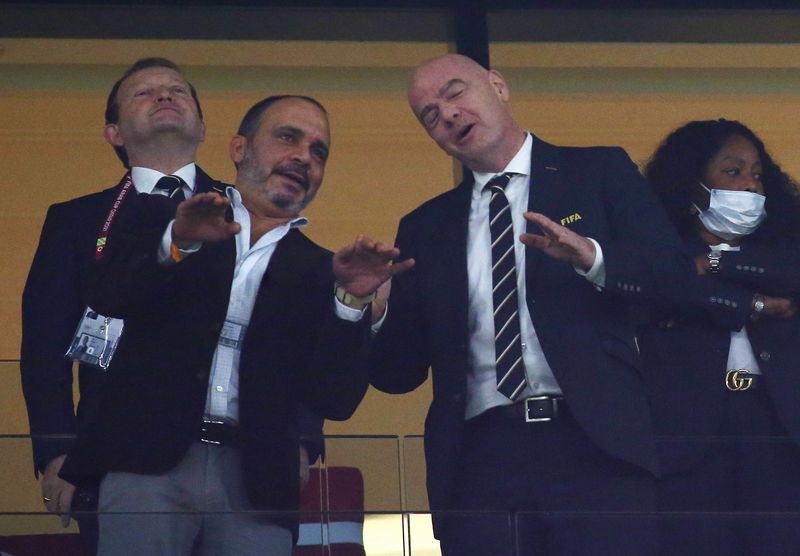
The head of Jordan's national soccer authority has launched a stinging public rebuke of FIFA President Gianni Infantino, accusing the Swiss official of leveraging institutional support as leverage for personal political backing. Ali bin Hussein, president of the Jordan Football Association, alleged on Tuesday that FIFA representatives made verbal overtures during the World Cup suggesting that endorsing Infantino "would go a long way to helping our FA out," following months in which the global soccer governing body had resisted providing assistance on matters material to Jordan's footballing infrastructure and operations. Hussein characterized this approach as unethical conduct inconsistent with the standards Jordan upholds, asserting publicly that his federation would neither have supported Infantino in the past nor would do so presently, and declaring the entire arrangement an instance of coercive behaviour to which his organization refuses capitulation.
Hussein's public denunciation arrives amid mounting turbulence within FIFA's institutional hierarchy, as Infantino confronts accelerating resistance from confederations and member associations worldwide. The FIFA president has been forced to shelve an ambitious commercial initiative that would have transferred minority ownership stakes in the organization's World Cup operations to external investors, a scheme designed to generate billions of dollars for global sports infrastructure development. National soccer bodies and confederations across multiple continents rejected this proposal following a September 19 deadline imposed unilaterally by the FIFA leadership, signaling organized pushback against what many perceived as an overreach by Infantino's administration.
Key figures within FIFA's own management structure have moved to create distance from the embattled president. FIFA Secretary General Mattias Grafstrom and renowned football executive Arsene Wenger both separated themselves publicly from Infantino's direction, with Hussein himself asserting that institutional leadership had become problematic. This fracturing of support within soccer's governing apparatus suggests that Infantino's authority, while technically intact, faces serious legitimacy challenges that could constrain his capacity to advance future initiatives.
Hussein itemized grievances specific to Jordan's experience navigating FIFA's bureaucratic and financial structures, issues that illuminate broader inequities faced by smaller football nations with constrained resources. Jordanian supporters have encountered prohibitively expensive ticket pricing for matches, yet simultaneously have been denied entry visas to attend fixtures during the World Cup held in the United States, creating a frustrating paradox whereby fans cannot financially access experiences they have already funded. These access barriers disproportionately affect supporters from developing economies and smaller nations, who often sacrifice greater proportions of household income for international tournament participation.
The federation has similarly faced an extended delay in receiving contractual payments owed to players for their participation in the 2025 Arab Cup, a FIFA-organized competition where Jordan reached the final. Despite FIFA's publicly documented financial reserves numbering in the billions of dollars, the organization has withheld these disbursements for extended periods, creating cash flow difficulties for the association and frustration among athletes who have fulfilled their contractual obligations. Hussein underscored this contradiction explicitly, noting that FIFA frequently touts its substantial financial position while simultaneously delaying compensation to smaller federations.
Jordan confronts a particularly inequitable taxation burden stemming from its participation in the 2026 World Cup on United States soil. The federation has incurred substantial tax liabilities imposed by the United States government through FIFA's administrative structures, costs that were conspicuously absent for teams based in Canada and Mexico, nations where portions of the tournament are also staged. Hussein characterized this differential treatment as creating "huge costs in taxes for having participated," diverting resources that should properly flow to player compensation and operational staffing. This asymmetry raises questions about whether FIFA has adequately negotiated host country tax arrangements to protect smaller member associations from disproportionate financial exposure based on geographical location.
Jordan's maiden World Cup qualification represented a historic achievement for the kingdom's football development, yet the experience has been complicated by institutional barriers and financial complications that extended beyond the pitch itself. The team's group stage exit, while disappointing competitively, has been accompanied by persistent administrative and financial friction with FIFA structures. Hussein's public airing of these grievances signals that smaller nations increasingly view FIFA's institutional framework as operating in ways that disadvantage them systematically, whether through access restrictions, payment delays, or unexpected tax liabilities.
The timing of Hussein's accusations carries particular significance for FIFA's governance trajectory. Infantino's proposal to monetize World Cup operations represented an assertion of his authority to reshape FIFA's financial model substantially, potentially generating resources that might have addressed some of the grievances smaller federations articulate. The withdrawal of this initiative under confederation pressure suggests that FIFA's membership retains meaningful veto power, yet Hussein's allegations indicate that this power may need exercising with greater frequency to counterbalance what he characterizes as increasingly coercive institutional practices.
For Southeast Asian football federations navigating comparable resource constraints and FIFA relationships, Hussein's public stand carries instructive implications. The Jordan FA chief's willingness to publicly document allegations of inappropriate pressure from FIFA leadership, combined with his specification of concrete financial grievances, establishes precedent for other smaller confederations considering whether to voice similar complaints. Malaysia, Thailand, Vietnam, and other regional associations operate within similar structural disadvantages relative to wealthy European and South American football superpowers, facing comparable access barriers, payment delays, and operational resource limitations within FIFA's ecosystem.
Hussein's allegations also illuminate the tension between FIFA's stated commitment to global soccer development and its institutional practices that appear to disadvantage the very federations most dependent on development support. The organization's ability to withhold assistance as negotiating leverage, delay player compensation indefinitely, and impose unequal tax burdens undermines its credibility as an impartial steward of global football interests. Whether other federation heads will follow Hussein's example by publicly confronting these practices remains uncertain, but his willingness to articulate specific grievances in unambiguous language may embolden other nations to voice comparable frustrations with FIFA's institutional conduct.

