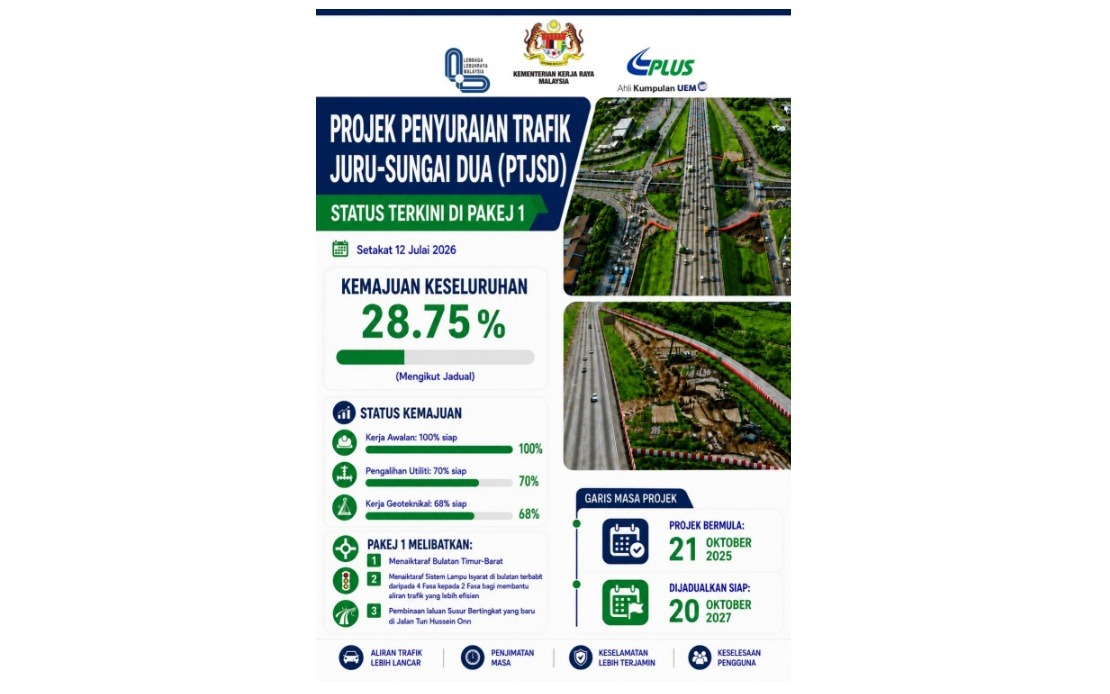
The Juru-Sungai Dua Traffic Dispersal Project (PTJSD) is progressing at a steady pace, with Package 1 achieving 28.75 per cent completion as of mid-July and tracking to its planned timeline. Operated by PLUS Malaysia Berhad, this significant infrastructure undertaking represents a major commitment to addressing chronic congestion on one of Malaysia's most vital transportation corridors, which links Penang to northern peninsula states.
Key components of the first package are advancing substantially. Preliminary works have been fully finished, while utility relocation efforts stand at 70 per cent of completion. The geotechnical investigations and groundwork, crucial for ensuring structural integrity of the planned infrastructure, have reached 68 per cent progress. These foundational stages are essential precursors to the main construction phases that will follow in subsequent project packages.
The first package of the PTJSD encompasses three distinct improvements to critical junctions. Work includes upgrading the East-West Roundabout, a key interchange handling thousands of vehicles daily, alongside a comprehensive redesign of the traffic light system at that location. Perhaps most significantly, engineers are constructing a new elevated slip road along Jalan Tun Hussein Onn that will redirect traffic flows and create new movement patterns reducing bottlenecks. Together, these interventions aim to fundamentally reshape how traffic navigates this crucial node.
The entire initiative stretches 17.3 kilometres across three administrative districts in Seberang Perai—the South, Central, and North divisions—making it a region-wide undertaking rather than a localised fix. This geographic scope underscores the severity of congestion issues that extend well beyond a single junction or road segment. An estimated 200,000 vehicles traverse this corridor daily, representing the intensity of demand on existing infrastructure that has struggled to cope with years of accumulating traffic volume.
Financial commitment to the project reflects its strategic importance. The PTJSD carries a projected cost of RM3 billion, positioning it among Malaysia's more substantial infrastructure investments. This substantial expenditure signals government recognition that incremental improvements are insufficient, and that transformative capacity-building is required to address the scale of the congestion problem. The scale of investment also indicates confidence in the project's long-term value and economic justification.
The anticipated completion target of October 2027 provides nearly three years for the remaining 71 per cent of work to proceed. Traffic modelling undertaken during project planning suggests that when fully operational, the new direct Juru-Sungai Dua route will absorb approximately 30 per cent of existing traffic volume, effectively diverting nearly one-third of vehicles from congested alternative roads. This strategic traffic redistribution is projected to reduce current peak-hour travel times from approximately 60 minutes to merely 20 minutes—a dramatic 67 per cent reduction that would transform commuting experiences and economic productivity throughout the region.
The implementation framework involves collaboration between three institutional partners: PLUS Malaysia Berhad as the operator, the Ministry of Works providing policy oversight, and the Malaysian Highways Authority contributing technical expertise and regulatory authority. This multi-agency coordination reflects the complexity of executing major transport infrastructure projects that affect multiple jurisdictions and stakeholder groups. Such partnerships are increasingly common in Southeast Asia as governments recognise that infrastructure challenges exceed the capacity of single organisations.
The decision to pursue this project emerged directly from documented traffic congestion problems on the Juru–Sungai Dua corridor that have persisted for years. The corridor functions as the primary connecting artery between Penang and northern peninsula states including Kedah, Perlis, and parts of Perak. Any delays or constraints on this route cascade through the entire regional transport network, affecting supply chains, tourism movements, and commuter flows. The PTJSD therefore addresses a bottleneck of regional significance extending well beyond Penang itself.
For Malaysian readers, particularly those in the northern region, the PTJSD's progression carries tangible implications. The promised travel time reductions would translate into meaningful improvements in daily commuting, reduced fuel consumption, and decreased vehicle wear through less idling and stop-start driving. Businesses dependent on timely transportation of goods would benefit from improved reliability and reduced transport costs. The improved safety aspects mentioned in PLUS's announcements likely refer to better intersection design and modern traffic management systems that reduce conflict points and accident risk—a secondary but important benefit of comprehensive road upgrading.
The project also exemplifies broader Malaysian infrastructure strategy as the nation seeks to enhance transportation efficiency across major corridors. Southeast Asian nations increasingly recognise that economic competitiveness depends partly on transport infrastructure quality and reliability. Malaysia's positioning as a regional trade hub and manufacturing centre makes reliable transport connections essential for maintaining foreign investor confidence and supporting business logistics networks. The Juru-Sungai Dua improvements therefore serve both local commuter needs and broader national economic objectives.
Maintaining this project's schedule will require managing complex logistics, coordinating utility relocations with telecommunications and water companies, ensuring that weather disruptions—particularly monsoon seasons—do not derail progress, and maintaining construction workforce stability. The halfway-point will arrive around mid-2026, at which stage the momentum must be sustained through the more demanding main construction phases. Regular progress updates, like the recent announcement, serve important communication functions in maintaining public confidence and stakeholder engagement throughout the implementation period.

