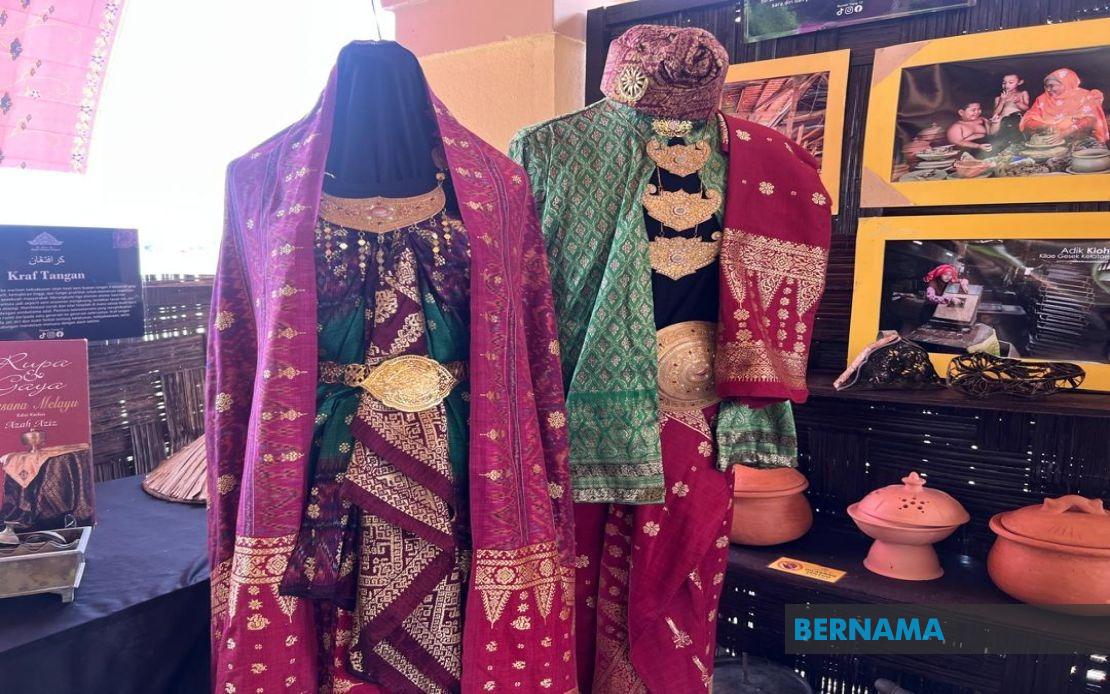
The delicate art of Kain Lima weaving, a centuries-old Malaysian textile tradition distinguished by its meticulous craftsmanship and reflective colour effects, stands on the precipice of permanent loss as the community of skilled weavers continues to shrink. This distinctive fabric, which has graced the courts of Malay royalty and embodied cultural sophistication for generations, now survives primarily through the efforts of a diminishing handful of practitioners and heritage conservationists scrambling to prevent its disappearance into forgotten history.
Unlike the more widely recognised songket with its golden and silver threadwork, Kain Lima represents a fundamentally different artistic approach to textile production. The defining characteristic of Kain Lima lies in its sophisticated weaving methodology, which employs tied or resist-dyed threads combined with an elaborate weaving process to generate intricate motifs accompanied by a distinctive iridescent quality that shifts colour depending on the viewing angle. This sophisticated technique creates patterns and colour interplay impossible to achieve through conventional embellishment methods, elevating each completed piece into a singular artwork rather than a mass-produced commodity.
According to Nik Mohd Murdani Nik Hassan, caretaker at Galeri Rumah Tiang 12, the production demands of Kain Lima explain both its rarity and contemporary market value. The fabrication of even a single length requires extraordinary precision, as each decorative element must be individually arranged through the combination of multiple coloured threads before the actual weaving commences. Those intimately acquainted with traditional Malaysian textiles can immediately recognise Kain Lima through its distinctive pattern arrangement, the structural complexity of its weave, and the particular materials incorporated into its construction—characteristics that set it apart unmistakably from simpler textile forms.
The economic reality of Kain Lima production underscores the challenge facing contemporary artisans. Current market pricing for individual pieces ranges between RM3,000 and RM4,000, with variations dependent upon the textile's age, the complexity of its motifs, its physical condition, and the exceptional calibre of the weaving execution. Historically, Kain Lima transcended ordinary fabric to become a symbol of elevated status, appearing primarily in the wardrobes of royal families who incorporated it into formal sarongs, ceremonial shawls, and state occasion garments. This association with aristocratic privilege, though historically prestigious, has ironically contributed to its contemporary obscurity among ordinary Malaysians.
The challenge of sustaining this textile tradition has prompted cultural institutions to adopt preservation strategies centred on public education and exhibition. Galeri Rumah Tiang 12, where Nik Mohd Murdani has worked since 2020, now functions as a repository and exhibition space for Kain Lima collections assembled by private enthusiasts. The gallery's curatorial mission focuses specifically on reintroducing Malay textile heritage to contemporary audiences, particularly by enabling direct visual comparison between Kain Lima, songket, and other traditional textile forms that have become progressively harder to locate in functional use or private collections. Such exhibitions serve the dual purpose of document preservation and cultural awakening among younger generations.
For practising artisans and heritage craftspeople, these institutional preservation efforts carry genuine significance. Nur Anira Akmal Che Abdul Aziz, a 34-year-old handicraft designer based in Pasir Mas, represents the demographic of creative professionals seeking to maintain connections with traditional techniques while developing contemporary applications. Her attendance at heritage textile exhibitions stems from a deliberate strategy to deepen her understanding of historical production methods, decorative principles, and structural aesthetics that distinguish authentic traditional work. Each exposure to these exhibitions generates fresh conceptual material for her own creative practice, strengthening her commitment to producing craft items that integrate recognisable local cultural elements into modern functional designs.
The disappearance of Kain Lima production reflects broader Southeast Asian challenges in preserving labour-intensive handicraft traditions within economies increasingly dominated by industrial production and digital entertainment. The transition from traditional textile production to contemporary livelihoods represents not merely an economic shift but a severing of intergenerational knowledge transmission. Young Malaysians pursuing textile arts face a dual problem: the technical mastery required demands years of dedicated apprenticeship during which income remains minimal, while market demand for authentic, labour-intensive textiles continues declining as affordable industrial alternatives proliferate globally. The decision to pursue Kain Lima mastery thus requires genuine cultural conviction rather than economic rationale.
Regional and national governments have begun acknowledging this heritage crisis, though intervention remains limited compared to the scale of the challenge. The Festival Kesenian Rakyat Kelantan, where these preservation discussions occur, provides crucial platform space for heritage advocates, though festivals alone cannot sustain living traditions. Effective preservation requires integrated approaches encompassing formal apprenticeship programmes with income support, domestic and international market development for authenticated heritage textiles, and educational curricula introducing young Malaysians to their own cultural material heritage. Without such comprehensive intervention, Kain Lima risks joining the lengthening catalogue of abandoned crafts known only through museum collections and historical documentation.
The implications extend beyond mere aesthetic loss. Kain Lima represents embodied knowledge about colour theory, weaving mathematics, material properties, and artistic composition that developed across centuries of experimentation and refinement. This knowledge, once lost, cannot be simply reconstructed through historical research; it exists only in the muscle memory and intuitive understanding of living practitioners. The extinction of such knowledge represents an irreversible diminishment of human creative capacity and cultural diversity, outcomes that resonate particularly acutely across Southeast Asia, where rapid modernisation has already erased countless local artistic traditions during the past seventy years.

