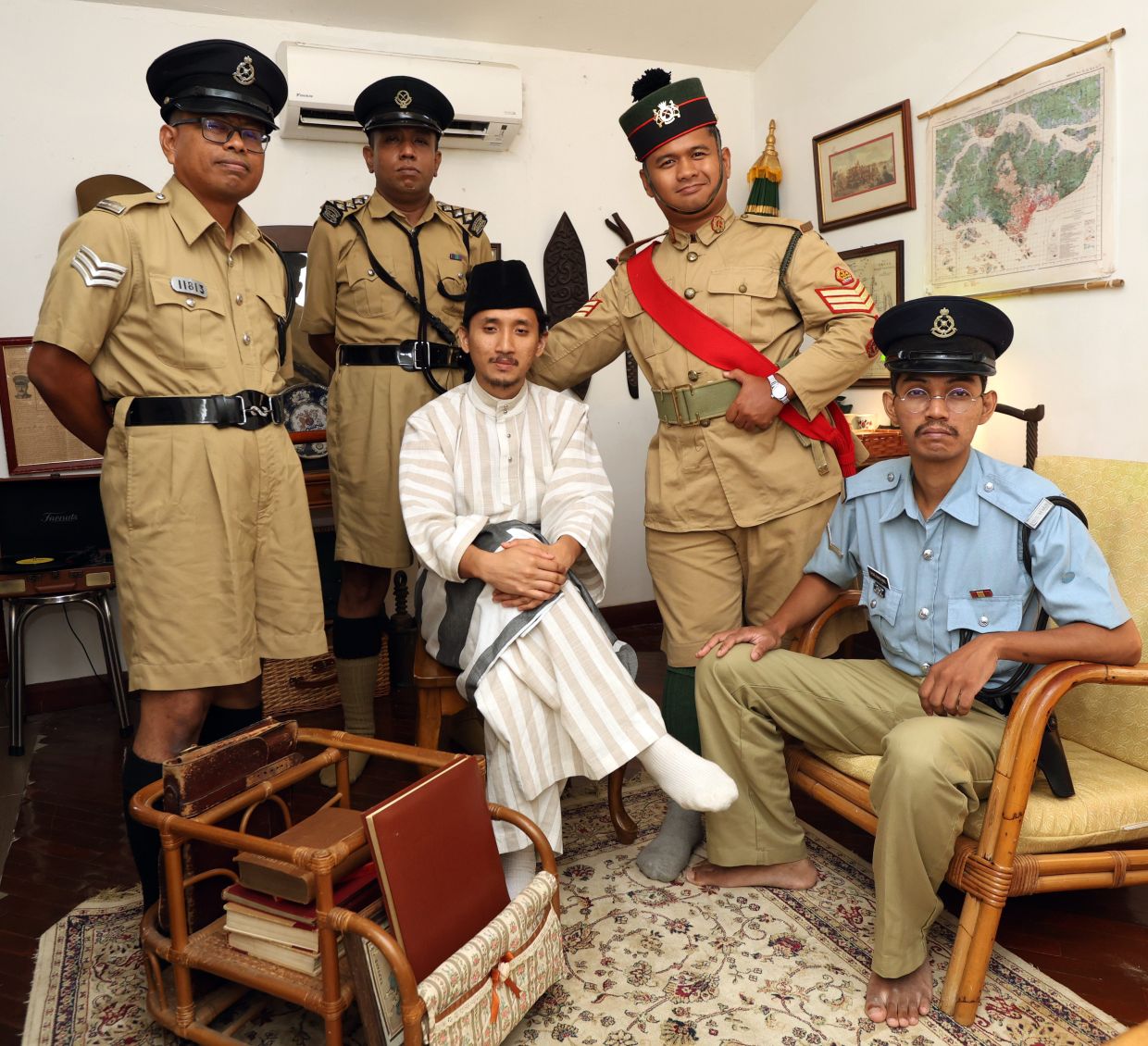
On weekends across Malaysia, members of Persatuan Reka Ulang Sejarah (PRUS) gather in period military uniforms to recreate the movements, mannerisms, and protocols of soldiers from different eras in the nation's past. What began as casual meetings among vintage uniform enthusiasts has evolved into a formal educational initiative, with the group officially registering as a society in 2023 to expand its reach into schools, museums, and public events. For these dedicated hobbyists, history transcends the confines of classroom walls and dusty archives—it becomes tangible, wearable, and demonstrable through meticulous reconstruction of historical authenticity.
The roots of PRUS trace back to the early 2010s, when collectors of military memorabilia and uniforms converged at an exhibition organised by the Port Dickson Army Museum at the decommissioned Royal Malaysian Air Force Base in Sungai Besi, Kuala Lumpur. Operating initially under the informal banner "We Are Re-enactors," these enthusiasts recognised a shared passion not merely for collecting artefacts but for understanding the contexts in which they were used. The transition to formal registration reflected a deliberate shift in purpose—from hobby to heritage preservation and public education. This transformation mirrors growing recognition across Southeast Asia that experiential learning can complement traditional historical instruction, particularly in engaging younger generations who may find conventional pedagogy disconnected from their lived reality.
Chairman Abdul Hakim Abdul Rani articulated a driving motivation behind PRUS's establishment: he had observed widespread confusion surrounding historical military uniforms, especially from periods when photography existed only in black and white and different service branches appeared superficially identical. The inability to distinguish uniforms across eras represented a broader knowledge gap. By creating a platform for sharing accumulated expertise through public exhibitions and school presentations, PRUS members positioned themselves as interpreters bridging the distance between archival records and public understanding. This mission carries particular significance for Malaysia, where competing narratives about the pre- and post-Independence military legacy sometimes circulate without adequate grounding in visual documentation and material evidence.
The group's commitment to historical fidelity extends far beyond merely donning period clothing. Members study original military manuals, practice authentic marching techniques, adopt era-appropriate body language and speech patterns, and meticulously research the codes of conduct that governed soldiers in specific decades. During a two-day, one-night jamboree held in July, participants underwent training in navigation, map reading, and combat manoeuvres based on pre-Independence protocols. Abdul Hakim, drawing on his prior service with the Territorial Army (Askar Wataniah), led these sessions with both technical expertise and educational purpose. Notably, the re-enactments employ wooden sticks rather than actual weapons to comply with regulations, ensuring that immersive learning remains legally and safely conducted while maintaining pedagogical integrity.
The distinction between entertainment and education remains central to PRUS's philosophy. Unlike generic historical costume events that prioritise aesthetic appeal or spectacle, the society approaches re-enactment as a discipline requiring rigorous preparation. Members invest substantial time studying period documents, examining photographs, consulting military historians, and consulting with museum curators to ensure accuracy in every detail—from the correct way to fold a uniform to the precise cadence of period-appropriate marching. This methodical approach reflects recognition that when historical recreation reaches schools and younger audiences, inaccuracies can fossilise into misunderstandings that persist into adulthood. The stakes of fidelity, therefore, extend beyond enthusiast circles into the broader project of shaping historical consciousness among Malaysian youth.
PRUS's engagement with the film and television industry represents another significant dimension of its work. The society advises productions on costume authenticity and occasionally provides members as extras, ensuring that Malaysia's growing media landscape portrays historical periods with visual credibility. Vice chairman Mohd Fadzreeq Mokti emphasises that this role transcends acting—it represents an extension of the society's core mission to present how Malaysian soldiers actually looked and behaved during specific historical periods. As productions increasingly reach international audiences and shape perceptions of Malaysian history, the contribution of such specialist consultants becomes culturally consequential, distinguishing documentarily-informed portrayals from imaginative fiction that risks perpetuating misconceptions.
The group's activity intensifies during August and September, coinciding with Malaysia Day celebrations and National Month observances, when exhibitions and public presentations become particularly concentrated. These heightened periods of engagement reflect strategic recognition that national commemorations create receptive audiences and institutional openings. Museums and schools invite PRUS members to populate exhibitions and classroom visits, reaching students who might otherwise encounter history exclusively through textbooks and passive classroom instruction. Abdul Hakim has observed alarming gaps in young people's familiarity with crucial historical figures and pivotal events, a concern he attributes partly to over-reliance on traditional pedagogical methods that fail to capture student imagination or facilitate retention through multisensory engagement.
The school environment constitutes a particularly fertile ground for PRUS's interventions. Mohd Fadzreeq, who works as a teacher and holds the position of vice chairman, has witnessed firsthand how his students' enthusiasm transforms when he appears in historical uniform—an appearance approved by school leadership. Students consistently inquire when they will see him next in period dress, revealing pent-up curiosity about history that conventional lessons had not fully activated. He attributes this responsiveness to the hands-on, visual, and embodied nature of re-enactment, which accommodates diverse learning styles and generates emotional connections to historical content. Young children, in particular, demonstrate heightened engagement with tangible artefacts and live demonstration rather than abstract textbook descriptions, a pedagogical reality that professional educators increasingly acknowledge.
Fadzreeq characterises PRUS members as "walking museums"—mobile repositories of knowledge that dissolve the boundaries between formal institutional spaces and everyday public encounters. When passers-by observe members in period uniforms at community events or exhibitions, spontaneous conversations emerge. Individuals approach with questions, and members respond based on their studied knowledge of historical context, regulations, and social protocols. This improvisational education occurring in organic social spaces reaches audiences who may lack transportation to distant museums or educational incentive to visit them. The accessibility democratises historical learning, making it available to economically disadvantaged communities and those living in regions distant from major heritage institutions.
The society's rapid formalisation and expansion since 2023 reflects broader regional trends wherein historical preservation increasingly involves active community participation rather than delegated expertise confined to academic or governmental institutions. As Malaysia navigates questions about national identity and historical narrative in an era of rapid social change and competing interpretations of the past, grassroots initiatives like PRUS contribute grounded, evidence-based perspectives. The group's emphasis on accuracy, combined with its commitment to public education and accessibility, positions it as a potential model for similar organisations across Southeast Asia seeking to engage citizens—particularly younger generations—in meaningful confrontation with their shared heritage. Through the meticulous recreation of uniforms, movements, and protocols long departed from living memory, PRUS members engage in a form of historical preservation that acknowledges that understanding the past requires not merely reading about it, but imaginatively inhabiting it.

