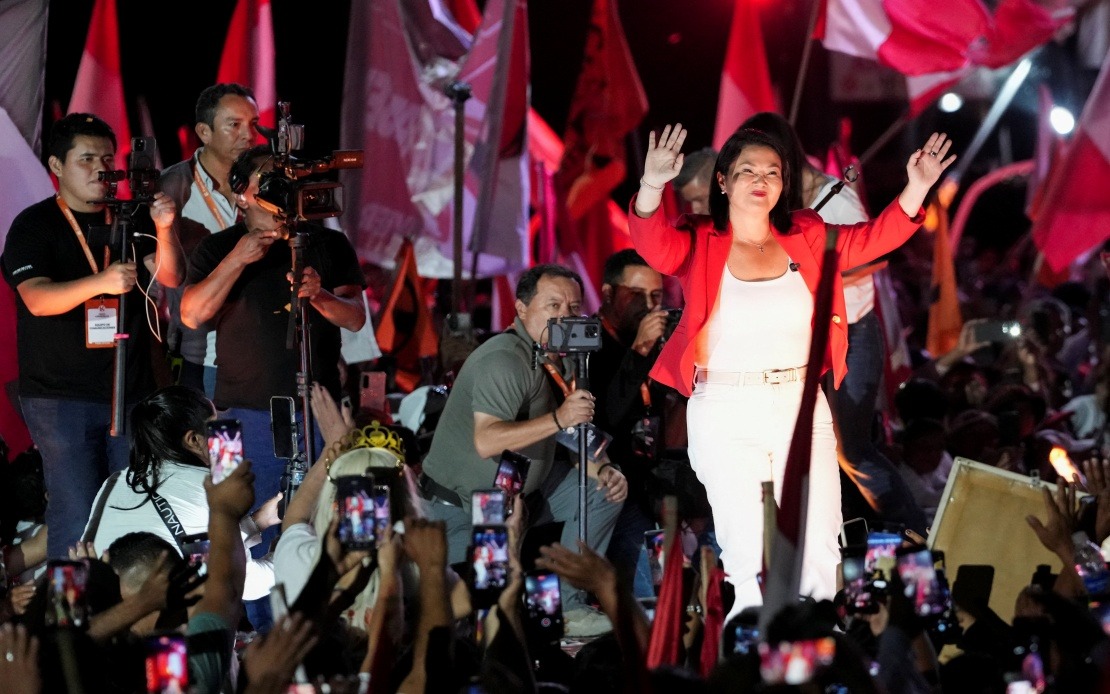
Keiko Fujimori has claimed victory in Peru's presidential election, capturing 50.135 per cent of valid votes according to the country's complete official tally released on Monday. The Popular Force standard-bearer edges out Together for Peru's Roberto Sanchez, who garnered 49.865 per cent of the count, marking an extraordinarily tight finish that underscores the deep political divisions within Peru's electorate.
The numerical gap between the two candidates represents just 49,641 votes from a total of over 18.3 million cast, a razor-thin margin that highlights how polarized Peruvian voters have become. Peru's National Office of Electoral Processes (ONPE) confirmed these figures after processing all 92,766 tally sheets from the June 7 polling day, a comprehensive recount that took weeks to complete and involved careful verification at every stage of the tabulation process.
Fujimori's victory marks a significant personal milestone after three unsuccessful presidential bids in previous election cycles. The right-wing candidate's triumph represents a consolidation of conservative political forces in Peru, a nation that has experienced considerable institutional turbulence and economic uncertainty in recent years. Her ascent to the presidency signals that voters ultimately favored continuity and market-oriented policies over the alternatives presented by her opponent.
The election victory carries particular symbolic weight given Fujimori's family history. She is the daughter of Alberto Fujimori, who served as Peru's president from 1990 to 2000, presiding over a period marked by economic stabilization but also significant human rights concerns and democratic erosion. Her political inheritance has been both an asset and a liability throughout her career, attracting supporters nostalgic for the relative stability of her father's era while repelling voters concerned about democratic backsliding and accountability.
Sanchez brings different credentials to the contest, having served as a cabinet minister during the administration of Pedro Castillo, who occupied the presidency between 2021 and 2022. The Together for Peru coalition attempted to position itself as a reformist alternative, yet narrowly failed to mobilize sufficient voter support. His candidacy represented the leftist current within Peruvian politics, which has struggled to maintain coherence and public confidence following Castillo's controversial exit from office and subsequent legal entanglements.
The election outcome reflects broader regional patterns in Latin America, where right-wing and conservative candidates have recently achieved electoral victories despite institutional challenges and social discontent. Peru's result suggests that concerns about inflation, crime, and governance failures may have outweighed other electoral considerations for the plurality of voters who cast ballots. The persistence of these fundamental challenges means that Fujimori's presidency will face immediate pressure to deliver tangible improvements in living standards and public security.
Southeast Asian observers should note Peru's electoral experience as a cautionary tale about political fragmentation and the risks of institutional instability in presidential systems. The narrowness of Fujimori's victory indicates that Peru remains divided, potentially constraining her ability to implement controversial reforms or consolidate power effectively. The country's recent history of presidential crises and depositions suggests that even election victories do not guarantee stable governance or effective policy implementation.
Peru's National Jury of Elections, with President Roberto Burneo at the helm, is expected to formally proclaim the official results on Friday, completing the legal and administrative requirements for Fujimori's assumption of office. This certification process represents a final hurdle, though the ONPE's comprehensive counting completed on Monday substantially diminishes any remaining uncertainty regarding the electoral outcome. The institutional machinery has operated as designed, processing results transparently through its real-time vote-counting platform, allowing independent observers and parties to monitor progress throughout the tabulation.
For regional stability and Peru's own development trajectory, Fujimori's presidency will test whether conservative governance can address the structural economic and security challenges that have plagued the nation. The narrowness of her mandate requires skillful coalition-building within Congress and sensitive management of the deep ideological divisions that shaped this election. How she navigates these constraints will determine whether her victory translates into meaningful reform or whether Peru's cyclical patterns of political dysfunction persist despite a change in the presidency.

