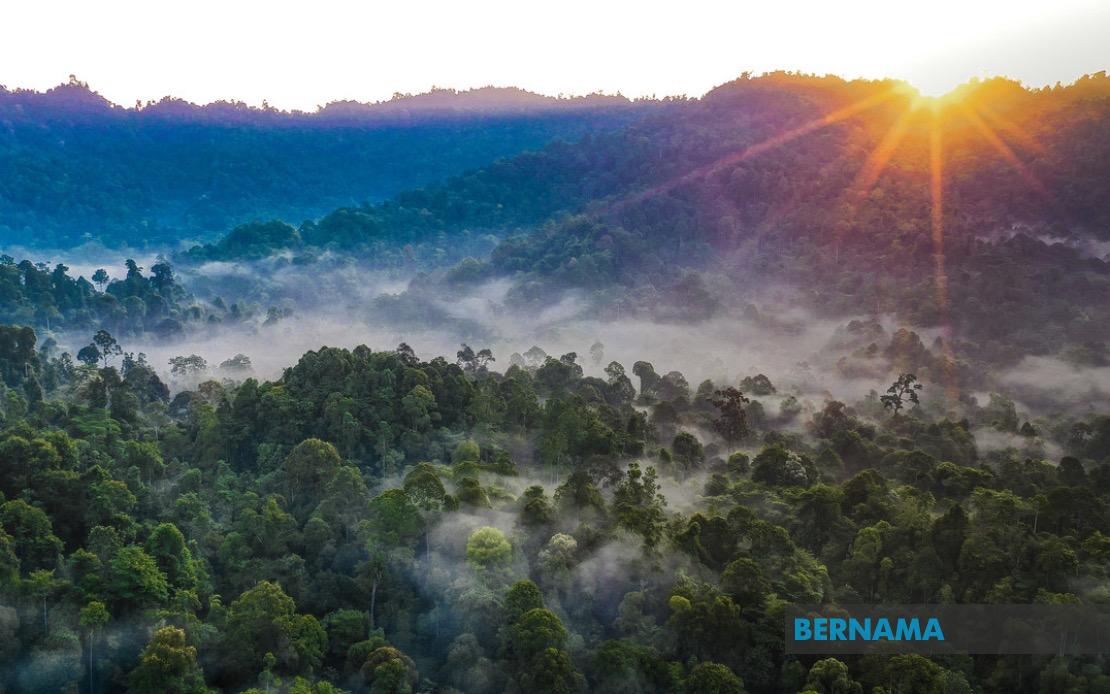
The Kelantan state government has pledged to replace all forest reserves that have been degazetted to facilitate development and mining operations, seeking to address mounting environmental concerns about the state's forest conservation efforts. The commitment comes as scrutiny grows over the degazetting of the Temangan Forest Reserve in Machang, which was formally cancelled to permit ongoing granite mining activities in the district.
Deputy Menteri Besar Datuk Dr Mohamed Fadzli Hassan made the assurance during a state government executive council meeting at the Kota Darulnaim Complex in Kota Bharu, indicating that the administration recognises the importance of maintaining Kelantan's total forest reserve coverage. The policy framework suggests that any reduction in gazetted forest land through industrial or extractive purposes would be offset by designating equivalent areas elsewhere in the state as replacement reserves.
The Temangan Forest Reserve case has emerged as a focal point in this broader discussion. The forest area was originally approved for granite mining by a private company back in 2009, but the reserve retained its official designation for over a decade despite the mining approval already being in place. This created an unusual legal situation where an extraction activity was permitted within a protected forest zone without formally removing the reserve status.
According to Mohamed Fadzli, the recent degazetting of Temangan represents the formal implementation of that 2009 approval decision. Rather than viewing this as a sudden or controversial move, state officials frame it as finally aligning bureaucratic documentation with earlier-approved industrial activities. The deputy minister clarified that the granite mining company has operated under that 2009 approval for the past fourteen years, and the degazetting process was merely the administrative step needed to regularise the arrangement.
The government has sought assurances from the Kelantan State Forestry Department regarding replacement forest reserve identification and designation. Mohamed Fadzli indicated that he has directly engaged with departmental officials to confirm that replacement areas will be properly identified and formally gazetted. The state forestry authority has reportedly confirmed that departmental policy requires any cancelled forest reserve to trigger a corresponding replacement designation elsewhere, ensuring no net loss of protected forest area across the state.
This approach reflects an increasingly common tension in Malaysia between conservation goals and economic development imperatives. Kelantan, like several other states, faces pressure to generate revenue from natural resources and attract industrial investment while simultaneously managing environmental responsibilities. The replacement forest policy represents an attempt to square this circle by accommodating extractive industries without fundamentally reducing overall forest protection levels.
However, the effectiveness of such replacement schemes depends critically on implementation details. Environmental observers across Southeast Asia have noted that replacement forests are not automatically equivalent to original reserves in terms of biodiversity value, carbon storage capacity, or ecological function. A replacement reserve in a different geographic location may not restore the specific ecosystem services or wildlife habitat provided by the degazetted area, raising questions about whether replacement-based policies genuinely maintain environmental integrity.
Kelantan's position as a forestry-dependent state makes this policy particularly significant. The state contains substantial tropical forest resources that support both commercial timber operations and considerable biodiversity. Mineral extraction, particularly granite mining, represents another economic use competing for the same land base. The degazetting of Temangan adds to a growing list of forest reserve modifications across the state undertaken to facilitate various development projects over recent years.
The granite mining sector specifically holds considerable economic importance for Kelantan and surrounding regions. Granite extraction supports construction industries throughout Malaysia and Southeast Asia, generating employment and contributing to state revenue. Yet mining operations carry substantial environmental costs, including habitat disruption, water contamination risks, and landscape degradation. The balance between these competing interests remains contentious among stakeholders including environmental groups, local communities, and industry representatives.
Implementation of the replacement policy will require close coordination between the Kelantan State Forestry Department and relevant land management agencies to identify suitable replacement areas. Potential replacement reserves must be formally gazetted to gain legal protection equivalent to the original designation. The process may also involve consultation with local communities and environmental stakeholders, depending on administrative procedures and regulatory requirements in Kelantan.
For Malaysian observers and policymakers, the Kelantan approach offers insights into how states are attempting to manage forest conservation amid development pressures. Whether replacement-based policies can genuinely preserve forest coverage and ecological function remains an open question that warrants monitoring by environmental researchers and conservation advocates across the region.
The success of Kelantan's replacement forest strategy will ultimately depend on whether substitute reserves are swiftly identified, properly gazetted, and genuinely protected from future encroachment. Close scrutiny of this implementation process may provide valuable lessons applicable to other Malaysian states facing similar pressures to balance conservation and development objectives.

