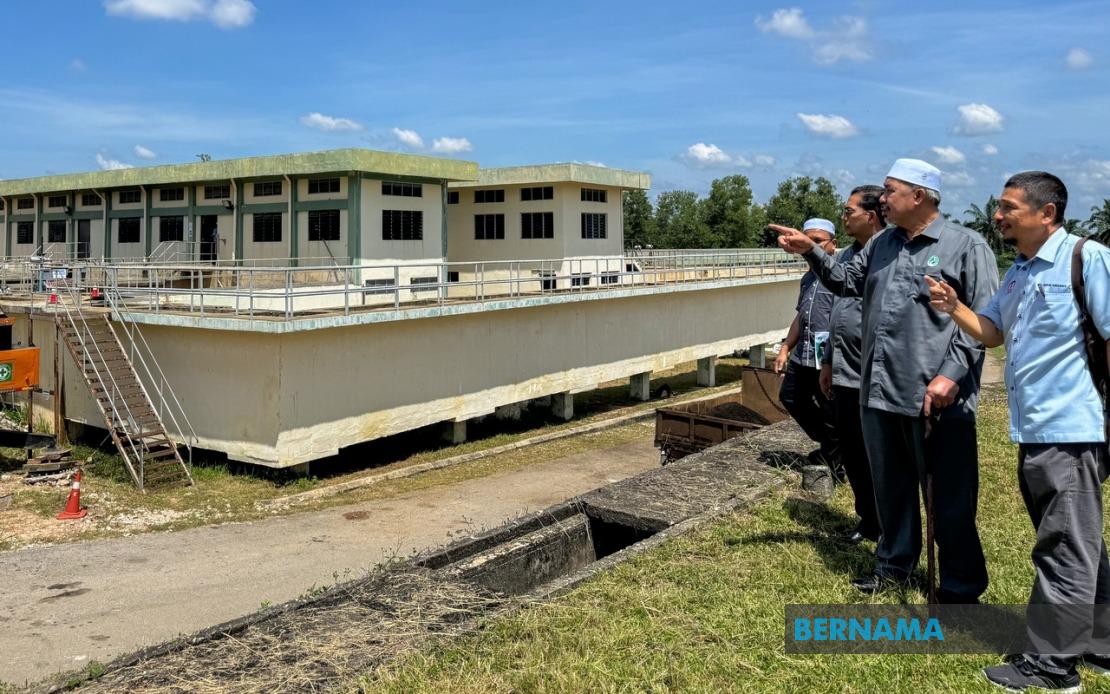
Water supply challenges in Kelantan are set to ease substantially following completion of a major infrastructure upgrade in the state's northern districts. Approximately 34,000 account holders across Machang, Pasir Puteh, and southern Kota Bharu will gain access to more consistent water services starting September, thanks to a RM11.5 million redevelopment of the Merbau Chondong Water Treatment Plant that has significantly expanded its operational capacity.
The facility's transformation represents a considerable leap forward for water security in the region. According to Datuk Dr Izani Husin, chairman of Kelantan's Public Works, Infrastructure, Water and Rural Development Committee, the plant will now be capable of delivering 80 million litres of treated water daily—a dramatic increase from its previous output of 45 million litres. This expansion directly addresses a longstanding constraint that had prevented water utility Air Kelantan Sdn Bhd from ramping up supply without compromising treatment quality, a concern that had effectively capped distribution levels despite growing demand from expanding residential areas.
The technical foundation underlying this improvement centres on the installation of the Xylem Underdrain Leopold filtration system, which has fundamentally altered how the plant processes raw water intake. Where previously the facility operated conservatively due to concerns about water purity, the new technology enables the treatment of between 70 million to nearly 90 million litres of raw water daily while maintaining superior standards. This flexibility in processing capacity creates a crucial buffer zone that permits sustained high-volume distribution without risking the degradation that concerned operators in the past.
Water quality metrics have improved measurably under the upgraded system. The Nephelometric Turbidity Unit reading—the standard measurement for water clarity and particulate contamination—has been reduced from over 10 NTU to three NTU, representing a substantial refinement in the purity of water reaching household taps. For consumers, this improvement translates to clearer water and potentially reduced sediment-related issues that plague distribution networks relying on less refined treatment protocols.
The project timeline indicates near-term relief for affected communities. Completion is expected by the end of July, with the new distribution commencing in early September. This phased approach allows for testing and system validation before full-scale operation, reducing the risk of service disruptions once the expansion becomes operational. For residents who have endured intermittent supply in these districts, the prospect of September delivery represents a meaningful milestone in addressing months or potentially years of water scarcity.
Beyond the immediate upgrade, state authorities are advancing longer-term infrastructure ambitions that will reshape water provision across the Machang area. The government, in partnership with Pengurusan Aset Air Berhad, is planning a new RM120 million treatment facility—the Machang 1 Water Treatment Plant—designed to supply an additional 50 million litres daily. Targeted for completion by 2030, this facility will serve the expanding Machang population while simultaneously freeing capacity at Merbau Chondong for redistribution to other water-stressed districts. The strategic logic is clear: as Machang grows, its dedicated facility will absorb local demand, allowing the upgraded Merbau Chondong plant to extend relief to neighboring areas currently facing shortages.
The Machang 1 project remains in preparatory phases, awaiting final agreement between the state government and PAAB before contractor selection moves forward. This bureaucratic sequencing, while sometimes frustrating for communities, reflects the scale of capital commitment involved and the need for formal institutional alignment before construction contracts are awarded. The 2030 completion window, while distant, represents a concrete commitment to infrastructure expansion that extends beyond current political cycles.
Progress toward comprehensive water security across Kelantan is measurable, though incomplete. Air Kelantan Sdn Bhd has successfully resolved approximately 70 percent of water supply problems affecting 270,000 user accounts throughout the state, according to committee chairman Izani. This represents substantial progress, yet equally indicates that roughly 80,000 accounts—more than a quarter of affected customers—continue experiencing supply irregularities. The utility has established an ambitious target of achieving at least 90 percent resolution by 2035, providing a timeline for sustained operational improvements across the broader network.
For Malaysian water policy observers, Kelantan's trajectory illustrates the complexity of managing supply in states where infrastructure has historically lagged demand growth. The Merbau Chondong upgrade exemplifies a pragmatic incremental approach: maximizing efficiency of existing facilities through technological enhancement while simultaneously planning new capacity to accommodate future growth. This dual-track strategy, combining immediate relief with long-term planning, offers a replicable model for other Malaysian states confronting comparable water security challenges.
The implications extend beyond Kelantan's borders. As peninsular Malaysia's urban populations expand and climate patterns show increasing volatility, water treatment infrastructure faces mounting pressure. The successful completion of the Merbau Chondong project may offer relevant technical and administrative lessons for water authorities throughout the region seeking to boost capacity without proportional increases in water sourcing—a critical consideration where raw water availability is finite and competing demands from agriculture, industry, and households continue escalating.

