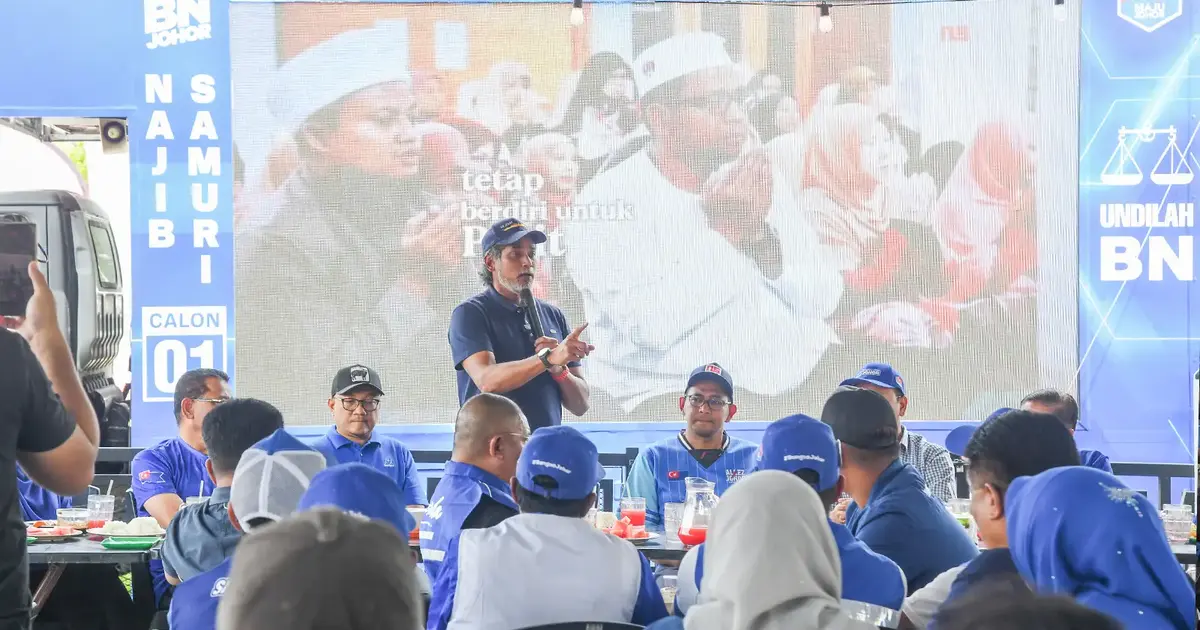
Khairy Jamaluddin, the former Umno Youth chief, has laid down conditions for any public debate involving Johor BN chairman Onn Hafiz Ghazi, insisting that Pakatan Harapan cannot simply dispatch any representative to the podium. Instead, the ruling coalition would need to present a figure of equivalent political rank—specifically its prospective menteri besar candidate—if such an encounter is to take place. The statement underscores the escalating stakes in Johor's political theatre, where both government and opposition blocs are mobilising their heavyweights ahead of electoral contests.
The demand reflects a broader calculation about political messaging and legitimacy. By framing the debate as requiring symmetrical positioning, Khairy effectively sets a high bar for PH engagement while simultaneously elevating Onn Hafiz's stature within the Johor political landscape. Onn Hafiz, as both menteri besar and Johor BN chairman, occupies a position of substantial influence in one of Malaysia's largest and most economically significant states. His visibility and credibility in public forums directly impact voter perceptions across both urban and rural constituencies, making debate participation a strategic consideration for all parties involved.
This posturing reflects deeper anxieties within the coalition arrangement. While Barisan Nasional and Perikatan Nasional have improved their electoral performance since 2018, Johor remains contested territory. The state witnessed significant political volatility in recent years, with shifting alignments and competing visions for governance. PH's presence in Johor, though weakened from its 2018 peak, retains organisational capacity and voter appeal in certain pockets, particularly among urban voters and communities sensitive to issues of institutional integrity and economic opportunity. A high-profile debate could either energise or expose vulnerabilities in PH's Johor strategy.
Khairy's intervention also signals internal coalition dynamics. As a prominent Umno figure, his public statements carry weight within the broader BN-PN arrangement. By articulating conditions for debate participation, he speaks not merely as an individual but as a representative of the conservative establishment currently anchoring federal and state governance. His emphasis on equivalent rank subtly reinforces hierarchy—that serious political discourse should involve decision-makers, not mere proxies. This principle, while ostensibly reasonable, effectively shields frontline politicians from uncontrolled public scrutiny by junior figures who might launch unexpected rhetorical assaults.
The broader context involves Malaysia's evolving political culture around public debate and transparency. While contentious speeches and political rallies remain common, structured televised or public debates between major candidates remain relatively rare, particularly at state level. This reflects traditional Malaysian politics' preference for controlled messaging through conventional media channels and internal party structures. Any evolution toward more debate-centred campaigns would represent significant cultural shift, potentially exposing leaders to scrutiny they might prefer to avoid. Khairy's conditional framing suggests establishment discomfort with unpredictable public forums.
For PH strategists, the calculus becomes complicated. Fielding the prospective menteri besar candidate would represent significant political commitment, essentially pre-announcing the coalition's official choice for state leadership. Such early declaration could energise supporters but also invite concentrated opposition attacks months before actual elections. Conversely, declining to meet Khairy's terms leaves PH open to accusations of avoiding serious engagement or lacking qualified candidates. The statement thus functions as political judo, using PH's own democratic rhetoric to constrain its tactical options.
Malaysian voters, particularly in Johor, will be watching how this particular standoff resolves. Public debates, when they occur, have demonstrated capacity to influence voting patterns, especially among undecided voters and younger citizens who increasingly expect transparency and direct engagement from political leaders. The question of whether such a debate materialises, and if so, what shape it takes, will provide important signals about both coalitions' confidence in their respective narratives and candidates.
Onn Hafiz himself represents the type of administrator that Umno and BN have invested considerable political capital in developing—a younger generation figure with business experience and state-level executive responsibility. His performance in such a debate would likely be calibrated to demonstrate competence and vision for Johor's development, particularly around industrial growth, foreign investment attraction, and integrated planning. The political stakes for him are equally high, as poor performance could undermine the succession narrative being carefully constructed within BN circles.
The debate question also intersects with broader Malaysian concerns about institutional capacity and democratic health. Public discourse about state-level governance, budget allocation, economic development strategies, and social policies benefits from direct leader engagement rather than filtered media interpretation. However, Malaysian politicians remain cautious about forums where their words cannot be edited or contextualised in supportive environments. The tension between accountability demands and leaders' preferences for communication control will likely persist regardless of whether Johor witnesses this particular debate.
Looking forward, Khairy's statement essentially opens negotiations rather than closing them. Both coalitions now face pressure to justify their positions—whether supporting or declining the encounter—to their respective supporters and the broader voting public. The political cost of appearing to avoid direct engagement may ultimately prove higher than the risks of debate exposure, especially as Malaysia's political culture gradually shifts toward expecting greater transparency and direct accountability from elected officials and aspiring leaders.

