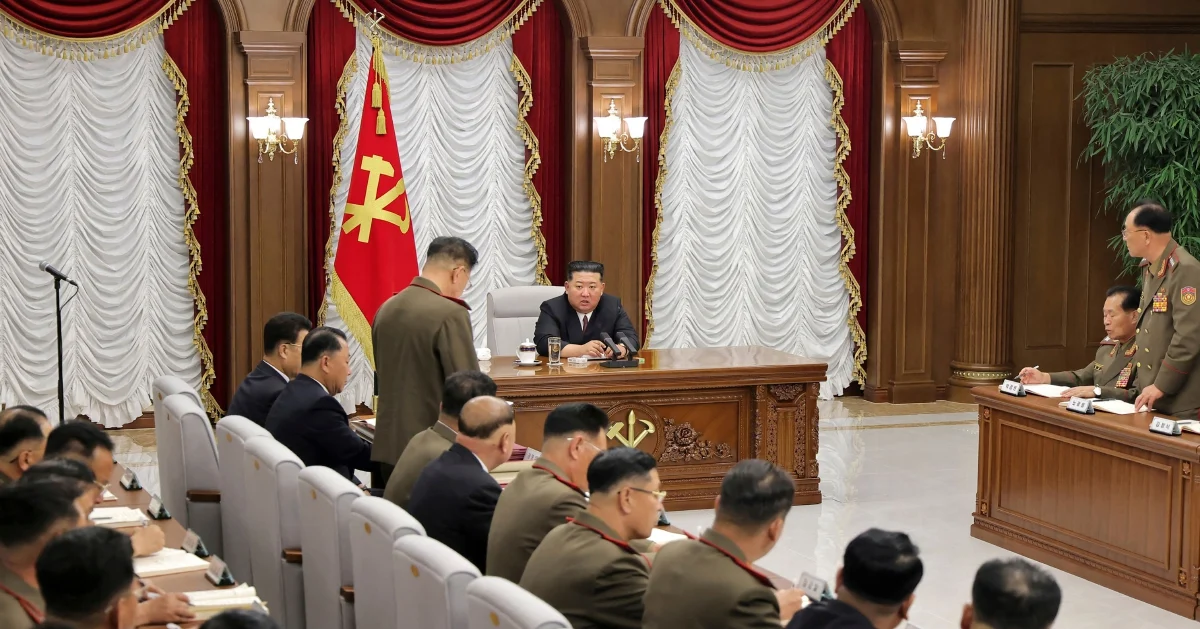
North Korean leader Kim Jong Un has removed a high-ranking military official from the ruling party following allegations of bribery and corruption, state media announced over the weekend. The action represents the latest in a pattern of purges within Pyongyang's military establishment, reflecting Kim's efforts to consolidate control and root out what authorities characterize as systemic malfeasance affecting governance. Authorities framed the misconduct as a grave political transgression rather than a routine administrative matter, underscoring the regime's zero-tolerance approach toward perceived disloyalty or enrichment schemes among the elite.
The precise identity of the expelled official and the specific circumstances surrounding the alleged bribery remain unclear from official announcements, a characteristic opacity that has long defined North Korean state communications. However, the timing and tenor of the announcement suggest the dismissal reflects broader concerns within the leadership about maintaining party discipline and ensuring loyalty within military ranks. Such purges have historically served multiple purposes in North Korea's political system: they demonstrate the leader's authority, eliminate potential rivals or dissidents, and send warning signals to others in positions of power about the consequences of stepping out of line.
North Korea's military occupies an extraordinarily significant position within the nation's political and economic structure, wielding influence far beyond typical armed forces in democratic societies. The Korean People's Army maintains direct control over vast swathes of state enterprise and resource allocation, creating abundant opportunities for individual enrichment among officers. Corruption within military circles threatens both the regime's control apparatus and its already strained economic resources, making anti-corruption campaigns a recurring priority for leadership.
Kim Jong Un's designation of the offense as a political rather than merely criminal matter carries serious implications. In North Korea's ideological framework, characterizing misconduct as a political crime elevates it to the level of regime betrayal or ideological deviation, justifications historically used to justify harsh punishments including execution or internment in political prison camps. The rhetorical choice suggests the regime views this particular case as carrying implications beyond simple theft or bribery, possibly indicating involvement with foreign entities or challenges to established authority structures.
The expulsion from the ruling Workers' Party represents a severe form of censure within North Korea's hierarchical system. Party membership constitutes a marker of political reliability and access to privilege, making removal a form of public humiliation and social degradation. Those expelled typically face employment difficulties, restrictions on their movements and those of their families, and heightened surveillance. Such consequences extend beyond the individual to affect their entire household, a practice reflecting the regime's emphasis on collective responsibility.
For observers of North Korean politics, such announcements offer limited windows into internal power struggles and leadership priorities. The decision to publicize this particular purge suggests the regime considered it important for domestic audiences to understand that corruption carries serious consequences. Simultaneously, the vagueness surrounding specific details reflects the regime's unwillingness to provide the level of transparency that might invite further scrutiny or questioning of broader governance practices.
North Korea's recurring anti-corruption campaigns serve multiple functions within the broader context of regime maintenance. They allow leadership to deflect blame for economic failures by attributing problems to official misconduct rather than systemic policy failures. They also provide opportunities to remove officials who have accumulated too much independent power or whose loyalty has come into question. Whether these campaigns produce sustained improvements in governance or simply represent periodic reshuffling of power among competing factions remains difficult to assess given the regime's information controls.
The international community has limited capacity to verify or investigate such allegations independently. Foreign observers, journalists, and human rights monitors operate under severe restrictions when attempting to document conditions within North Korea, making independent verification of corruption charges nearly impossible. This information vacuum means assessments of the regime's actual governance practices remain largely based on regime propaganda, defector testimony, and fragmentary evidence collected through satellite imagery and signals intelligence.
The incident nonetheless reflects continuity in North Korea's approach to elite management under Kim Jong Un's leadership. Since assuming power following his father's death in 2011, Kim has executed or purged numerous high-ranking officials, demonstrating his willingness to deploy severe measures to consolidate authority. These actions have included his own uncle, Jang Song Thaek, a move that shocked observers accustomed to anticipating stability based on family relationships. The purge of this military official follows this established pattern of periodic housekeeping among the leadership structure.
For regional observers in Southeast Asia and beyond, such announcements carry implications primarily for understanding North Korea's internal stability and the regime's capacity to maintain effective governance. A military establishment riddled with corruption and depleted by purges faces degraded operational capability, potentially affecting the balance of forces on the Korean Peninsula. However, these dynamics remain largely opaque to external analysis, requiring careful monitoring of subsequent official statements and observable shifts in military appointments or strategic posture.

